The question
Does HIV cause the immune damage that leads to AIDS?
This is the specific idea being tested.
Does HIV cause the immune damage that leads to AIDS?
What you need to knowHIV causes HIV-associated AIDS; treatment and prevention change that course.Relative explanatory fit: Leading among models compared
Why the evidence supports this: Studies of infection, virus-suppressing treatment, treatment interruption and prevention point to the same causal explanation. HIV infection does not make progression to AIDS inevitable, and other illnesses can cause similar immune problems.
For health decisions: Suppressing HIV with treatment protects immune health, and prevention can stop new infections; interrupting effective treatment can allow disease to progress.
Claim assessed: HIV infection is the necessary cause of AIDS.
Finding: Overall Θ follows registered SC3. The convergent clinical causal case is strong and predictively consistent: documented acquisition precedes immune deterioration, suppression changes clinical trajectories, interrupted suppression worsens them, and prophylaxis prevents acquisition. Host and coinfection modifiers make infection insufficient for inevitable disease. Non-HIV ICL shows that low CD4/OI phenotypes are not HIV-specific; its existence does not erase the viral causal process established by intervention, but it blocks a broader claim that HIV is necessary for all acquired immunodeficiency.
Evidence scope: 63 primary reports; literature cutoff 2026-10-09; source examination UTC date 2026-10-10; bounded critical review, not exhaustive systematic review.
The grade applies to the stated claim. Model rankings and individual subclaim grades remain separate from the overall causal-evidence grade.
Full scientific assessment and references · Scorecard (JSON) · Review source (Markdown)
HYPOTHESIS CRITIC  /  REVIEW EXPLAINER
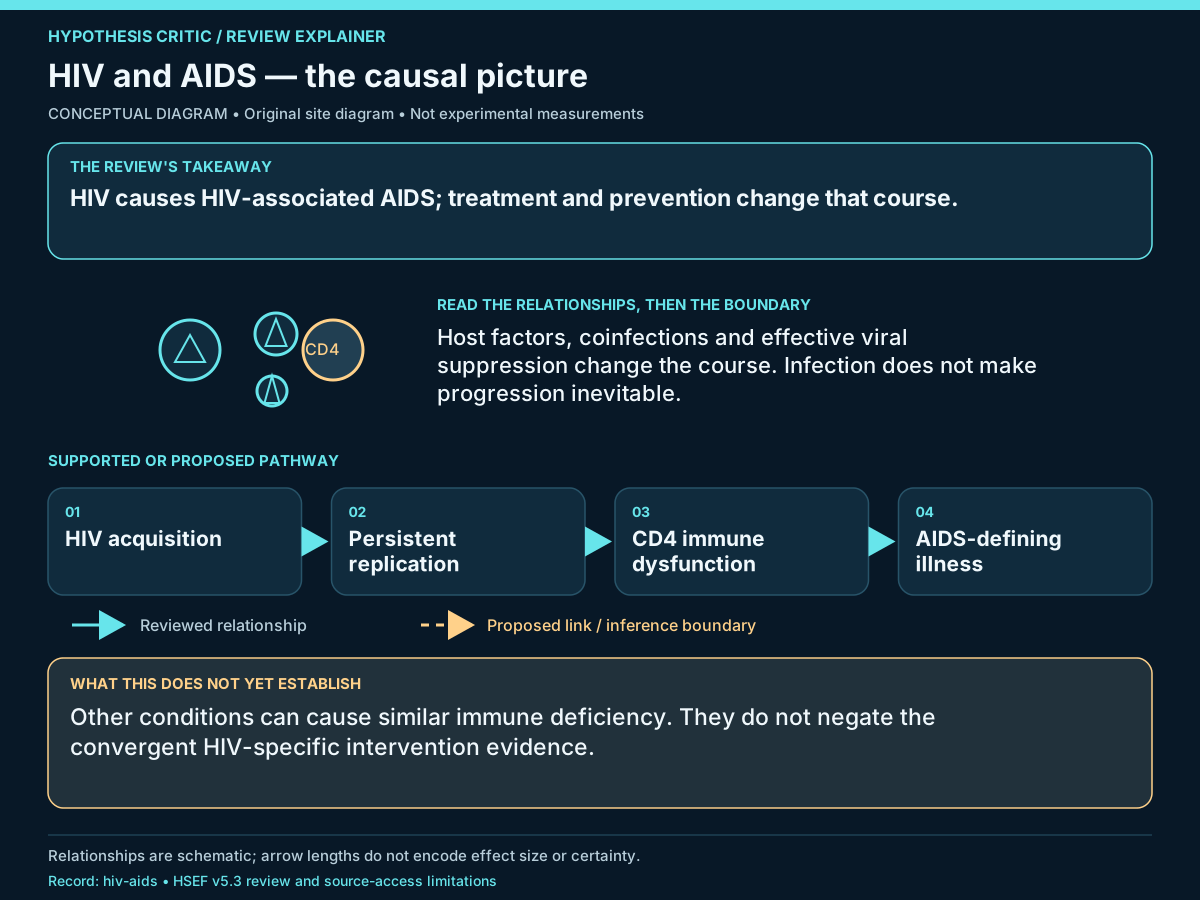
HIV and AIDS — the causal picture
CONCEPTUAL DIAGRAM  •  Original site diagram  •  Not experimental measurements
THE REVIEW'S TAKEAWAY
HIV causes HIV-associated AIDS; treatment and prevention change that course.
CD4
READ THE RELATIONSHIPS, THEN THE BOUNDARY
Host factors, coinfections and effective viral suppression change the course. Infection does not make progression inevitable.
SUPPORTED OR PROPOSED PATHWAY
01
HIV acquisition
02
Persistent replication
03
CD4 immune dysfunction
04
AIDS-defining illness
Reviewed relationship
Proposed link / inference boundary
WHAT THIS DOES NOT YET ESTABLISH
Other conditions can cause similar immune deficiency. They do not negate the convergent HIV-specific intervention evidence.
Relationships are schematic; arrow lengths do not encode effect size or certainty.
Record: hiv-aids  •  HSEF v5.3 review and source-access limitations
This is the specific idea being tested.
Studies of infection, virus-suppressing treatment, treatment interruption and prevention point to the same causal explanation. HIV infection does not make progression to AIDS inevitable, and other illnesses can cause similar immune problems.
This conclusion applies to the people, conditions and outcomes covered by the review.
The reviewed hypothesis ranks first among 4 models compared for this stated claim.
Claim under review: rank 1 among 4 compared models.
Leading explanation: HIV-driven acquired immunodeficiency.
Position in this comparison: First rank.
The causal grade asks how well the stated causal claim is established. This comparison asks which of the assessed explanations fits the reviewed findings better. A leading explanation can remain unproven. Models can overlap or include the tested mechanism; an alternative ahead does not make that mechanism irrelevant. These ordinal ranks apply within this review; they do not measure the size of a difference or rank scientific strength across topics.
HYPOTHESIS CRITIC  /  REVIEW EXPLAINER
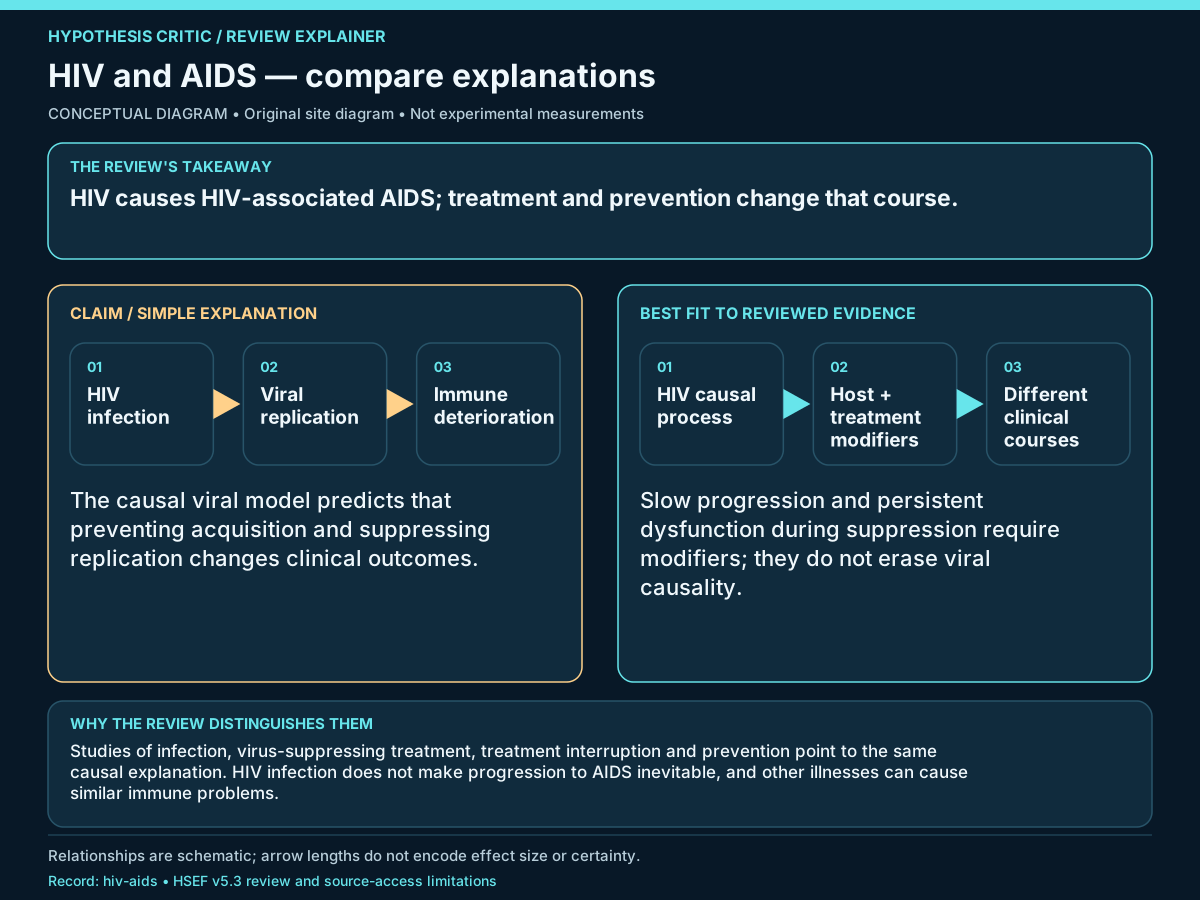
HIV and AIDS — compare explanations
CONCEPTUAL DIAGRAM  •  Original site diagram  •  Not experimental measurements
THE REVIEW'S TAKEAWAY
HIV causes HIV-associated AIDS; treatment and prevention change that course.
CLAIM / SIMPLE EXPLANATION
01
HIV infection
02
Viral replication
03
Immune deterioration
The causal viral model predicts that preventing acquisition and suppressing replication changes clinical outcomes.
BEST FIT TO REVIEWED EVIDENCE
01
HIV causal process
02
Host + treatment modifiers
03
Different clinical courses
Slow progression and persistent dysfunction during suppression require modifiers; they do not erase viral causality.
WHY THE REVIEW DISTINGUISHES THEM
Studies of infection, virus-suppressing treatment, treatment interruption and prevention point to the same causal explanation. HIV infection does not make progression to AIDS inevitable, and other illnesses can cause similar immune problems.
Relationships are schematic; arrow lengths do not encode effect size or certainty.
Record: hiv-aids  •  HSEF v5.3 review and source-access limitations
Very well established for the stated claim.
Studies of infection, virus-suppressing treatment, treatment interruption and prevention point to the same causal explanation. HIV infection does not make progression to AIDS inevitable, and other illnesses can cause similar immune problems.
These explanations can overlap. Ranking their fit to the evidence is separate from deciding how firmly a cause has been established.
Rank 1: HIV-driven acquired immunodeficiency — Persistent HIV infection drives a modifiable immune-deficiency trajectory.
Rank 2: HIV with host and coinfection modifiers — Host factors and concurrent diseases modify a viral causal trajectory.
Rank 3: Non-HIV immunodeficiency phenocopies — Other conditions produce low CD4 counts and opportunistic disease.
Rank 4: Nonviral exposure or behavioral confounding — HIV measurements merely mark another exposure causing the syndrome.
Evidence rating: Θ · High confidence. How the evidence was assessed.
Studies of infection, virus-suppressing treatment, treatment interruption and prevention point to the same causal explanation. HIV infection does not make progression to AIDS inevitable, and other illnesses can cause similar immune problems.
HIV medicines suppress the virus and give the immune system a chance to recover. Prevention medicines and other proven prevention measures reduce the chance of acquiring HIV. Interrupting effective treatment can allow the virus to return and immune health to worsen, so treatment changes belong in a discussion with the treating clinician. Individual differences in progression do not undo the evidence that HIV causes HIV-associated AIDS.
Further reading: NIH: HIV treatment · NIH: HIV prevention · NIH: treatment interruption.
Look for the proposed factor and the outcome, in the people or systems covered by the claim.
HIV damages the immune system, while treatment and a person's other health factors affect what happens next. Studies of infection, virus-suppressing treatment, treatment interruption and prevention point to the same causal explanation. HIV infection does not make progression to AIDS inevitable, and other illnesses can cause similar immune problems.
Find out why some immune problems persist even when treatment suppresses HIV, and test ways to improve lasting immune recovery and health.
HYPOTHESIS CRITIC  /  REVIEW EXPLAINER
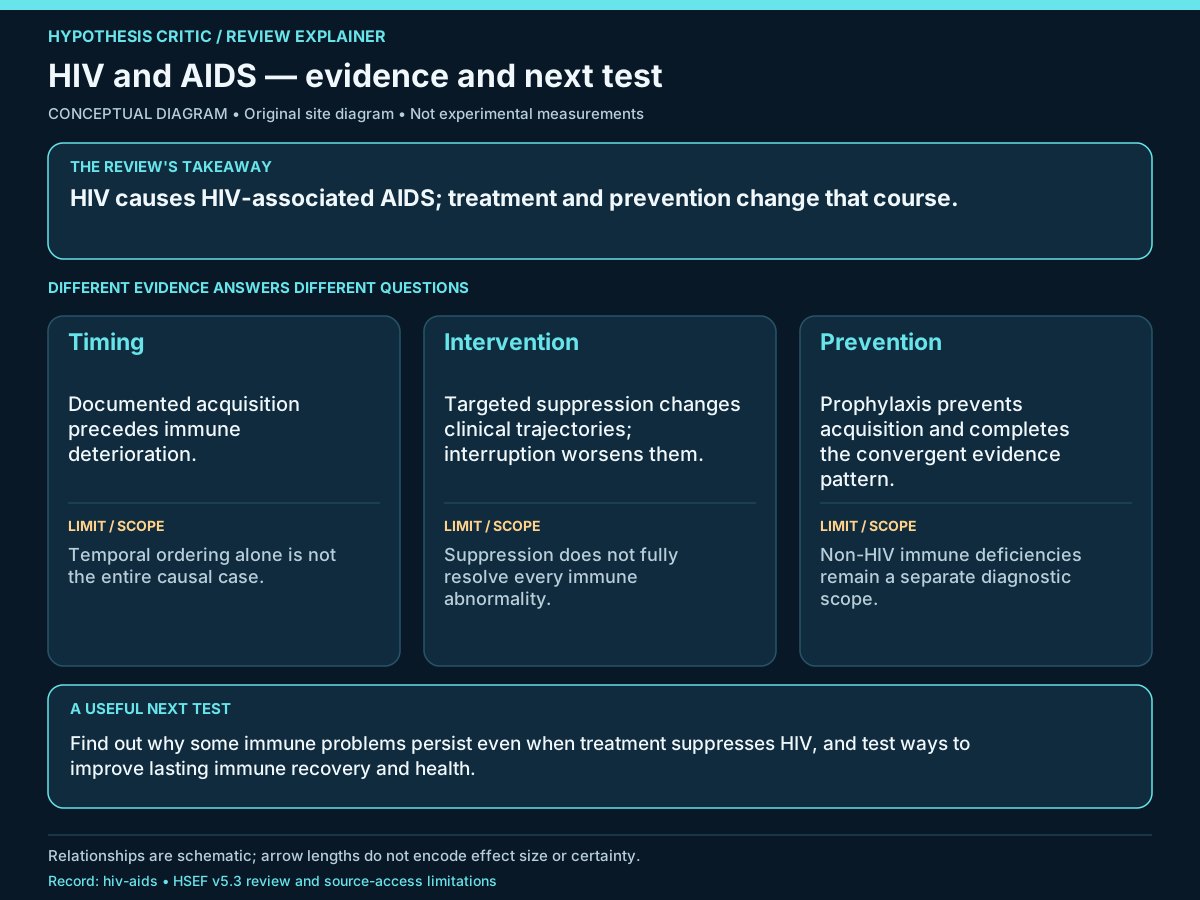
HIV and AIDS — evidence and next test
CONCEPTUAL DIAGRAM  •  Original site diagram  •  Not experimental measurements
THE REVIEW'S TAKEAWAY
HIV causes HIV-associated AIDS; treatment and prevention change that course.
DIFFERENT EVIDENCE ANSWERS DIFFERENT QUESTIONS
Timing
Documented acquisition precedes immune deterioration.
LIMIT / SCOPE
Temporal ordering alone is not the entire causal case.
Intervention
Targeted suppression changes clinical trajectories; interruption worsens them.
LIMIT / SCOPE
Suppression does not fully resolve every immune abnormality.
Prevention
Prophylaxis prevents acquisition and completes the convergent evidence pattern.
LIMIT / SCOPE
Non-HIV immune deficiencies remain a separate diagnostic scope.
A USEFUL NEXT TEST
Find out why some immune problems persist even when treatment suppresses HIV, and test ways to improve lasting immune recovery and health.
Relationships are schematic; arrow lengths do not encode effect size or certainty.
Record: hiv-aids  •  HSEF v5.3 review and source-access limitations
Find out why some immune problems persist even when treatment suppresses HIV, and test ways to improve lasting immune recovery and health.
Check that the intended change really happened.
Allow for other factors and compare with suitable controls.
Look for independent confirmation and the limits of the effect.
These are questions for research, not a claim that the proposed studies have already succeeded.
Proposed tests: 1 test design(s) are registered in the scorecard.
In plain terms, researchers would change the proposed cause, check that it changed as intended, then measure a meaningful outcome while controlling plausible alternatives. The result should be able to support or count against the claim—not only show that a pathway exists.
Study design: A stronger necessity-and-sufficiency assessment would require a prospectively specified noncircular syndrome definition and independently verified naturally acquired HIV status, host modifiers, exposure history and longitudinal outcomes. Use ethically delivered target-engaged treatment and adjudicated natural-course/clinical-care observations; do not induce infection or withhold effective therapy. The purpose is causal scope discrimination rather than recreating established treatment harm.
What would be measured: Predetermined clinical immune-deficiency trajectory, verified viral engagement and independently adjudicated opportunistic events
Important controls: Independent diagnostic confirmation, explicit non-HIV phenocopy comparator, blinded clinical adjudication and prespecified host/timing scope
Result that would support the claim: Prospectively correct cause-specific prediction and target-dependent trajectory alteration across the predetermined scope
Result that would count against it: Repeated independently verified HIV-negative cases meeting a genuinely same-cause noncircular syndrome definition, or engaged suppression without predicted causal alteration after accounting for established timing irreversibility
Follow the studies, detailed comparisons and evidence ratings behind this guide.
Open the scientific review →