The question
Does laetrile or amygdalin improve tumour control or survival when used as a cancer treatment?
This is the specific idea being tested.

Does laetrile or amygdalin improve tumour control or survival when used as a cancer treatment?
What you need to knowLaboratory findings have not established meaningful cancer benefit from promoted human regimens, and cyanide poisoning is a documented risk.Relative explanatory fit: Alternative ranked ahead
Why the alternative fits better: The historical human treatment programme found no substantive benefit, although it was not a randomized trial. Cell and animal findings remain research leads; new experimental formulations are different from the promoted oral or injected regimens. Cyanide risk depends on the route and on what is taken with the compound.
For health decisions: The review provides no demonstrated human cancer benefit for promoted laetrile regimens, while oral use can cause serious cyanide poisoning.
Claim assessed: Laetrile/amygdalin treatment provides clinically meaningful anticancer benefit through selective tumour toxicity at regimens promoted for human treatment.
Finding: Overall Α follows the preregistered primary SC2 human-regimen clinical-benefit gate. Partial selectivity and experimental activity remain Γ in SC1; they cannot be transferred into the clinical-benefit score. Toxicity avoidance is separately contradicted at Α, and generic care-substitution survival associations remain Β. Route-dependent cyanide harm has its own Ζ model assessment. No finding of toxicity alone determines the benefit grade.
Evidence scope: 67 primary reports; literature cutoff 2026-10-12; source examination UTC date 2026-10-12; bounded critical review, not exhaustive systematic review.
The grade applies to the stated claim. Model rankings and individual subclaim grades remain separate from the overall causal-evidence grade.
Full scientific assessment and references · Scorecard (JSON) · Review source (Markdown)
HYPOTHESIS CRITIC  /  REVIEW EXPLAINER
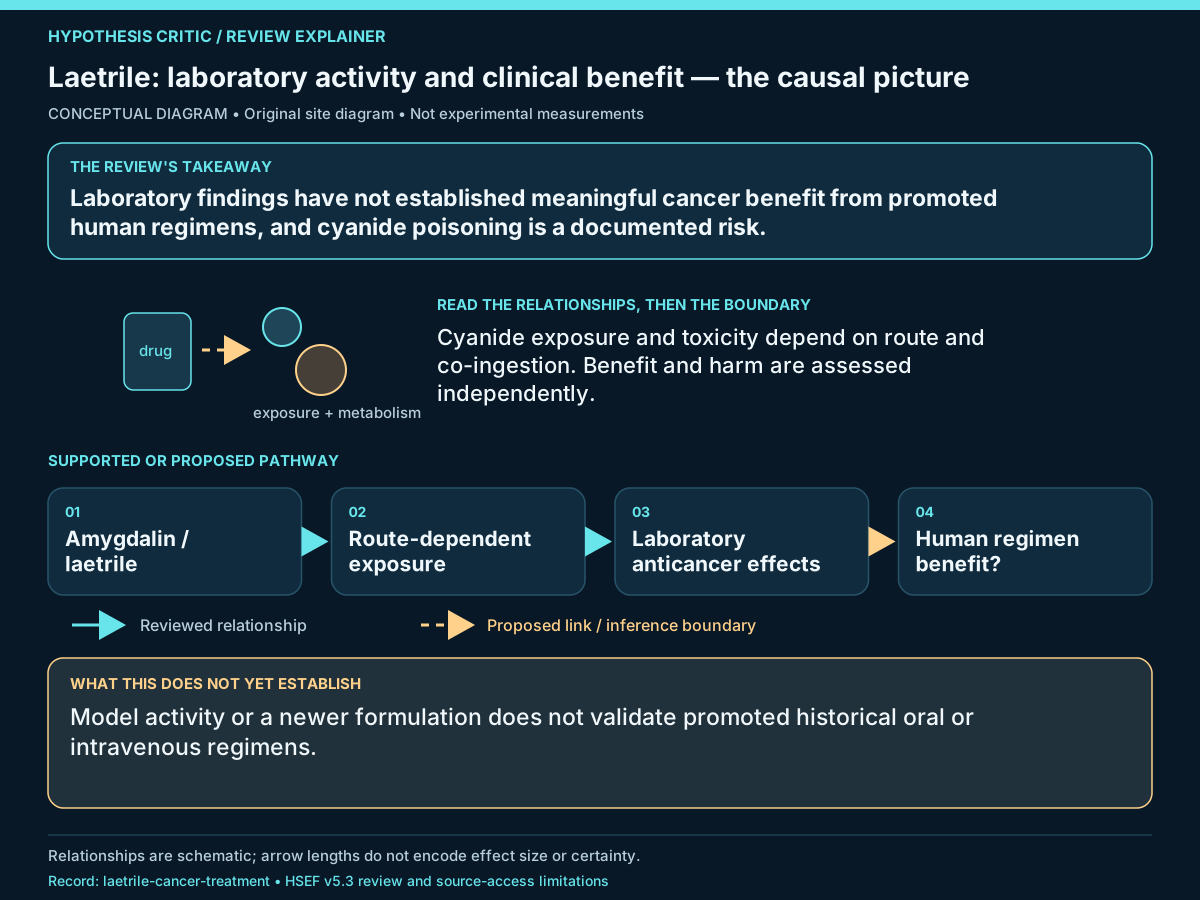
Laetrile: laboratory activity and clinical benefit — the causal picture
CONCEPTUAL DIAGRAM  •  Original site diagram  •  Not experimental measurements
THE REVIEW'S TAKEAWAY
Laboratory findings have not established meaningful cancer benefit from promoted human regimens, and cyanide poisoning is a documented risk.
drug
exposure + metabolism
READ THE RELATIONSHIPS, THEN THE BOUNDARY
Cyanide exposure and toxicity depend on route and co-ingestion. Benefit and harm are assessed independently.
SUPPORTED OR PROPOSED PATHWAY
01
Amygdalin / laetrile
02
Route-dependent exposure
03
Laboratory anticancer effects
04
Human regimen benefit?
Reviewed relationship
Proposed link / inference boundary
WHAT THIS DOES NOT YET ESTABLISH
Model activity or a newer formulation does not validate promoted historical oral or intravenous regimens.
Relationships are schematic; arrow lengths do not encode effect size or certainty.
Record: laetrile-cancer-treatment  •  HSEF v5.3 review and source-access limitations
This is the specific idea being tested.
The historical human treatment programme found no substantive benefit, although it was not a randomized trial. Cell and animal findings remain research leads; new experimental formulations are different from the promoted oral or injected regimens. Cyanide risk depends on the route and on what is taken with the compound.
A higher rank means a better fit to the evidence in this comparison. It does not prove every part of the leading explanation.
The reviewed hypothesis ranks 4 among 4 models compared; 1 alternative model(s) hold first rank for this stated claim.
Claim under review: rank 4 among 4 compared models.
Leading explanation: Route-dependent nonselective cyanide toxicity.
Position in this comparison: Last recorded rank.
The causal grade asks how well the stated causal claim is established. This comparison asks which of the assessed explanations fits the reviewed findings better. A leading explanation can remain unproven. Models can overlap or include the tested mechanism; an alternative ahead does not make that mechanism irrelevant. These ordinal ranks apply within this review; they do not measure the size of a difference or rank scientific strength across topics.
HYPOTHESIS CRITIC  /  REVIEW EXPLAINER
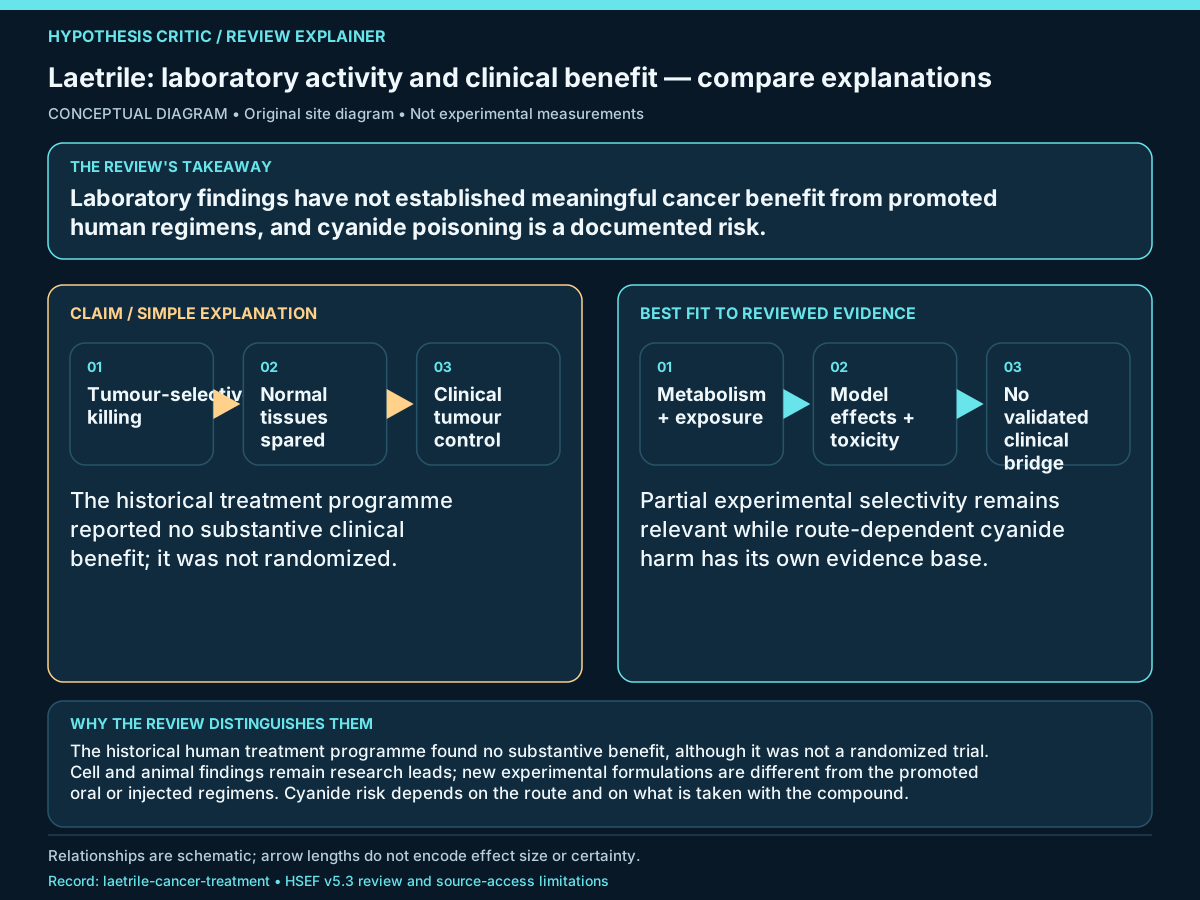
Laetrile: laboratory activity and clinical benefit — compare explanations
CONCEPTUAL DIAGRAM  •  Original site diagram  •  Not experimental measurements
THE REVIEW'S TAKEAWAY
Laboratory findings have not established meaningful cancer benefit from promoted human regimens, and cyanide poisoning is a documented risk.
CLAIM / SIMPLE EXPLANATION
01
Tumour-selective killing
02
Normal tissues spared
03
Clinical tumour control
The historical treatment programme reported no substantive clinical benefit; it was not randomized.
BEST FIT TO REVIEWED EVIDENCE
01
Metabolism + exposure
02
Model effects + toxicity
03
No validated clinical bridge
Partial experimental selectivity remains relevant while route-dependent cyanide harm has its own evidence base.
WHY THE REVIEW DISTINGUISHES THEM
The historical human treatment programme found no substantive benefit, although it was not a randomized trial. Cell and animal findings remain research leads; new experimental formulations are different from the promoted oral or injected regimens. Cyanide risk depends on the route and on what is taken with the compound.
Relationships are schematic; arrow lengths do not encode effect size or certainty.
Record: laetrile-cancer-treatment  •  HSEF v5.3 review and source-access limitations
Not established for the stated claim.
The historical human treatment programme found no substantive benefit, although it was not a randomized trial. Cell and animal findings remain research leads; new experimental formulations are different from the promoted oral or injected regimens. Cyanide risk depends on the route and on what is taken with the compound.
These explanations can overlap. Ranking their fit to the evidence is separate from deciding how firmly a cause has been established.
Rank 1: Route-dependent nonselective cyanide toxicity — Microbial or food-enzyme activation and coingestions generate systemic cyanide rather than a reliably tumour-selective clinical exposure.
Rank 2: Contextual cell activity without a clinical exposure bridge — Culture effects and engineered delivery can be real without being achievable as a safe effective promoted human regimen.
Rank 3: Selection and concurrent treatment explain apparent clinical benefit — Solicited favorable cases and provider impressions can reflect selection, prior treatment and subjective endpoints rather than drug efficacy.
Rank 4: Selective tumour toxicity produces clinical benefit — Promoted laetrile exposure safely targets tumour cells and improves human disease control.
Evidence rating: Α · Moderate confidence. How the evidence was assessed.
The historical human treatment programme found no substantive benefit, although it was not a randomized trial. Cell and animal findings remain research leads; new experimental formulations are different from the promoted oral or injected regimens. Cyanide risk depends on the route and on what is taken with the compound.
Activity against cells in a laboratory is not the same as a treatment that helps people with cancer. The examined human regimens have no demonstrated meaningful benefit, and oral use can cause serious cyanide poisoning. New delivery systems in animal experiments remain different, experimental interventions. Discuss laetrile, amygdalin and any other products with the cancer care team before changing care, because both toxicity and interactions matter.
Further reading: NCI: laetrile and amygdalin.
Look for the proposed factor and the outcome, in the people or systems covered by the claim.
How the compound is taken affects its breakdown and toxicity; laboratory activity has not translated into a proven human benefit. The historical human treatment programme found no substantive benefit, although it was not a randomized trial. Cell and animal findings remain research leads; new experimental formulations are different from the promoted oral or injected regimens. Cyanide risk depends on the route and on what is taken with the compound.
First establish selective effects at realistic exposures with suitable normal-cell, tumour and toxicity comparisons, before considering any justified clinical study alongside effective care.
HYPOTHESIS CRITIC  /  REVIEW EXPLAINER
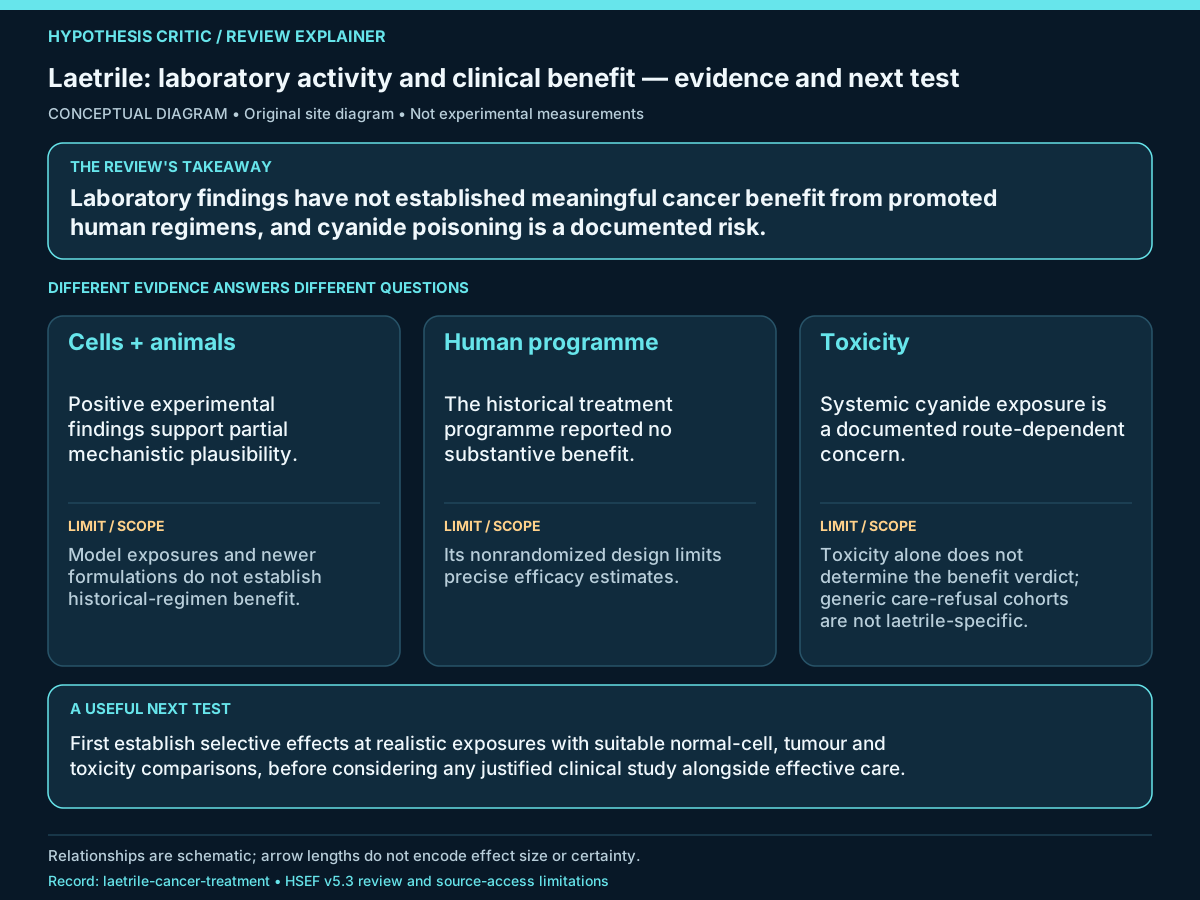
Laetrile: laboratory activity and clinical benefit — evidence and next test
CONCEPTUAL DIAGRAM  •  Original site diagram  •  Not experimental measurements
THE REVIEW'S TAKEAWAY
Laboratory findings have not established meaningful cancer benefit from promoted human regimens, and cyanide poisoning is a documented risk.
DIFFERENT EVIDENCE ANSWERS DIFFERENT QUESTIONS
Cells + animals
Positive experimental findings support partial mechanistic plausibility.
LIMIT / SCOPE
Model exposures and newer formulations do not establish historical-regimen benefit.
Human programme
The historical treatment programme reported no substantive benefit.
LIMIT / SCOPE
Its nonrandomized design limits precise efficacy estimates.
Toxicity
Systemic cyanide exposure is a documented route-dependent concern.
LIMIT / SCOPE
Toxicity alone does not determine the benefit verdict; generic care-refusal cohorts are not laetrile-specific.
A USEFUL NEXT TEST
First establish selective effects at realistic exposures with suitable normal-cell, tumour and toxicity comparisons, before considering any justified clinical study alongside effective care.
Relationships are schematic; arrow lengths do not encode effect size or certainty.
Record: laetrile-cancer-treatment  •  HSEF v5.3 review and source-access limitations
First establish selective effects at realistic exposures with suitable normal-cell, tumour and toxicity comparisons, before considering any justified clinical study alongside effective care.
Check that the intended change really happened.
Allow for other factors and compare with suitable controls.
Look for independent confirmation and the limits of the effect.
These are questions for research, not a claim that the proposed studies have already succeeded.
Proposed tests: 1 test design(s) are registered in the scorecard.
In plain terms, researchers would change the proposed cause, check that it changed as intended, then measure a meaningful outcome while controlling plausible alternatives. The result should be able to support or count against the claim—not only show that a pathway exists.
Study design: First characterize formulation identity, parent/metabolite kinetics and cyanide generation with clinically anchored exposure in matched malignant and normal systems. Establish selective functional activity, normal-organ margin and pharmacodynamic tumour exposure in controlled relevant models using carrier/enzyme-only and route-matched controls. A future new-platform add-on trial would require those preclinical criteria and independent review; it must preserve effective cancer care and is not a recommendation to revive the historical unbeneficial regimen.
What would be measured: Measured parent, cyanide and thiocyanate in tumour and normal compartments; objective tumour function/control and systemic injury; conditional later clinical progression/survival
Important controls: Formulation/purity, free drug versus carrier/enzyme, oral/IV/topical route, microbiota/foods, normal tissue proliferation, delivered tumour exposure, systemic toxicity, concurrent standard therapy and prespecified endpoints
Result that would support the claim: A new platform produces replicated selective functional tumour control at attainable exposure with verified normal-organ safety and then, only if justified, an add-on clinical endpoint benefit
Result that would count against it: Cell activity requires unachievable or toxic exposure, disappears against normal tissue/carrier controls, or delivery improves markers without tumour control and systemic safety
Follow the studies, detailed comparisons and evidence ratings behind this guide.
Open the scientific review →