The question
Can replacing saturated fats with unsaturated fats reduce heart disease by lowering harmful blood particles?
This is the specific idea being tested.

Can replacing saturated fats with unsaturated fats reduce heart disease by lowering harmful blood particles?
What you need to knowReplacing saturated fat can reduce heart risk in defined settings; what replaces it matters.Relative explanatory fit: Alternative ranked ahead
Why the alternative fits better: Genetic studies and medicines provide strong evidence that cholesterol-carrying particles contribute to artery disease. Dietary trials test different replacements and outcomes, and some find no clinical benefit; a cholesterol change alone cannot settle the whole dietary question.
For health decisions: For food decisions, ask what will replace the saturated fat: unsaturated-fat foods and the overall dietary pattern matter more than a single blood-test change.
Claim assessed: Replacing cis-unsaturated dietary fats with saturated fats causally increases ASCVD risk through elevation of LDL/apoB particles.
Finding: Overall Ε follows preregistered SC3. The isolated biomarker component is Γ and the independently convergent particle-to-ASCVD component is Η. SC3 is assessed on their assembled complementary evidence with clinical dietary results, not by reimposing the biomarker cap on the whole set. Comparator-specific effects, historical endpoint conflicts, food matrix and uncertain selective mediation prevent broad diet-specific Ζ. This remains a bounded reviewer judgement, not a numerical estimate of individual risk.
Evidence scope: 53 primary reports; literature cutoff 2026-10-09; source examination UTC date 2026-10-12; bounded critical review, not exhaustive systematic review.
The grade applies to the stated claim. Model rankings and individual subclaim grades remain separate from the overall causal-evidence grade.
Full scientific assessment and references · Scorecard (JSON) · Review source (Markdown)
HYPOTHESIS CRITIC  /  REVIEW EXPLAINER
Diet, particles and heart disease — the causal picture
CONCEPTUAL DIAGRAM  •  Original site diagram  •  Not experimental measurements
THE REVIEW'S TAKEAWAY
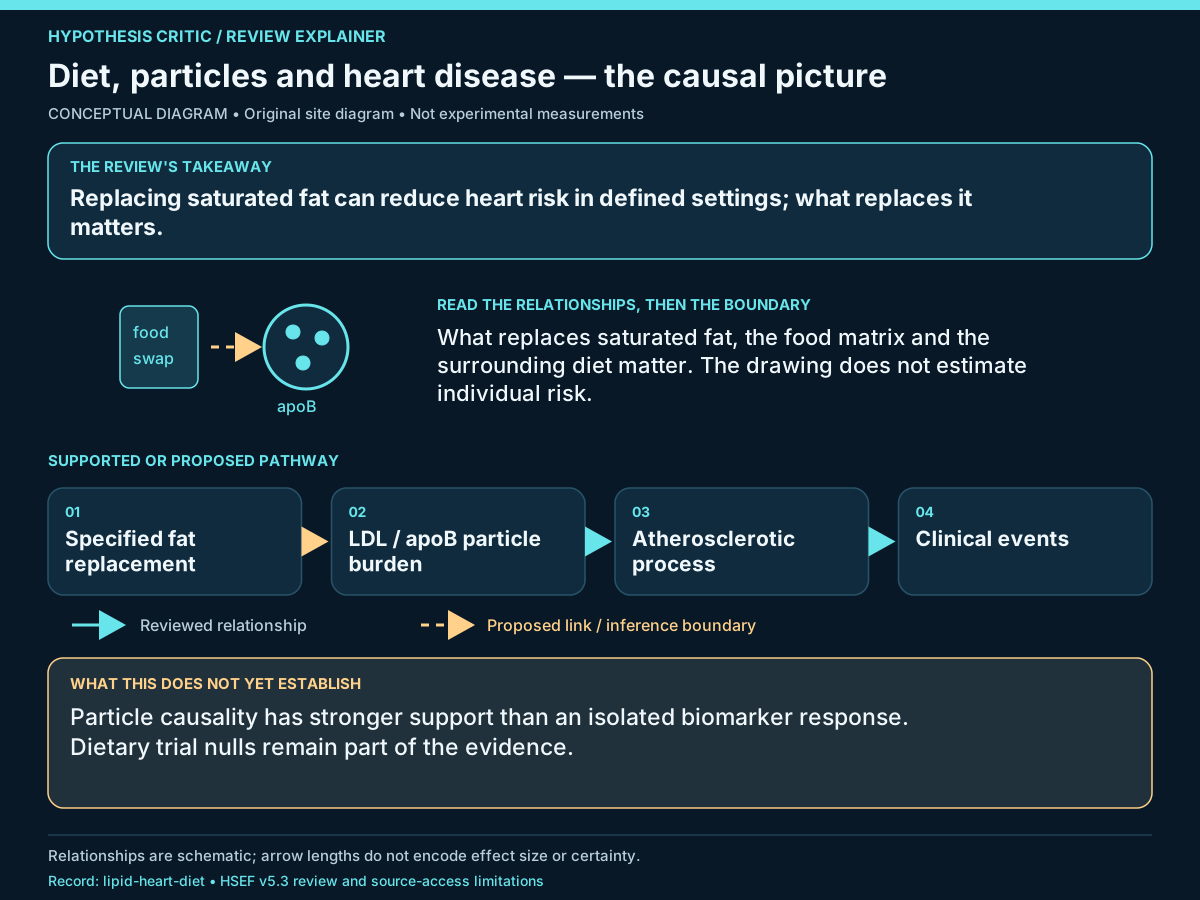
Replacing saturated fat can reduce heart risk in defined settings; what replaces it matters.
food
swap
apoB
READ THE RELATIONSHIPS, THEN THE BOUNDARY
What replaces saturated fat, the food matrix and the surrounding diet matter. The drawing does not estimate individual risk.
SUPPORTED OR PROPOSED PATHWAY
01
Specified fat replacement
02
LDL / apoB particle burden
03
Atherosclerotic process
04
Clinical events
Reviewed relationship
Proposed link / inference boundary
WHAT THIS DOES NOT YET ESTABLISH
Particle causality has stronger support than an isolated biomarker response. Dietary trial nulls remain part of the evidence.
Relationships are schematic; arrow lengths do not encode effect size or certainty.
Record: lipid-heart-diet  •  HSEF v5.3 review and source-access limitations
This is the specific idea being tested.
Genetic studies and medicines provide strong evidence that cholesterol-carrying particles contribute to artery disease. Dietary trials test different replacements and outcomes, and some find no clinical benefit; a cholesterol change alone cannot settle the whole dietary question.
A higher rank means a better fit to the evidence in this comparison. It does not prove every part of the leading explanation.
The reviewed hypothesis ranks 2 among 4 models compared; 1 alternative model(s) hold first rank for this stated claim.
Claim under review: rank 2 among 4 compared models.
Leading explanation: Replacement-nutrient and food-matrix model.
Position in this comparison: Next after leading rank.
The causal grade asks how well the stated causal claim is established. This comparison asks which of the assessed explanations fits the reviewed findings better. A leading explanation can remain unproven. Models can overlap or include the tested mechanism; an alternative ahead does not make that mechanism irrelevant. These ordinal ranks apply within this review; they do not measure the size of a difference or rank scientific strength across topics.
HYPOTHESIS CRITIC  /  REVIEW EXPLAINER
Diet, particles and heart disease — compare explanations
CONCEPTUAL DIAGRAM  •  Original site diagram  •  Not experimental measurements
THE REVIEW'S TAKEAWAY
Replacing saturated fat can reduce heart risk in defined settings; what replaces it matters.
CLAIM / SIMPLE EXPLANATION
01
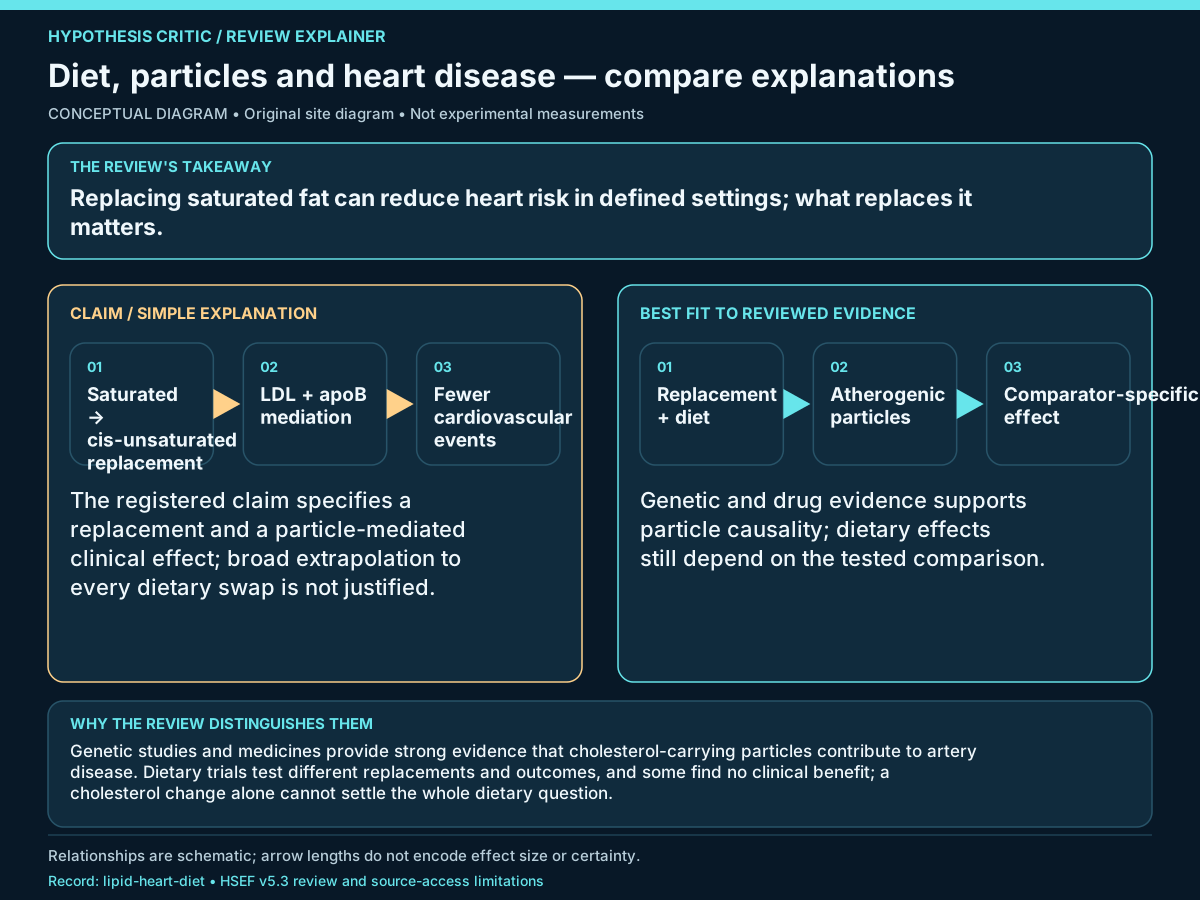
Saturated → cis-unsaturated replacement
02
LDL + apoB mediation
03
Fewer cardiovascular events
The registered claim specifies a replacement and a particle-mediated clinical effect; broad extrapolation to every dietary swap is not justified.
BEST FIT TO REVIEWED EVIDENCE
01
Replacement + diet
02
Atherogenic particles
03
Comparator-specific effect
Genetic and drug evidence supports particle causality; dietary effects still depend on the tested comparison.
WHY THE REVIEW DISTINGUISHES THEM
Genetic studies and medicines provide strong evidence that cholesterol-carrying particles contribute to artery disease. Dietary trials test different replacements and outcomes, and some find no clinical benefit; a cholesterol change alone cannot settle the whole dietary question.
Relationships are schematic; arrow lengths do not encode effect size or certainty.
Record: lipid-heart-diet  •  HSEF v5.3 review and source-access limitations
Causal in a specific setting for the stated claim.
Genetic studies and medicines provide strong evidence that cholesterol-carrying particles contribute to artery disease. Dietary trials test different replacements and outcomes, and some find no clinical benefit; a cholesterol change alone cannot settle the whole dietary question.
These explanations can overlap. Ranking their fit to the evidence is separate from deciding how firmly a cause has been established.
Rank 1: Replacement-nutrient and food-matrix model — Net risk depends on which foods/fatty acids replace which nutrients, with the particle pathway as a causal component.
Rank 2: Saturated-fat–LDL risk model — Sustained SFA-for-cis-UFA replacement elevates particles and thereby contributes to ASCVD.
Rank 3: LDL-independent dietary pathways — Foods also act through weight, metabolism, inflammation and other pathways.
Rank 4: Observational-confounding explanation — Dietary associations reflect socioeconomic and behavioural confounding.
Evidence rating: Ε · Moderate confidence. How the evidence was assessed.
Genetic studies and medicines provide strong evidence that cholesterol-carrying particles contribute to artery disease. Dietary trials test different replacements and outcomes, and some find no clinical benefit; a cholesterol change alone cannot settle the whole dietary question.
Replacing some saturated-fat foods with foods richer in unsaturated fats is consistent with public-health advice for heart health. The benefit depends on the replacement and the surrounding diet; replacing one food with another is a different question from simply adding an oil or supplement. Blood cholesterol and particle tests can inform risk assessment, but this review does not calculate an individual's benefit or settle every food comparison.
Further reading: WHO: dietary fats and replacement foods.
Look for the proposed factor and the outcome, in the people or systems covered by the claim.
The replacement food, the number of artery-damaging particles and the overall diet all influence the result. Genetic studies and medicines provide strong evidence that cholesterol-carrying particles contribute to artery disease. Dietary trials test different replacements and outcomes, and some find no clinical benefit; a cholesterol change alone cannot settle the whole dietary question.
Compare a clearly specified food replacement, check that people follow it, and track both blood particles and heart attacks or other clinical events over enough time.
HYPOTHESIS CRITIC  /  REVIEW EXPLAINER
Diet, particles and heart disease — evidence and next test
CONCEPTUAL DIAGRAM  •  Original site diagram  •  Not experimental measurements
THE REVIEW'S TAKEAWAY
Replacing saturated fat can reduce heart risk in defined settings; what replaces it matters.
DIFFERENT EVIDENCE ANSWERS DIFFERENT QUESTIONS
Genetics + drugs
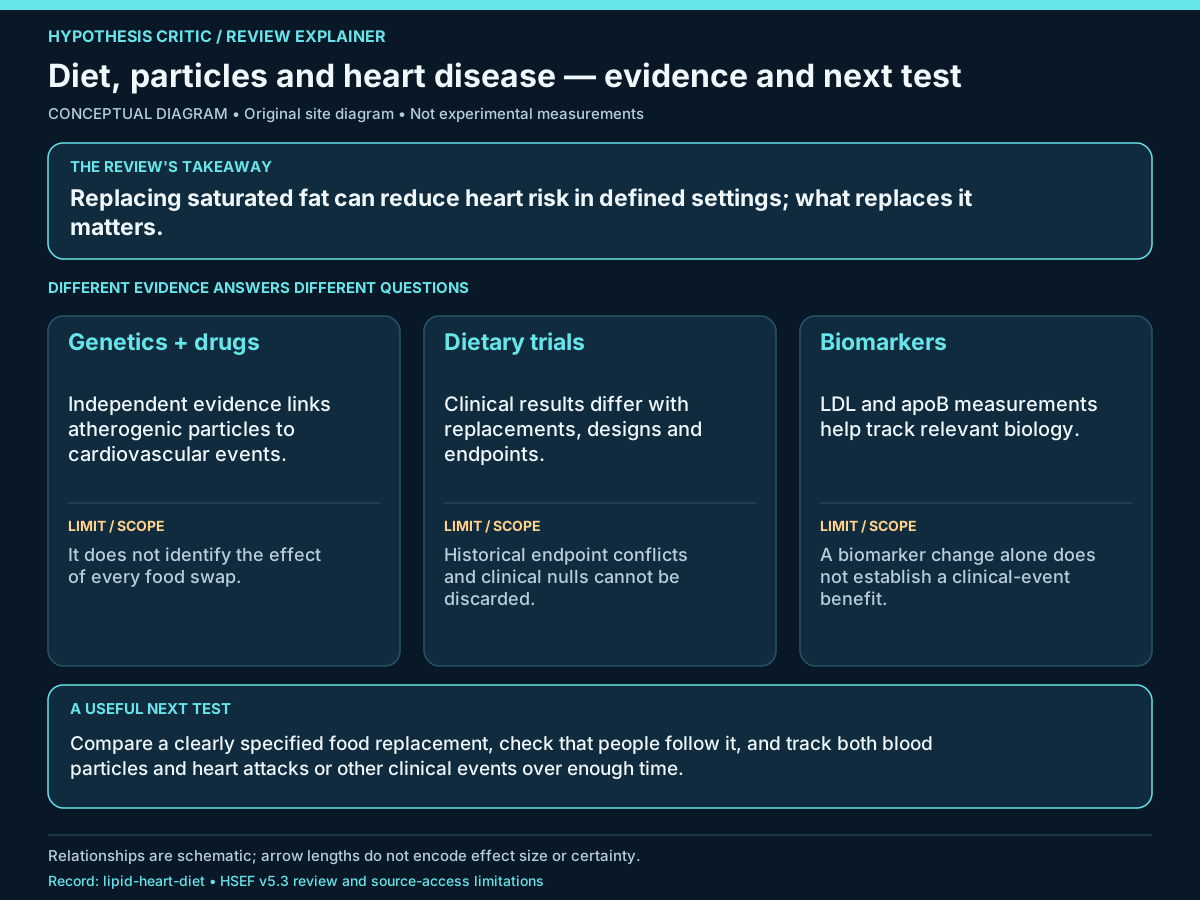
Independent evidence links atherogenic particles to cardiovascular events.
LIMIT / SCOPE
It does not identify the effect of every food swap.
Dietary trials
Clinical results differ with replacements, designs and endpoints.
LIMIT / SCOPE
Historical endpoint conflicts and clinical nulls cannot be discarded.
Biomarkers
LDL and apoB measurements help track relevant biology.
LIMIT / SCOPE
A biomarker change alone does not establish a clinical-event benefit.
A USEFUL NEXT TEST
Compare a clearly specified food replacement, check that people follow it, and track both blood particles and heart attacks or other clinical events over enough time.
Relationships are schematic; arrow lengths do not encode effect size or certainty.
Record: lipid-heart-diet  •  HSEF v5.3 review and source-access limitations
Compare a clearly specified food replacement, check that people follow it, and track both blood particles and heart attacks or other clinical events over enough time.
Check that the intended change really happened.
Allow for other factors and compare with suitable controls.
Look for independent confirmation and the limits of the effect.
These are questions for research, not a claim that the proposed studies have already succeeded.
Proposed tests: 1 test design(s) are registered in the scorecard.
In plain terms, researchers would change the proposed cause, check that it changed as intended, then measure a meaningful outcome while controlling plausible alternatives. The result should be able to support or count against the claim—not only show that a pathway exists.
Study design: Independently run, preregistered long-term isoenergetic replacement trial with fixed SFA species, cis-PUFA/cis-MUFA comparators, matched food matrices, trans-fat measurement, sustained apoB separation and blinded adjudicated ASCVD outcomes; prospectively test mediation and competing metabolic pathways.
What would be measured: Adjudicated ASCVD events and prespecified exposure/apoB-mediated risk differences
Important controls: Energy balance, food matrix, adherence, medications, cis/trans composition, unbiased allocation and outcome assessment
Result that would support the claim: Replicated clinical event separation aligned with sustained particle differences under the specified replacement
Result that would count against it: Adequate sustained exposure and apoB separation with precise absent or opposite event effect, or benefits explained by prespecified nonparticle pathways
Follow the studies, detailed comparisons and evidence ratings behind this guide.
Open the scientific review →