The question
Does industrial processing itself cause excess eating and weight gain?
This is the specific idea being tested.
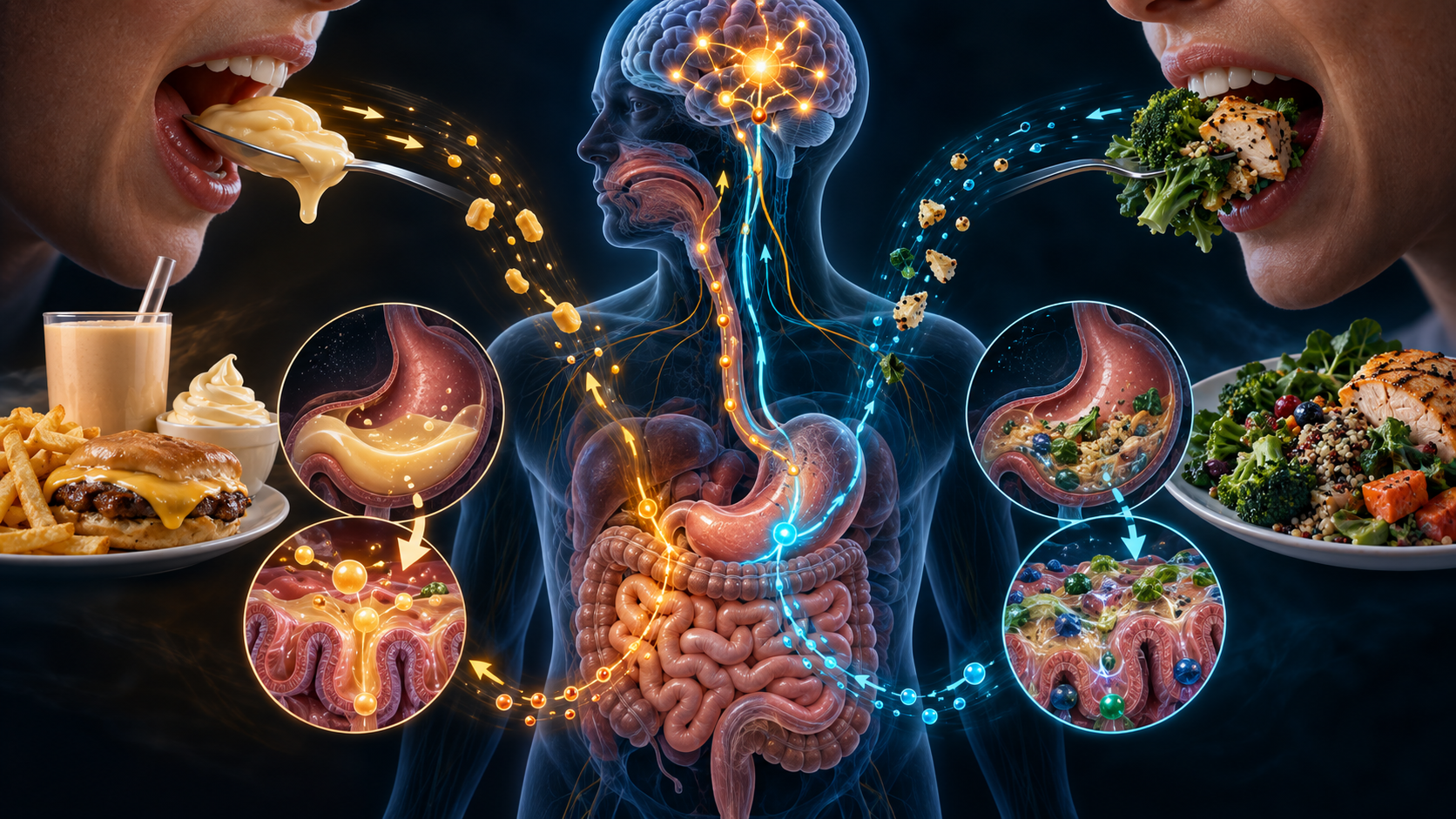
Does industrial processing itself cause excess eating and weight gain?
What you need to knowSome ultra-processed diets increase intake, but texture, energy density and appeal explain more than the processing label alone.Relative explanatory fit: Alternative ranked ahead
Why the alternative fits better: Intake varies within the processed category, and differences shrink when key properties are matched.
Claim assessed: In adults given ad libitum access to a defined diet, assigning foods classified as ultra-processed (NOVA 4) causes greater energy intake and subsequent weight gain (body weight and fat mass) than a minimally processed comparator, and this effect persists when nutrient composition as consumed (macronutrient and micronutrient amounts, their combinations, and the compositional determinants of energy density) is matched, being carried instead by properties that industrial processing confers on foods (such as texture and eating rate, food-matrix disruption, and additives) that are characteristic of the category.
Finding: Some ultra-processed whole-diet packages causally increase energy intake and relative short-term weight or fat gain, reaching Ε for those bounded subclaims. The submitted proposition additionally requires that the effect persist when nutrient composition is matched and be carried by processing-conferred properties characteristic of the category; those clauses remain Γ because the most direct composition-matched contrast is non-significant [18], matched designs are null [8,11,22], composition changes intake within UPF [21], and processing-conferred properties act in both directions within NOVA 4 [4,6,23,24]. The level does not rest on the registry-only result [18].
Evidence scope: Primary human feeding, mechanistic, and prospective evidence through 2026-09-30, including ClinicalTrials.gov posted results. Full text read wherever accessible; abstract-only and registry-only records are labeled. The HSEF v5.4 packet (SHA256 7E097D3D50D2068F68BDB1CD022DF4A045DAC46A9F25E51262EC7568E9DB11EB) was treated as methodology, not scientific evidence.
The grade applies to the stated claim. Model rankings and individual subclaim grades remain separate from the overall causal-evidence grade.
Full scientific assessment and references · Scorecard (JSON) · Review source (Markdown)
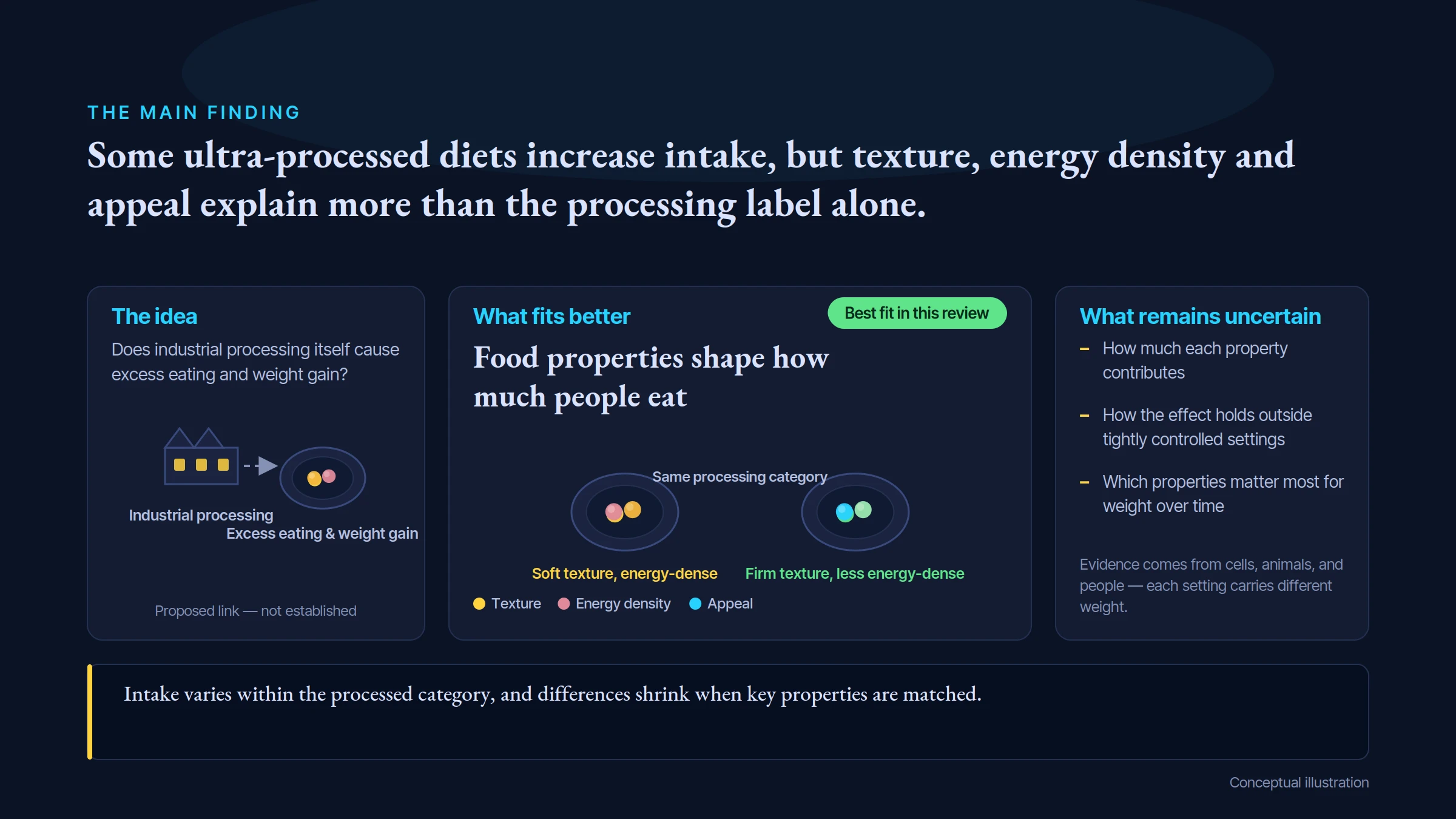
THE MAIN FINDING
Some ultra-processed diets increase intake, but texture, energy density and appeal explain more than the processing label alone.
The idea
Does industrial processing itself cause excess eating and weight gain?
Industrial processing
Excess eating and weight gain (proposed consequence)
Proposed link — not established
What fits better
Food properties shape how much people eat
Best fit in this review
Plate A: soft texture, energy-dense
Plate B: firm texture, less energy-dense
Same processing category
Texture
Energy density
Appeal
What remains uncertain
How much each property contributes
How the effect holds outside tightly controlled settings
Which properties matter most for weight over time
Evidence comes from cells, animals, and people — each setting carries different weight.
Intake varies within the processed category, and differences shrink when key properties are matched.
Conceptual illustration
This is the specific idea being tested.
Intake varies within the processed category, and differences shrink when key properties are matched.
A higher rank means a better fit to the evidence in this comparison. It does not prove every part of the leading explanation.
The reviewed hypothesis ranks 4 among 4 models compared; 1 alternative model(s) hold first rank for this stated claim.
Claim under review: rank 4 among 4 compared models.
Leading explanation: Proximal food-property model (energy density, hyperpalatable nutrient combinations, texture and eating rate).
Position in this comparison: Last recorded rank.
The causal grade asks how well the stated causal claim is established. This comparison asks which of the assessed explanations fits the reviewed findings better. A leading explanation can remain unproven. Models can overlap or include the tested mechanism; an alternative ahead does not make that mechanism irrelevant. These ordinal ranks apply within this review; they do not measure the size of a difference or rank scientific strength across topics.
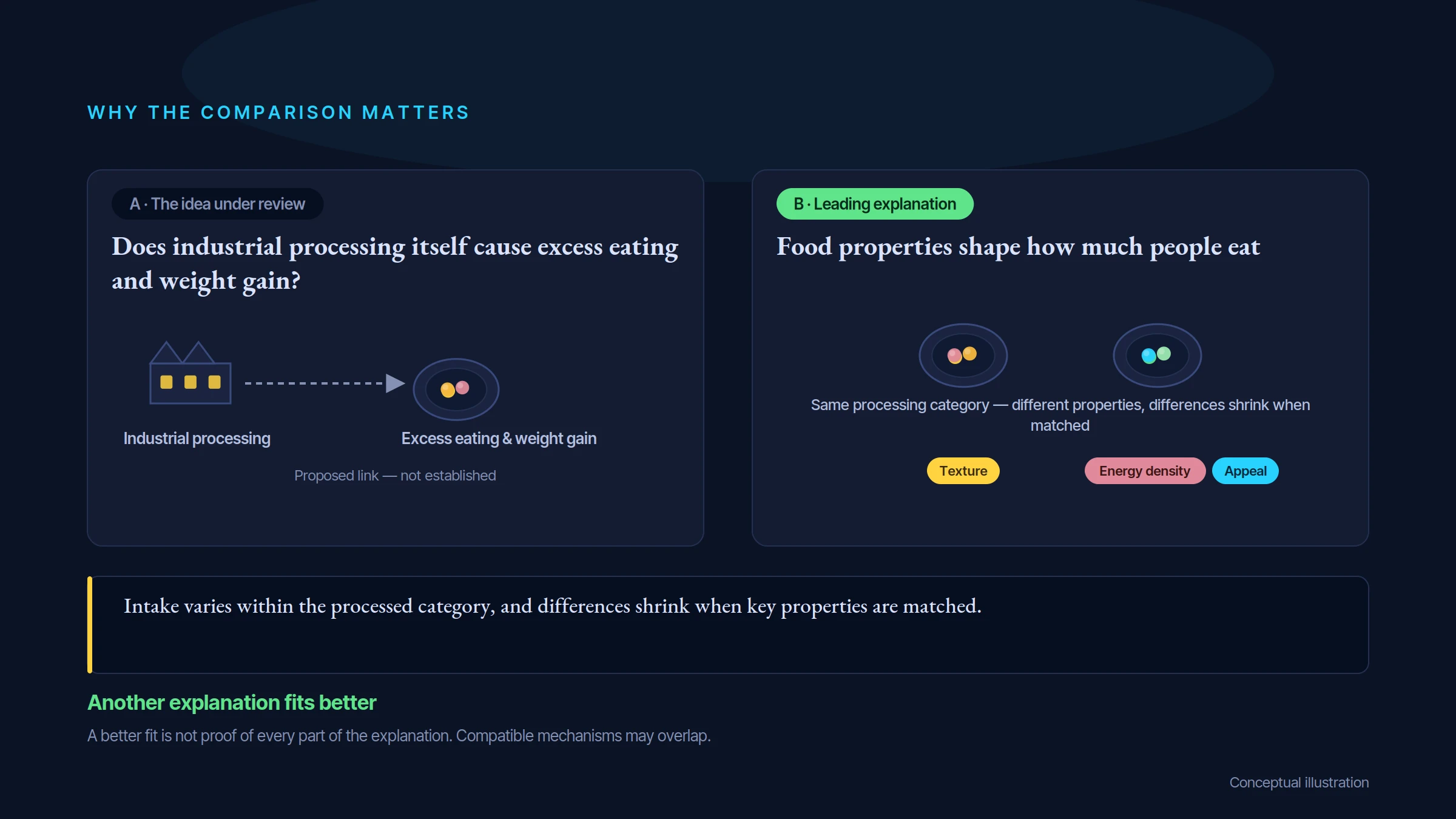
WHY THE COMPARISON MATTERS
A · The idea under review
Does industrial processing itself cause excess eating and weight gain?
B · Leading explanation
Food properties shape how much people eat
Intake varies within the processed category, and differences shrink when key properties are matched.
Another explanation fits better
A better fit is not proof of every part of the explanation. Compatible mechanisms may overlap.
Conceptual illustration
Industrial processing
Excess eating and weight gain (proposed consequence)
Proposed link — not established
Same processing category — different properties, differences shrink when matched
Texture
Energy density
Appeal
Plausible, not established for the stated claim.
Intake varies within the processed category, and differences shrink when key properties are matched.
These explanations can overlap. Ranking their fit to the evidence is separate from deciding how firmly a cause has been established.
Rank 1: Proximal food-property model (energy density, hyperpalatable nutrient combinations, texture and eating rate) — Energy density, hyperpalatable nutrient combinations, and texture-derived eating rate determine the rate and amount of energy consumed; industrial processing often creates these properties but can also produce low-risk versions.
Rank 2: Whole-diet ultra-processed package model — Some UPF-rich menu packages increase intake and relative weight through the combined effect of formulation, food form, energy density, eating behavior, convenience, and choice, without requiring one residual processing essence.
Rank 3: Nutrient-form, matrix, formulation, and protein-leverage model — Differences in nutrient form, fibre type, carbohydrate-fat combinations, protein share, food matrix, and formulation account for part of the apparent UPF effect even when aggregate macronutrients are nominally matched as offered.
Rank 4: Nutrient-independent processing model (nominal) — Properties conferred by industrial processing and characteristic of ultra-processed foods cause excess intake and weight gain when nutrient composition as consumed is matched.
Evidence rating: Γ · Moderate confidence. How the evidence was assessed.
Intake varies within the processed category, and differences shrink when key properties are matched.
The evidence supports practical research and public-health attention to food environments, product design, and dietary patterns—not a single magic label that predicts health. Reducing reliance on foods that make it easy to overeat may help some people, while a sustainable diet also has to be adequate, affordable, culturally workable, and appropriate for the person. The review does not support claims that a NOVA category alone can diagnose the cause of weight change or replace established obesity care.
Look for the proposed factor and the outcome, in the people or systems covered by the claim.
Food properties shape how much people eat. Intake varies within the processed category, and differences shrink when key properties are matched.
Match food properties across processing categories and measure eating rate, intake and weight change.
These illustrations show the key questions tested in the review. They are conceptual drawings, not microscope images or experimental results.

Assigning an ultra-processed-rich whole diet rather than a minimally or unprocessed comparator can increase ad libitum energy intake in humans.
The intake and weight effect of UPF-rich diets persists when nutrient composition as consumed is matched, including the compositional determinants of energy density and hyperpalatable nutrient combinations.
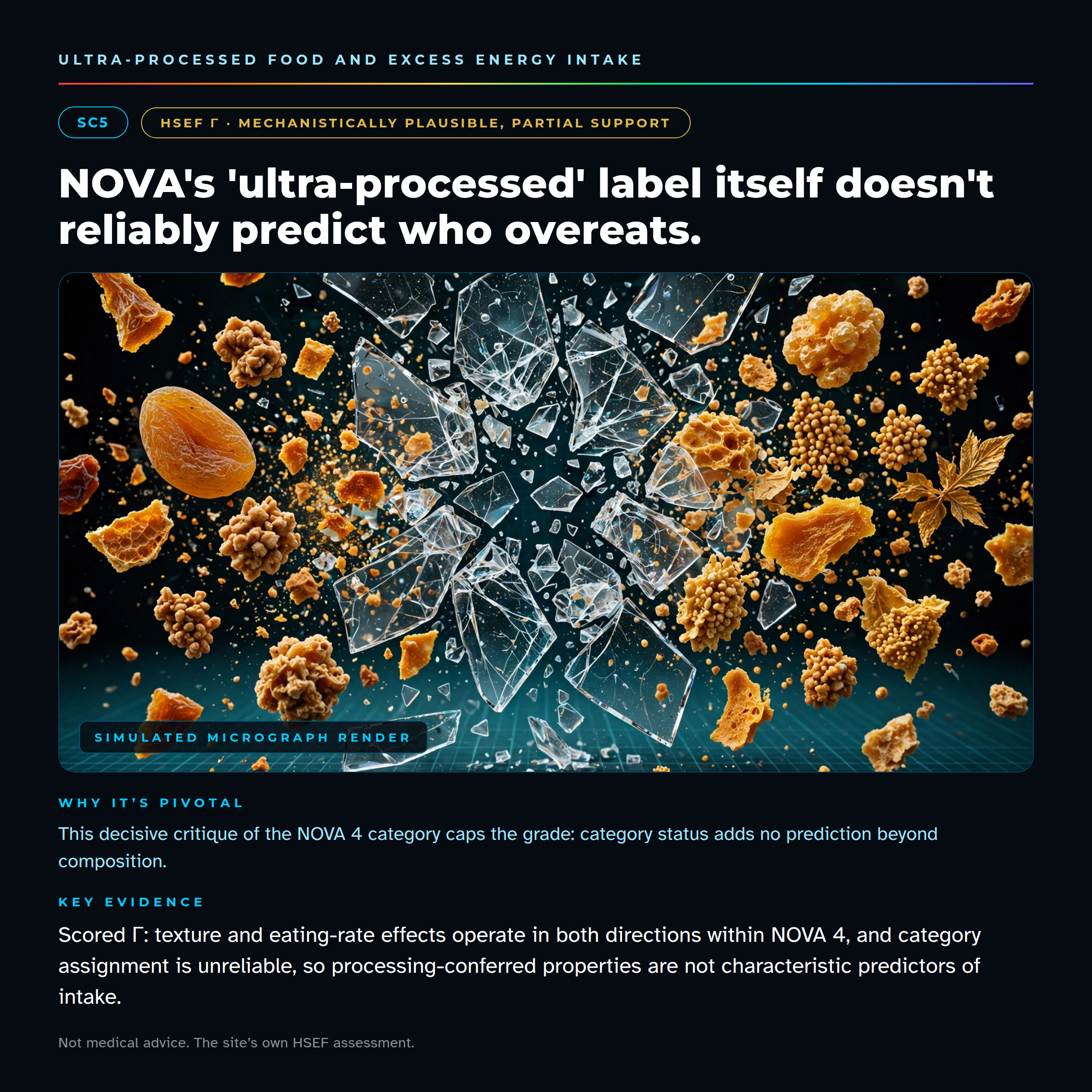
Processing-conferred properties that raise intake (such as soft texture and fast eating rate) are characteristic of the NOVA 4 category, so category status predicts excess intake and weight gain beyond composition across foods and populations.
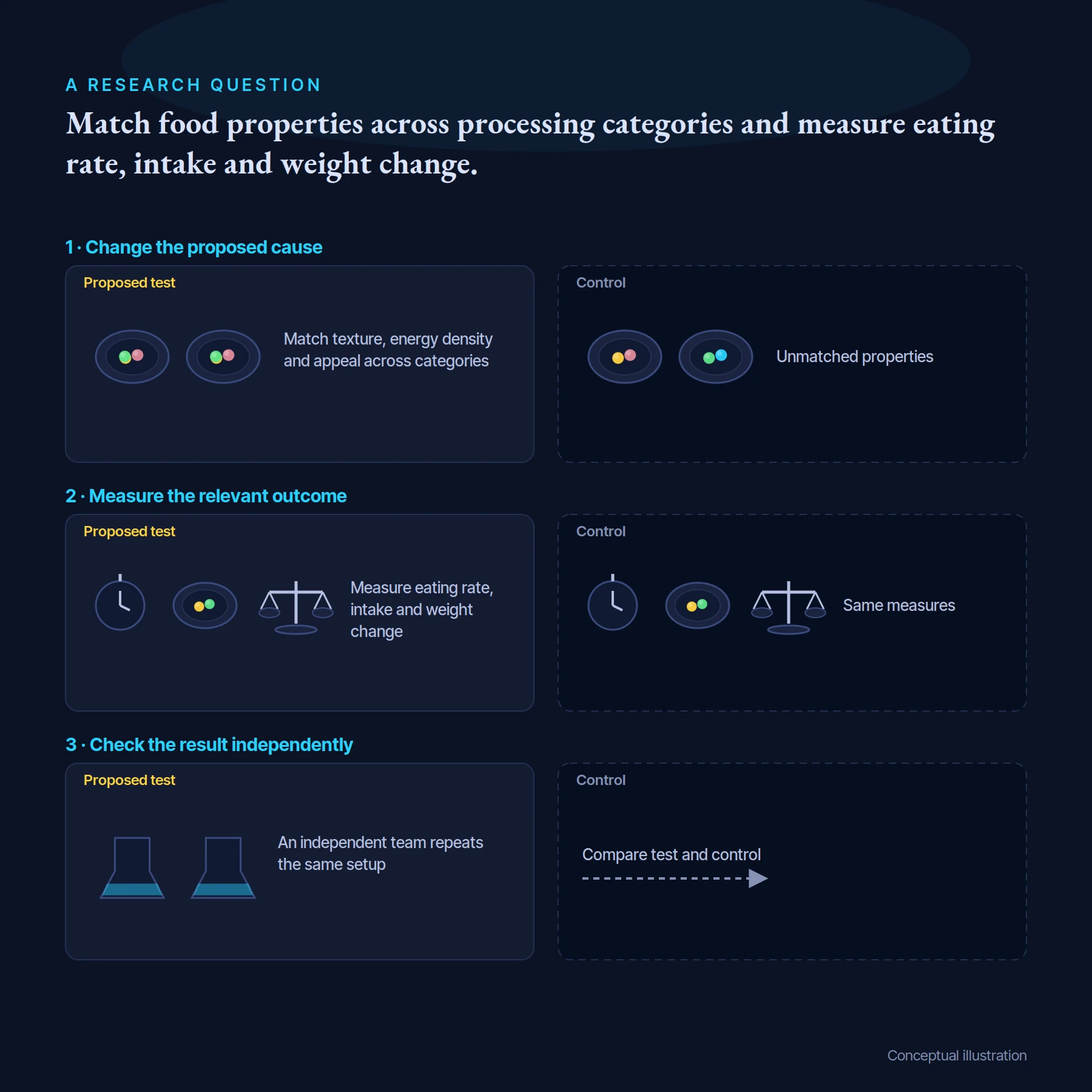
A research question
Match food properties across processing categories and measure eating rate, intake and weight change.
1 · Change the proposed cause
Proposed test
Control
Match texture, energy density and appeal across categories
Unmatched properties
2 · Measure the relevant outcome
Proposed test
Control
Measure eating rate, intake and weight change
Same measures in control
3 · Check the result independently
Proposed test
Control
An independent team repeats the same setup
Compare test and control
Conceptual illustration
Match food properties across processing categories and measure eating rate, intake and weight change.
Check that the intended change really happened.
Allow for other factors and compare with suitable controls.
Look for independent confirmation and the limits of the effect.
These are questions for research, not a claim that the proposed studies have already succeeded.
Proposed tests: 3 test design(s) are registered in the scorecard.
In plain terms, researchers would change the proposed cause, check that it changed as intended, then measure a meaningful outcome while controlling plausible alternatives. The result should be able to support or count against the claim—not only show that a pathway exists.
Study design: Residential randomized crossover at an independent site, at least four weeks per condition, comparing UPF and minimally processed diets matched as consumed on macronutrient and micronutrient amounts, hyperpalatable combinations, and total and non-beverage energy density, crossed with a prespecified processing route (industrial versus home-style preparation of ingredient-identical foods) so that texture and matrix vary by design.
What would be measured: Continuous weighed intake, energy-intake rate, nutrient intake, appetite, body weight and fat mass, fecal energy, and metabolizable energy.
Important controls: Verify composition as consumed, not only as offered; preregister a smallest effect of interest so that a null result is informative.
Result that would support the claim: A replicated composition-independent effect on intake and fat mass, carried by the prespecified processing route.
Result that would count against it: Equivalence of UPF and minimally processed diets at matched composition within the preregistered margin.
Study design: Rebuild the Hall menus in sequential versions that equalize non-beverage energy density, hyperpalatable combinations, texture/eating rate, protein share, fibre type, and carbohydrate-fat blend one block at a time, using randomized order and washout.
What would be measured: Change in the original approximately 500-kcal/day intake contrast after each block, with meal-level mediation and body-composition follow-up.
Important controls: Keep variety, presentation, palatability, meal schedule, availability, and food mass prospectively specified; blind outcome analysis and use the same decision rules in an independent replication site.
Result that would support the claim: A substantial reproducible residual remains after every prospectively measured mediator is controlled.
Result that would count against it: The diet effect collapses when named proximal properties are equated, leaving no reproducible residual associated with process history.
Study design: Randomize adults for 12-16 weeks to slow/low-energy-intake-rate UPF, fast/high-energy-intake-rate UPF, and matched minimally processed diets, with menus spanning multiple food families.
What would be measured: Ad libitum intake, body fat, weight, adherence, diet acceptability, and durability of effects over time.
Important controls: Match macronutrients across texture arms (which earlier texture trials did not), include UPF foods predicted not to increase intake as internal negative controls, and prespecify whether NOVA status adds prediction beyond measured properties.
Result that would support the claim: NOVA category retains a reproducible effect after food-property prediction and internal negative controls.
Result that would count against it: Measured food properties predict intake and weight while NOVA category adds no out-of-sample information.
Follow the studies, detailed comparisons and evidence ratings behind this guide.
Open the scientific review →