The question
Can innate immune cells retain a lasting changed response after an earlier challenge?
This is the specific idea being tested.
Can innate immune cells retain a lasting changed response after an earlier challenge?
What you need to knowLasting immune responses have causal support in defined settings, but depend on the challenge and cell type.Relative explanatory fit: Alternative ranked ahead
Why the alternative fits better: A persistent response can protect, dampen immunity or cause harm. One universal mechanism does not explain all outcomes.
Claim assessed: Innate immune cells and their hematopoietic progenitors acquire intrinsic, long-lasting, autonomously maintained epigenetic and metabolic memory that enhances responses to later heterologous challenges.
Finding: Preregistered primary-subclaim aggregation uses SC3 and returns Ε, context-dependent causality, with Moderate confidence. Purified post-resolution and long-term donor-cell transfer support conditional intrinsic persistence without continued original tissue exposure. Complete ligand exclusion and independence from all ongoing signaling are not demonstrated; normal homeostatic maintenance is compatible with cell-intrinsic memory. The strict universal signal/antigen-free extension remains Γ. Weakest-link sensitivity is Γ because histone-carrier specificity and human clinical mediation remain unresolved; scope-matched primary sensitivity is Ε. The final letter does not certify the full conjunctive mechanism or universal clinical protection.
Evidence scope: 63 primary reports; literature cutoff 2026-10-07; source examination UTC date 2026-10-08; bounded critical review, not exhaustive systematic review.
The grade applies to the stated claim. Model rankings and individual subclaim grades remain separate from the overall causal-evidence grade.
Full scientific assessment and references · Scorecard (JSON) · Review source (Markdown)
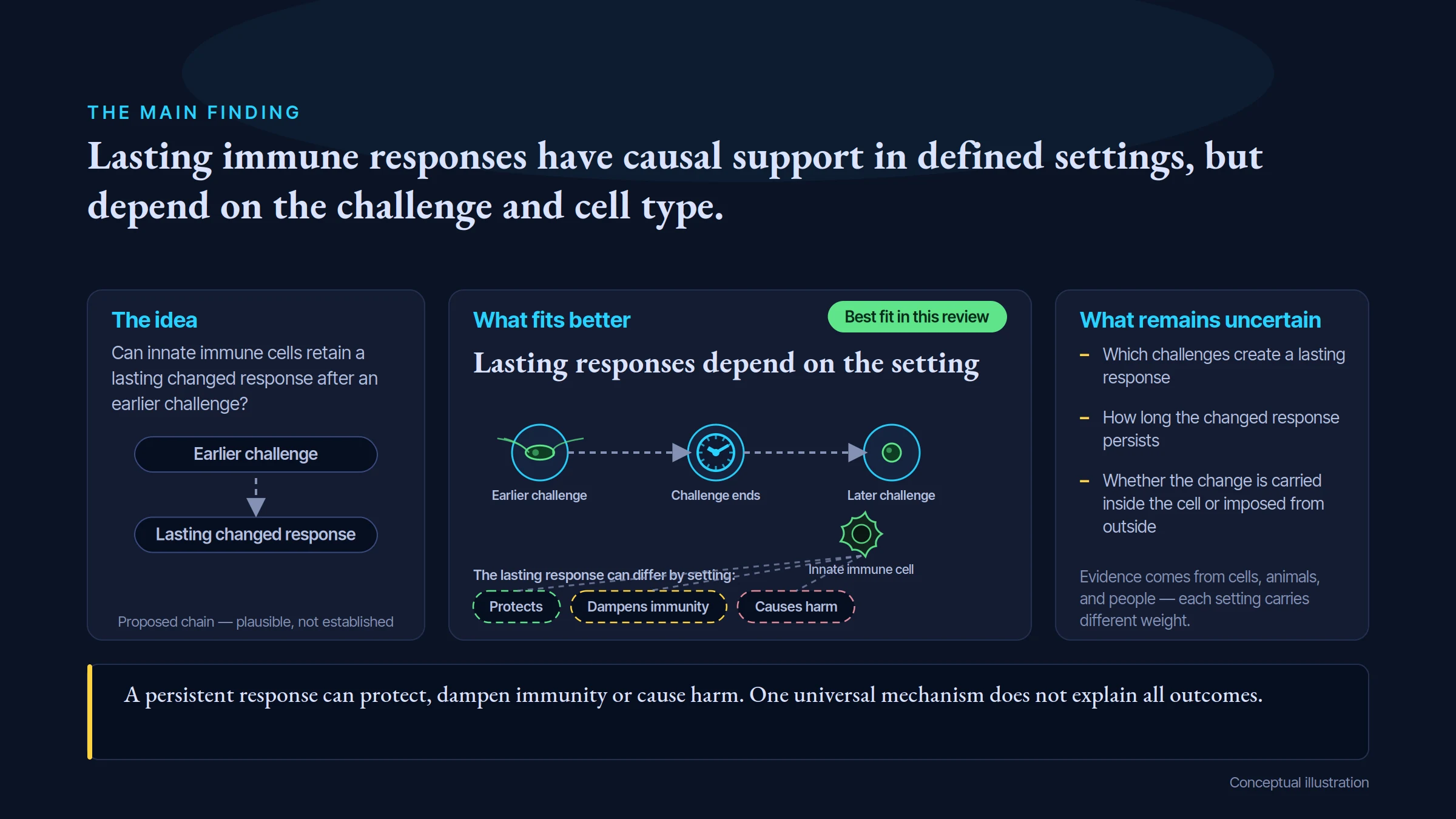
THE MAIN FINDING
Lasting immune responses have causal support in defined settings, but depend on the challenge and cell type.
The idea
Can innate immune cells retain a lasting changed response after an earlier challenge?
Earlier challenge
Lasting changed response
Proposed chain — plausible, not established
What fits better
Best fit in this review
Lasting responses depend on the setting
Earlier challenge
Challenge ends
Later challenge
Innate immune cell
The lasting response can differ by setting
Protects
Dampens immunity
Causes harm
What remains uncertain
Which challenges create a lasting response
How long the changed response persists
Whether the change is carried inside the cell or imposed from outside
Evidence comes from cells, animals, and people — each setting carries different weight.
A persistent response can protect, dampen immunity or cause harm. One universal mechanism does not explain all outcomes.
Conceptual illustration
This is the specific idea being tested.
A persistent response can protect, dampen immunity or cause harm. One universal mechanism does not explain all outcomes.
A higher rank means a better fit to the evidence in this comparison. It does not prove every part of the leading explanation.
The reviewed hypothesis ranks 2 among 5 models compared; 1 alternative model(s) hold first rank for this stated claim.
Claim under review: rank 2 among 5 compared models.
Leading explanation: Dose- and context-dependent innate set-point.
Position in this comparison: Next after leading rank.
The causal grade asks how well the stated causal claim is established. This comparison asks which of the assessed explanations fits the reviewed findings better. A leading explanation can remain unproven. Models can overlap or include the tested mechanism; an alternative ahead does not make that mechanism irrelevant. These ordinal ranks apply within this review; they do not measure the size of a difference or rank scientific strength across topics.
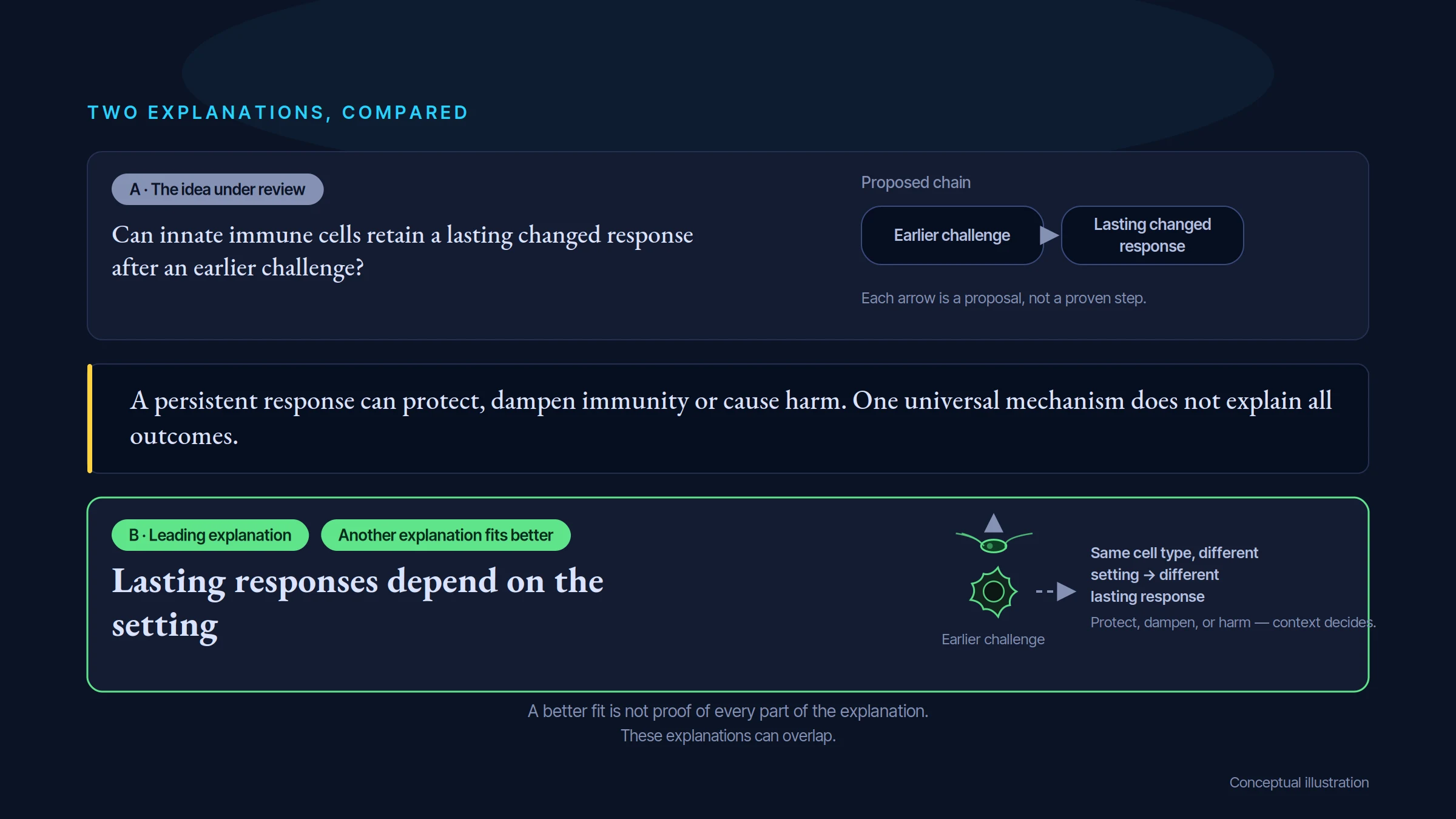
TWO EXPLANATIONS, COMPARED
A · The idea under review
Can innate immune cells retain a lasting changed response after an earlier challenge?
Proposed chain
Earlier challenge
Lasting changed response
Each arrow is a proposal, not a proven step.
A persistent response can protect, dampen immunity or cause harm. One universal mechanism does not explain all outcomes.
B · Leading explanation
Another explanation fits better
Lasting responses depend on the setting
Earlier challenge
Same cell type, different setting → different lasting response
Protect, dampen, or harm — context decides
A better fit is not proof of every part of the explanation.
These explanations can overlap.
Conceptual illustration
Causal in a specific setting for the stated claim.
A persistent response can protect, dampen immunity or cause harm. One universal mechanism does not explain all outcomes.
These explanations can overlap. Ranking their fit to the evidence is separate from deciding how firmly a cause has been established.
Rank 1: Dose- and context-dependent innate set-point — Stimulus, tissue and lineage determine a persistent responsive state that can protect, tolerate or cause harm.
Rank 2: Cell-intrinsic memory with unresolved carrier — Cells/progenitors preserve altered responsiveness after removal from the original exposure context.
Rank 3: Progenitor selection and differentiation bias — Some durable outputs arise from altered HSC composition, lineage propensity or selected clones.
Rank 4: Maladaptive inflammatory amplification — Past disease exposure can transmit a susceptibility state that amplifies later pathology.
Rank 5: Persistent antigen, metabolites or external signaling — Some long-lived effects reflect continuing inducer, microbiome or niche inputs.
Evidence rating: Ε · Moderate confidence. How the evidence was assessed.
A persistent response can protect, dampen immunity or cause harm. One universal mechanism does not explain all outcomes.
A result about how a disease works is a separate question from whether a treatment improves health.
Look for the proposed factor and the outcome, in the people or systems covered by the claim.
Lasting responses depend on the setting. A persistent response can protect, dampen immunity or cause harm. One universal mechanism does not explain all outcomes.
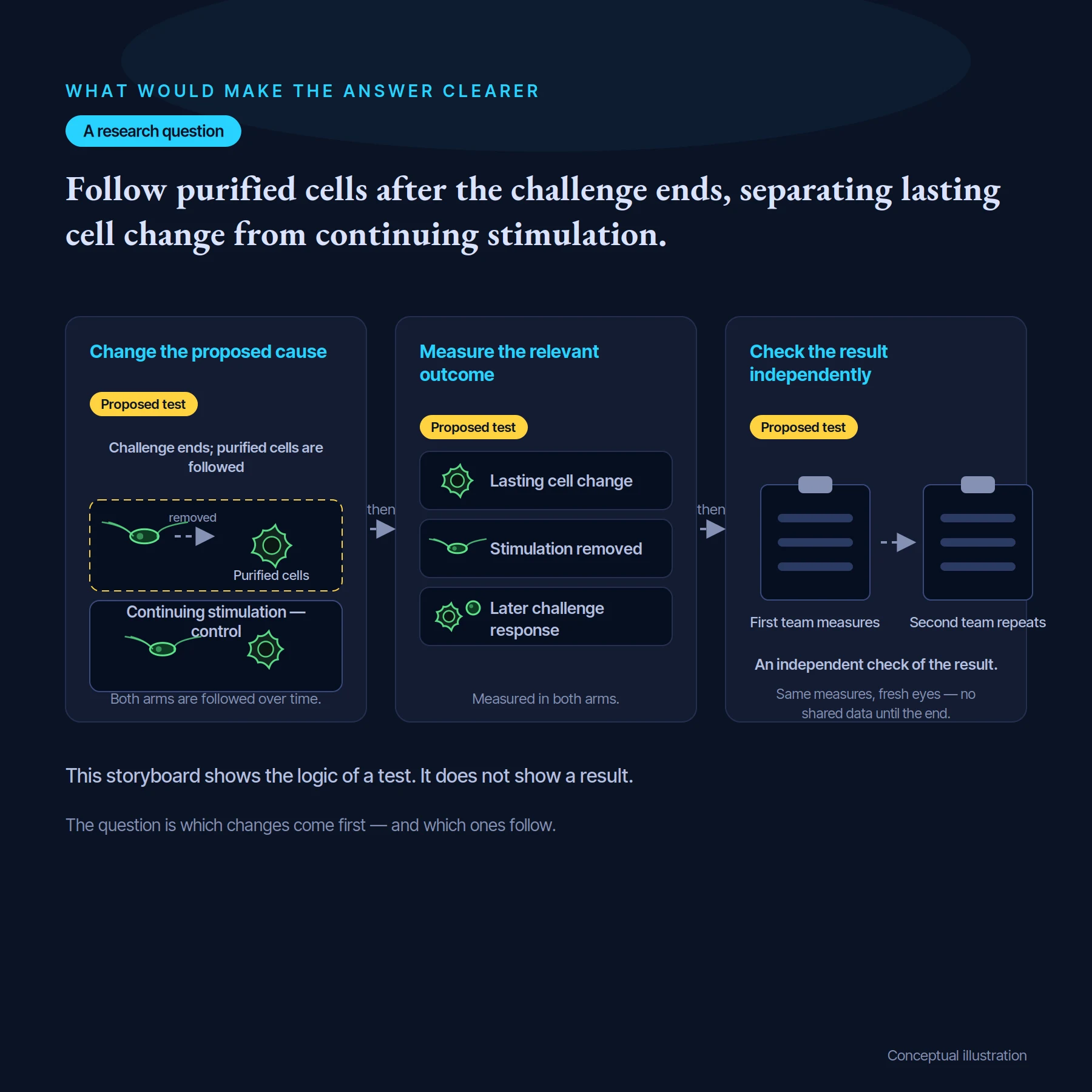
Follow purified cells after the challenge ends, separating lasting cell change from continuing stimulation.
WHAT WOULD MAKE THE ANSWER CLEARER
A research question
Follow purified cells after the challenge ends, separating lasting cell change from continuing stimulation.
then
then
Change the proposed cause
Proposed test
Challenge ends; purified cells are followed
Challenge removed
Purified cells
Continuing stimulation — control
Both arms are followed over time.
Measure the relevant outcome
Proposed test
Lasting cell change
Stimulation removed
Later challenge response
Measured in both arms.
Check the result independently
Proposed test
First team measures
Second team repeats
An independent check of the result.
Same measures, fresh eyes — no shared data until the end.
This storyboard shows the logic of a test. It does not show a result.
The question is which changes come first — and which ones follow.
Conceptual illustration
Follow purified cells after the challenge ends, separating lasting cell change from continuing stimulation.
Check that the intended change really happened.
Allow for other factors and compare with suitable controls.
Look for independent confirmation and the limits of the effect.
These are questions for research, not a claim that the proposed studies have already succeeded.
Proposed tests: 1 test design(s) are registered in the scorecard.
In plain terms, researchers would change the proposed cause, check that it changed as intended, then measure a meaningful outcome while controlling plausible alternatives. The result should be able to support or count against the claim—not only show that a pathway exists.
Study design: After a defined nonreplicating inducer has cleared by sensitive labeled-ligand and molecular assays, isolate barcoded LT-HSCs and self-renewing primary macrophages. Randomize delayed cell-specific removal of original receptor/niche signaling, candidate chromatin-maintenance machinery and matched rescue. Transfer into ligand-free recipients with matched conditioning and engraftment; follow clones, baseline competence and heterologous challenge function over months.
What would be measured: Single-clone descendants, preserved viability/baseline inducibility, ligand burden, mark/TF/metabolic trajectories and challenge killing or disease phenotype
Important controls: Naive transferred cells; ligand-spiked assay sensitivity; induction-only versus delayed blockade; clone and lineage matching; inactive degron/rescue; nonconditioned or matched-niche comparison; adaptive-cell controls
Result that would support the claim: Recall persists after verified original-input removal, disappears selectively after delayed candidate-carrier subtraction and returns with matched rescue without baseline impairment
Result that would count against it: Recall tracks detectable original ligand/niche input, disappears with input removal rather than carrier-specific subtraction, or apparent loss is explained by clone selection or general cell dysfunction
Follow the studies, detailed comparisons and evidence ratings behind this guide.
Open the scientific review →