The question
Are stable cancer stem-cell groups necessary for tumour survival and relapse?
This is the specific idea being tested.
Are stable cancer stem-cell groups necessary for tumour survival and relapse?
What you need to knowCancer stem-cell roles can matter, but a universal fixed hierarchy fits less well than changing cell roles.Relative explanatory fit: Alternative ranked ahead
Why the alternative fits better: Cells move into or out of tumour-regrowing states depending on genes, surroundings and treatment.
Claim assessed: Discrete self-renewing cancer stem-cell populations organized in stable hierarchies are necessary for tumour maintenance and post-treatment relapse across human cancers.
Finding: Γ for the exact registered broad fixed-hierarchy claim. The cancer rubric explicitly permits Ε for context-specific CSC validity; that threshold is awarded to SC2 and SC3 rather than silently replacing SC5 with a weaker functional-stemness statement. Across-context causal studies are credited as a convergent set, but their results include genuine population replacement, stage-specific dispensability and alternative lineage routes. They therefore do not cross the fixed cross-human necessity gate. Scope-matched and primary-subclaim aggregation both return Γ; weakest-link also returns Γ. Narrow existence is Ζ, and defined maintenance/relapse dependencies are Ε.
Evidence scope: 68 primary reports; literature cutoff 2026-10-05; source examination UTC date 2026-10-06; bounded critical review, not exhaustive systematic review.
The grade applies to the stated claim. Model rankings and individual subclaim grades remain separate from the overall causal-evidence grade.
Full scientific assessment and references · Scorecard (JSON) · Review source (Markdown)
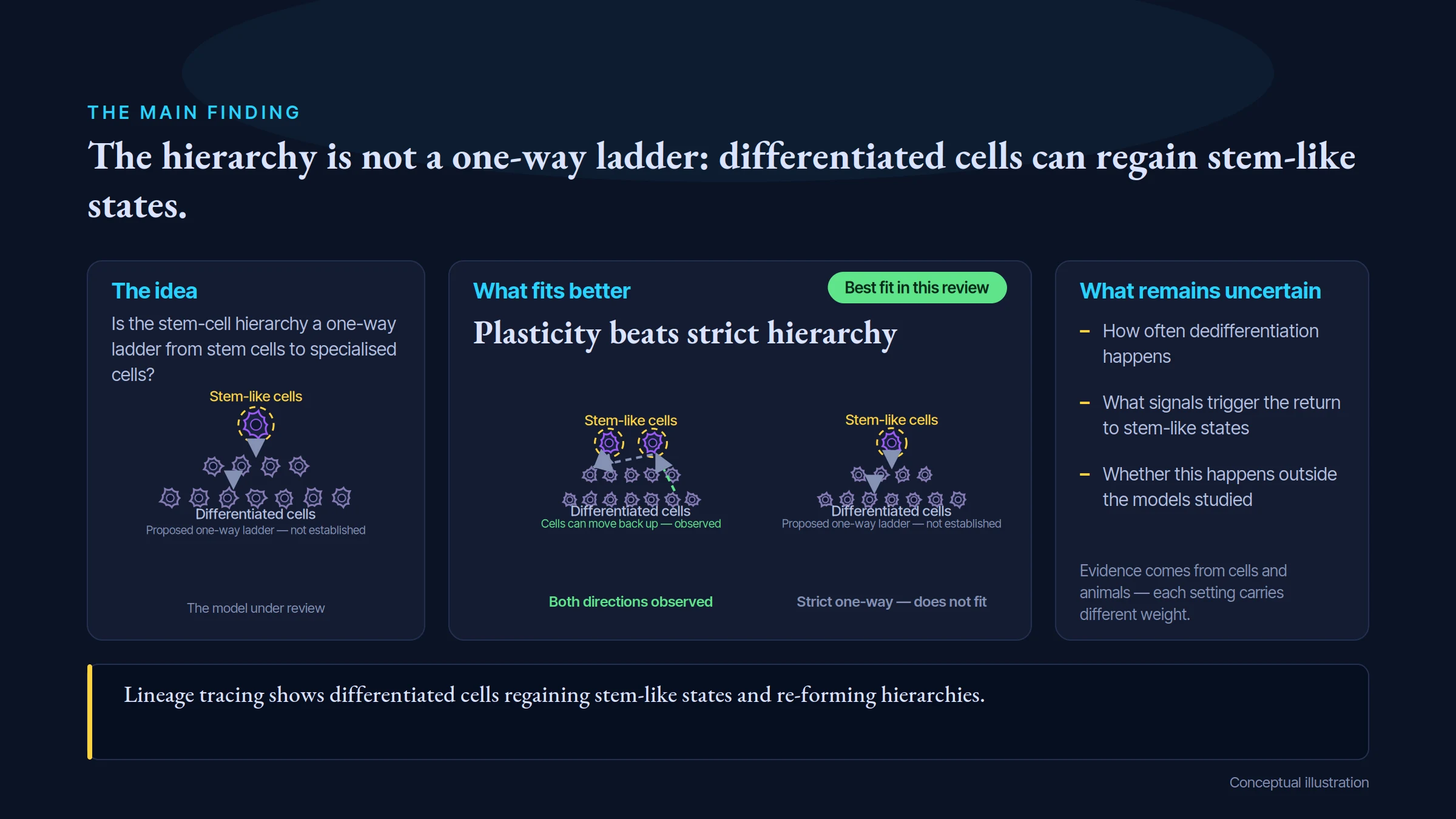
THE MAIN FINDING
The hierarchy is not a one-way ladder: differentiated cells can regain stem-like states.
The idea
Is the stem-cell hierarchy a one-way ladder from stem cells to specialised cells?
Stem-like cells
Differentiated cells
Proposed one-way ladder — dashed arrows are not established
The model under review
What fits better
Plasticity beats strict hierarchy
Best fit in this review
Stem-like cells
Differentiated cells
Cells can move back up — observed in lineage tracing
Both directions observed
Stem-like cells
Differentiated cells
Proposed one-way ladder — dashed arrows are not established
Strict one-way — does not fit
What remains uncertain
How often dedifferentiation happens
What signals trigger the return to stem-like states
Whether this happens outside the models studied
Evidence comes from cells and animals — each setting carries different weight.
Lineage tracing shows differentiated cells regaining stem-like states and re-forming hierarchies.
Conceptual illustration
This is the specific idea being tested.
Cells move into or out of tumour-regrowing states depending on genes, surroundings and treatment.
A higher rank means a better fit to the evidence in this comparison. It does not prove every part of the leading explanation.
The reviewed hypothesis ranks 5 among 5 models compared; 1 alternative model(s) hold first rank for this stated claim.
Claim under review: rank 5 among 5 compared models.
Leading explanation: Context-dependent hybrid hierarchy/plasticity.
Position in this comparison: Last recorded rank.
The causal grade asks how well the stated causal claim is established. This comparison asks which of the assessed explanations fits the reviewed findings better. A leading explanation can remain unproven. Models can overlap or include the tested mechanism; an alternative ahead does not make that mechanism irrelevant. These ordinal ranks apply within this review; they do not measure the size of a difference or rank scientific strength across topics.
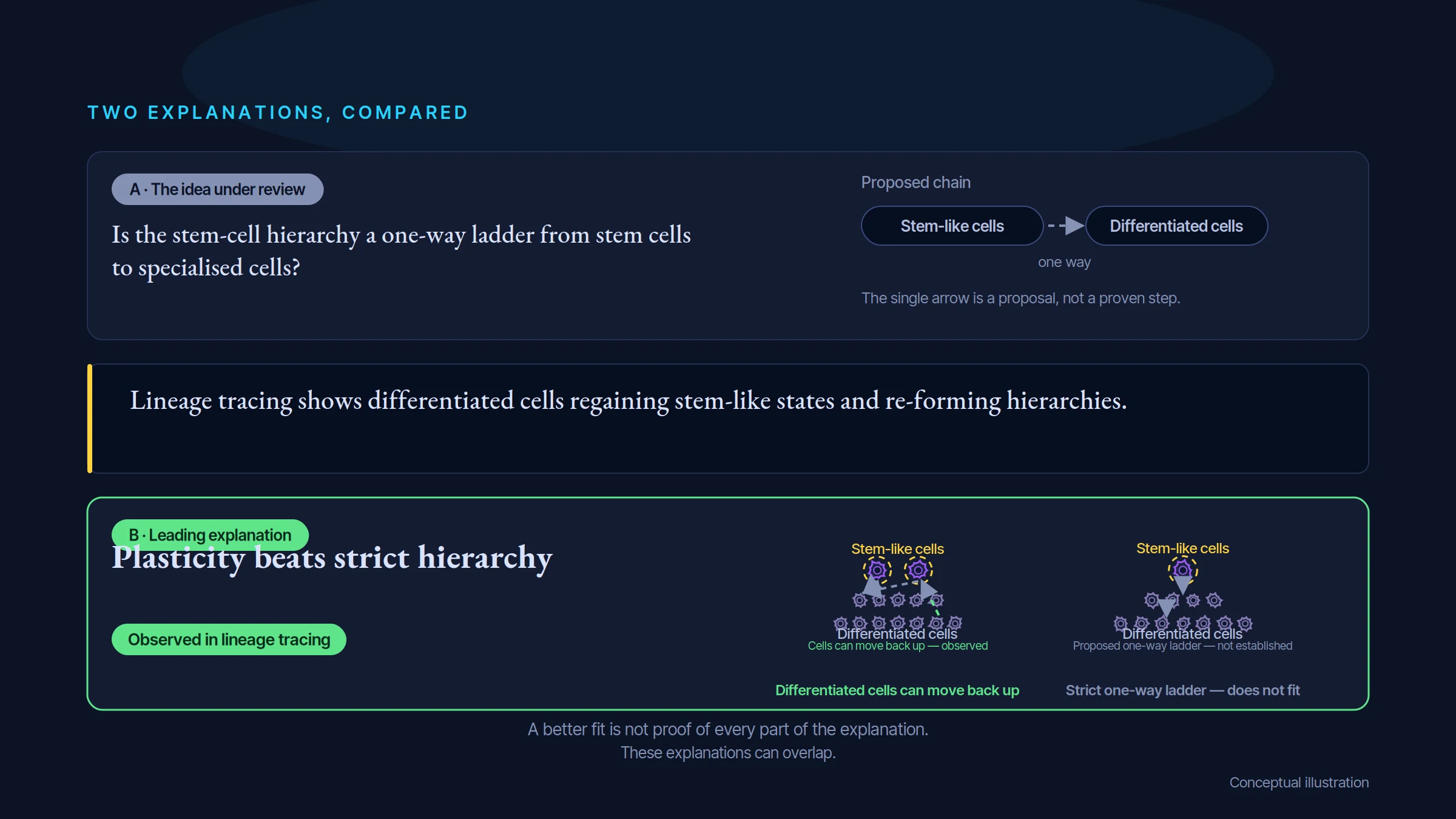
TWO EXPLANATIONS, COMPARED
A · The idea under review
Is the stem-cell hierarchy a one-way ladder from stem cells to specialised cells?
Proposed chain
Stem-like cells
Differentiated cells
one way
The single arrow is a proposal, not a proven step.
Lineage tracing shows differentiated cells regaining stem-like states and re-forming hierarchies.
B · Leading explanation
Plasticity beats strict hierarchy
Observed in lineage tracing
Stem-like cells
Differentiated cells
Cells can move back up — observed in lineage tracing
Differentiated cells can move back up
Stem-like cells
Differentiated cells
Proposed one-way ladder — dashed arrows are not established
Strict one-way ladder — does not fit
A better fit is not proof of every part of the explanation.
These explanations can overlap.
Conceptual illustration
Plausible, not established for the stated claim.
Cells move into or out of tumour-regrowing states depending on genes, surroundings and treatment.
These explanations can overlap. Ranking their fit to the evidence is separate from deciding how firmly a cause has been established.
Rank 1: Context-dependent hybrid hierarchy/plasticity — Functional hierarchies coexist with changing membership and genetic/niche constraints.
Rank 2: Reversible state plasticity — Tumour cells can enter or leave self-renewing/therapy-resistant states.
Rank 3: Microenvironment-dependent stemness — Location and stromal or metabolic signals determine functional stemness.
Rank 4: Clonal evolution — Genetic subclones selected by therapy generate propagation and resistance.
Rank 5: Fixed CSC hierarchy — A discrete self-renewing apex has stable membership and is irreplaceable across human cancers.
Evidence rating: Γ · Moderate confidence. How the evidence was assessed.
Cells move into or out of tumour-regrowing states depending on genes, surroundings and treatment.
This is an assessment of a causal explanation, not proof that a particular supplement, diet, test, or treatment improves health. A treatment claim needs studies that test the intervention in people and measure meaningful benefits and harms. These findings can help frame research and informed clinical questions, but they do not identify what is right for one person.
Look for the proposed factor and the outcome, in the people or systems covered by the claim.
Flexible cell roles within a tumour. Cells move into or out of tumour-regrowing states depending on genes, surroundings and treatment.
Track ancestry and changing cell state during treatment and tumour regrowth.
These illustrations show the key questions tested in the review. They are conceptual drawings, not microscope images or experimental results.
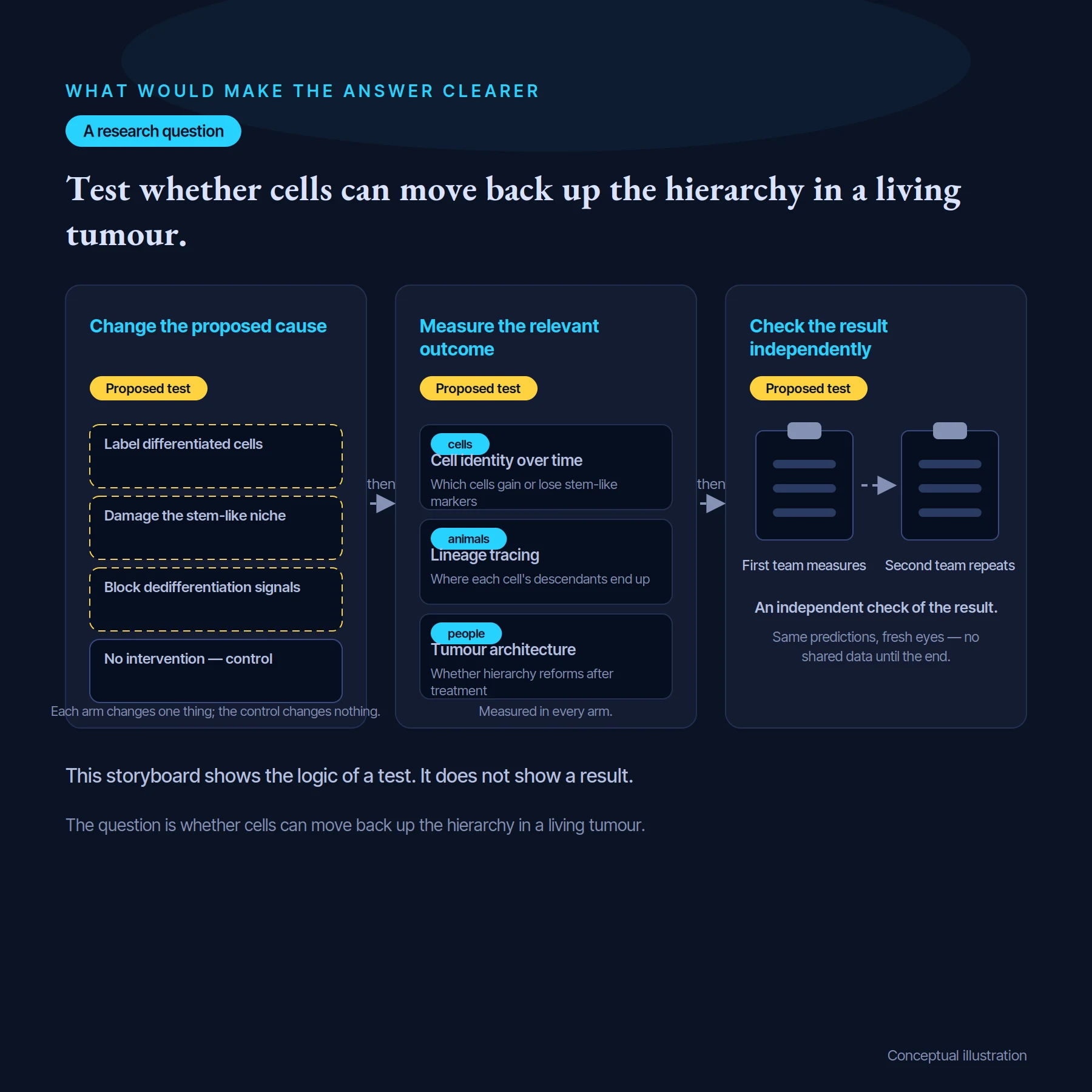
WHAT WOULD MAKE THE ANSWER CLEARER
A research question
Test whether cells can move back up the hierarchy in a living tumour.
then
then
Change the proposed cause
Proposed test
Label differentiated cells
Damage the stem-like niche
Block dedifferentiation signals
No intervention — control
Each arm changes one thing; the control changes nothing.
Measure the relevant outcome
Proposed test
cells
Cell identity over time
Which cells gain or lose stem-like markers
animals
Lineage tracing
Where each cell's descendants end up
people
Tumour architecture
Whether hierarchy reforms after treatment
Measured in every arm.
Check the result independently
Proposed test
First team measures
Second team repeats
An independent check of the result.
Same predictions, fresh eyes — no shared data until the end.
This storyboard shows the logic of a test. It does not show a result.
The question is whether cells can move back up the hierarchy in a living tumour.
Conceptual illustration
Track ancestry and changing cell state during treatment and tumour regrowth.
Check that the intended change really happened.
Allow for other factors and compare with suitable controls.
Look for independent confirmation and the limits of the effect.
These are questions for research, not a claim that the proposed studies have already succeeded.
Proposed tests: 1 test design(s) are registered in the scorecard.
In plain terms, researchers would change the proposed cause, check that it changed as intended, then measure a meaningful outcome while controlling plausible alternatives. The result should be able to support or count against the claim—not only show that a pathway exists.
Study design: In prespecified AML and epithelial tumour cohorts, combine longitudinal clone/state tracking with selective depletion of the putative stable apex, an equally cytotoxic bulk-killing comparator and population-specific rescue; quantify replacement from negative states and durable maintenance/relapse. Use native human serial sampling and independent disease-relevant perturbation platforms rather than relying on one marker or host.
What would be measured: Clone ancestry, bidirectional transition frequencies, target engagement, total burden and durable relapse-free survival with prespecified state-replacement detection limits
Important controls: Marker-independent tracking; lineage-label induction controls; intact niche; normal stem-cell toxicity; orthogonal targeting; sham and matched bulk cytotoxicity; blinded relapse assessment; rescue without changing oncogenic drivers
Result that would support the claim: Irreplaceable fixed-apex depletion abolishes maintenance and recurrence across predefined classes, with selective rescue restoring both and no regeneration from negative cells
Result that would count against it: Negative cells or alternate states sustain disease or regenerate the apex; selective depletion fails despite verified engagement, or benefit tracks generalized killing rather than state dependency
Follow the studies, detailed comparisons and evidence ratings behind this guide.
Open the scientific review →