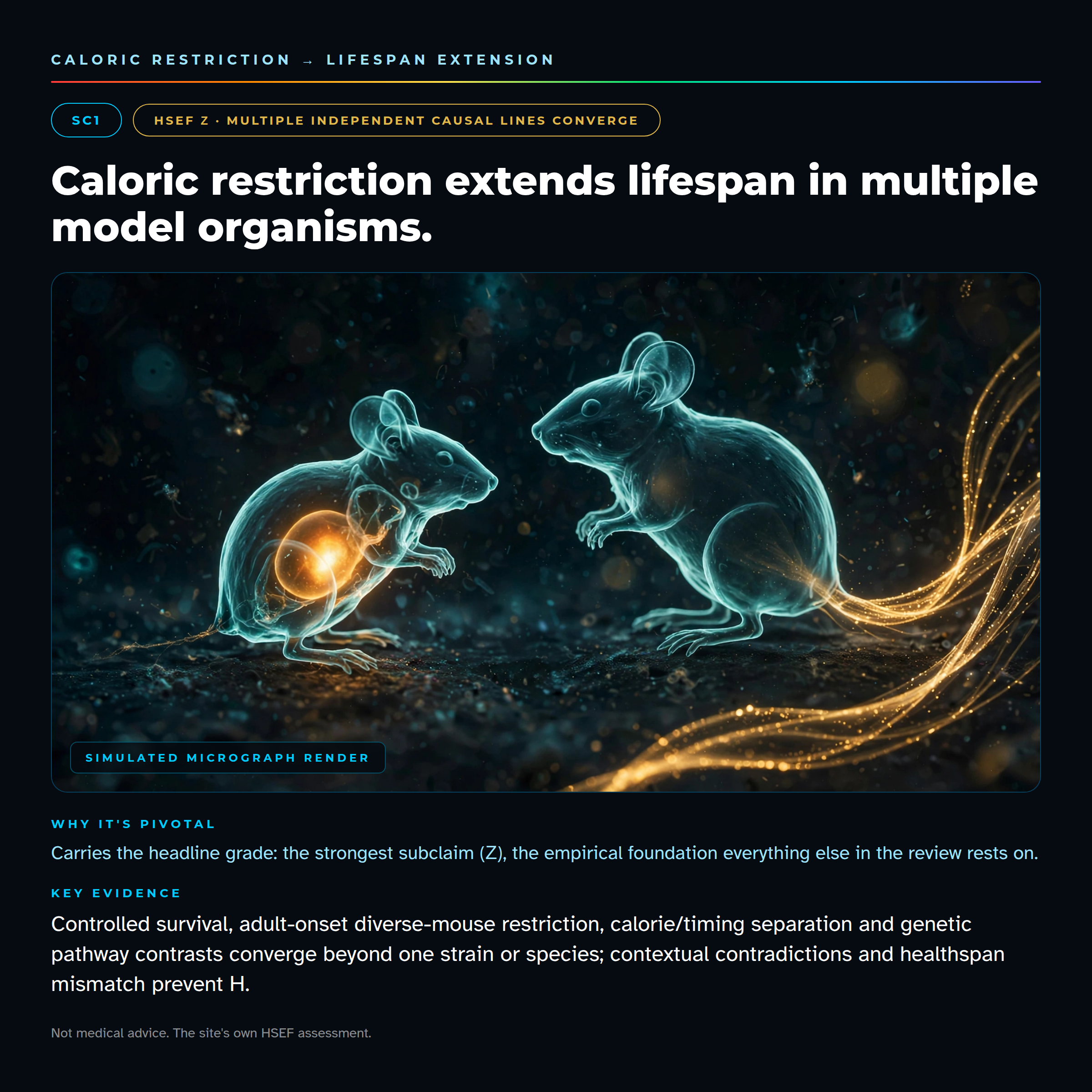
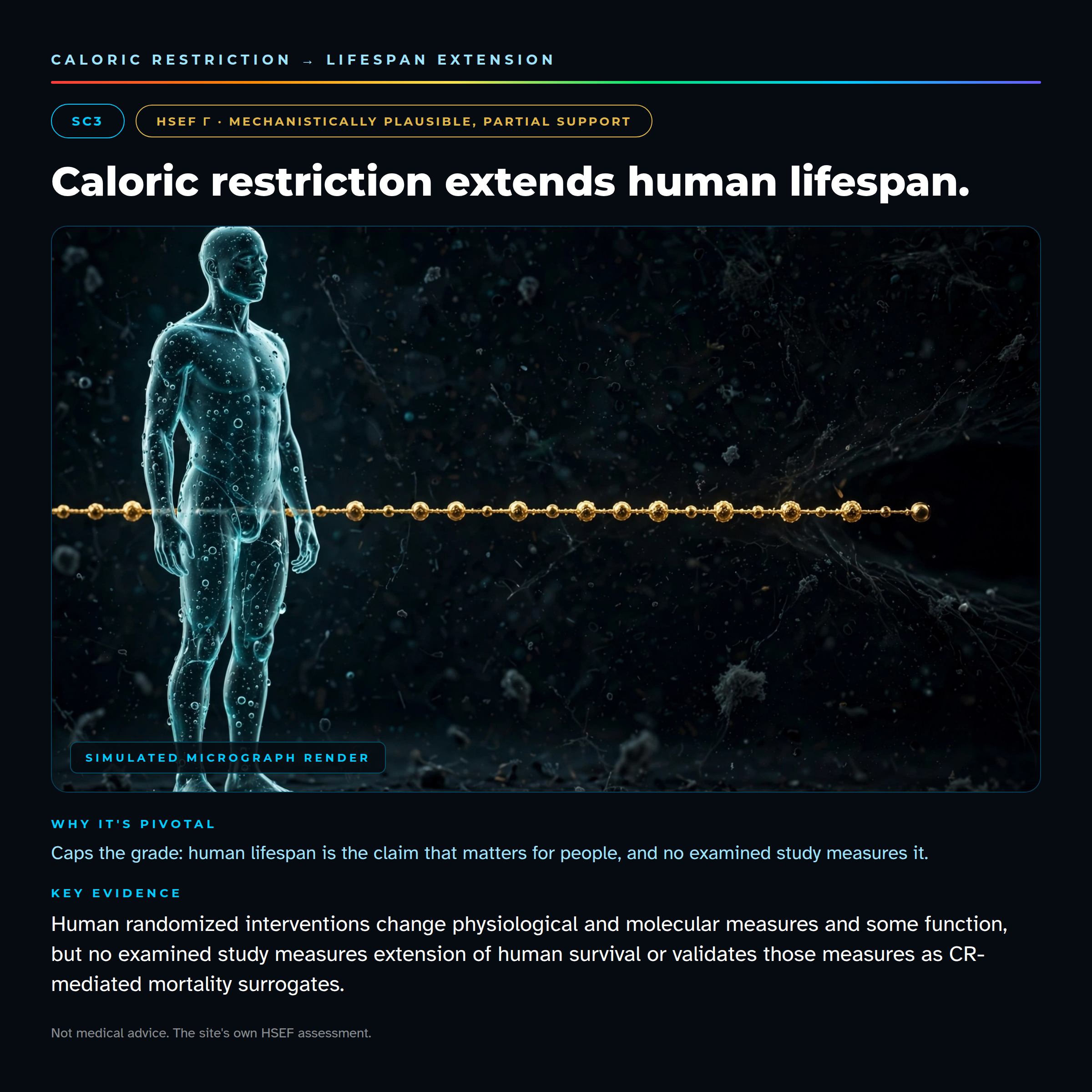
The question
Does eating fewer calories without malnutrition extend life, including in people?
This is the specific idea being tested.
Does eating fewer calories without malnutrition extend life, including in people?
What you need to knowEating less affects several ageing pathways. A longer human lifespan is not established by this review.Relative explanatory fit: Alternative ranked ahead
Why the alternative fits better: Diet changes many processes at once. One controlling pathway cannot explain all the results and trade-offs.
Claim assessed: Sustained caloric restriction without malnutrition causally extends lifespan across model organisms and humans.
Finding: The registered scope-matched human-lifespan gate SC3 returns Γ. SC1 animal survival reaches Ζ and SC4 human function reaches Ε; the candidate unified mechanism SC2 is separately Γ and is not an added necessary clause of the generic exposure claim. All preregistered aggregation sensitivities happen to return Γ.
Evidence scope: 60 primary reports; cutoff 2026-10-04; bounded critical review, not exhaustive systematic review.
The grade applies to the stated claim. Model rankings and individual subclaim grades remain separate from the overall causal-evidence grade.
Full scientific assessment and references · Scorecard (JSON) · Review source (Markdown)
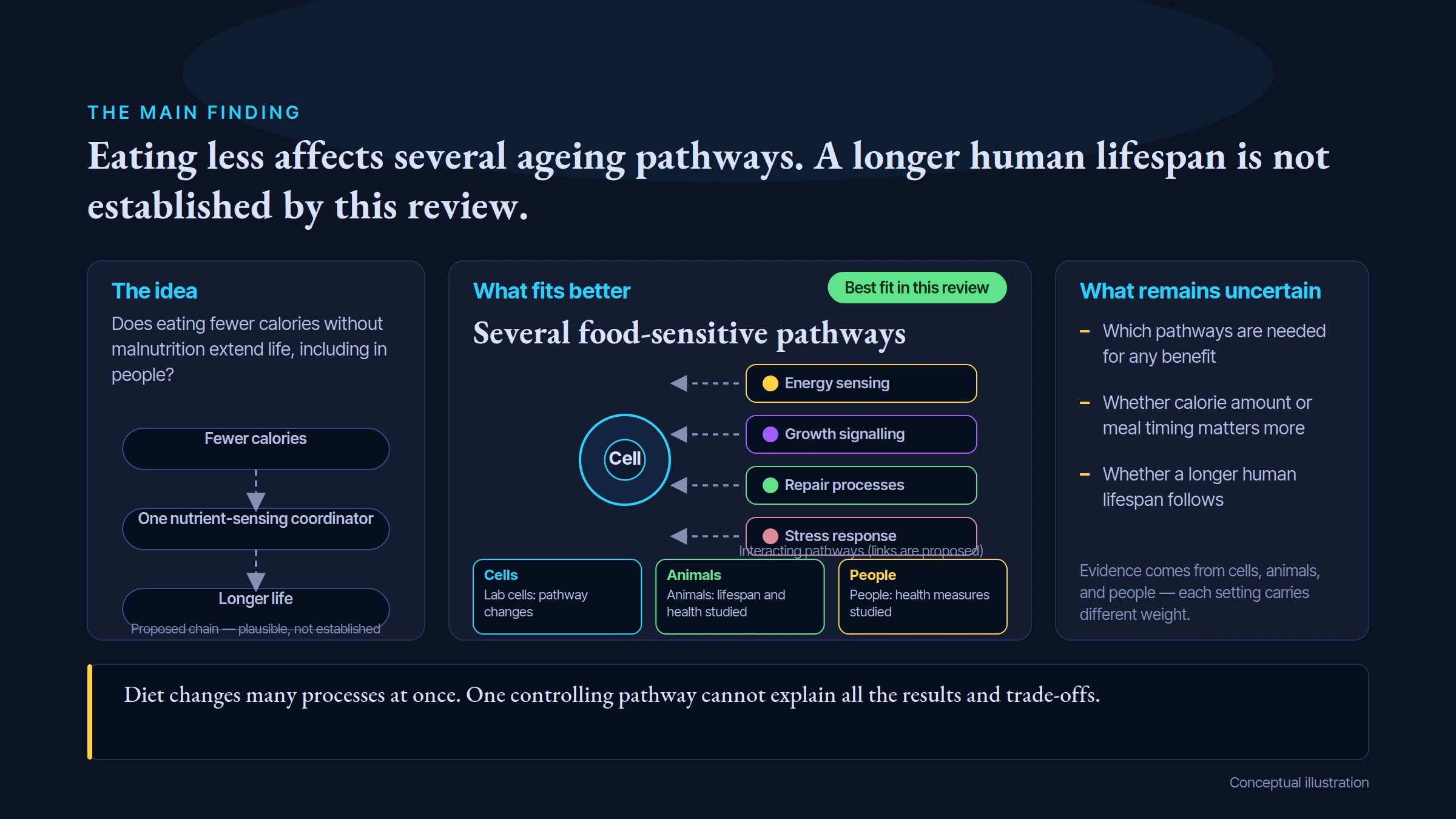
THE MAIN FINDING
Eating less affects several ageing pathways. A longer human lifespan is not established by this review.
The idea
Does eating fewer calories without malnutrition extend life, including in people?
Fewer calories
One nutrient-sensing coordinator
Longer life
Proposed chain — plausible, not established
What fits better
Several food-sensitive pathways
Best fit in this review
Cell
Energy sensing
Growth signalling
Repair processes
Stress response
Interacting pathways (links are proposed)
Cells
Lab cells: pathway changes
Animals
Animals: lifespan and health studied
People
People: health measures studied
What remains uncertain
Which pathways are needed for any benefit
Whether calorie amount or meal timing matters more
Whether a longer human lifespan follows
Evidence comes from cells, animals, and people — each setting carries different weight.
Diet changes many processes at once. One controlling pathway cannot explain all the results and trade-offs.
Conceptual illustration
This is the specific idea being tested.
Diet changes many processes at once. One controlling pathway cannot explain all the results and trade-offs.
A higher rank means a better fit to the evidence in this comparison. It does not prove every part of the leading explanation.
The reviewed hypothesis ranks 5 among 5 models compared; 1 alternative model(s) hold first rank for this stated claim.
Claim under review: rank 5 among 5 compared models.
Leading explanation: Parallel nutrient-sensing and repair pathways.
Position in this comparison: Last recorded rank.
The causal grade asks how well the stated causal claim is established. This comparison asks which of the assessed explanations fits the reviewed findings better. A leading explanation can remain unproven. Models can overlap or include the tested mechanism; an alternative ahead does not make that mechanism irrelevant. These ordinal ranks apply within this review; they do not measure the size of a difference or rank scientific strength across topics.
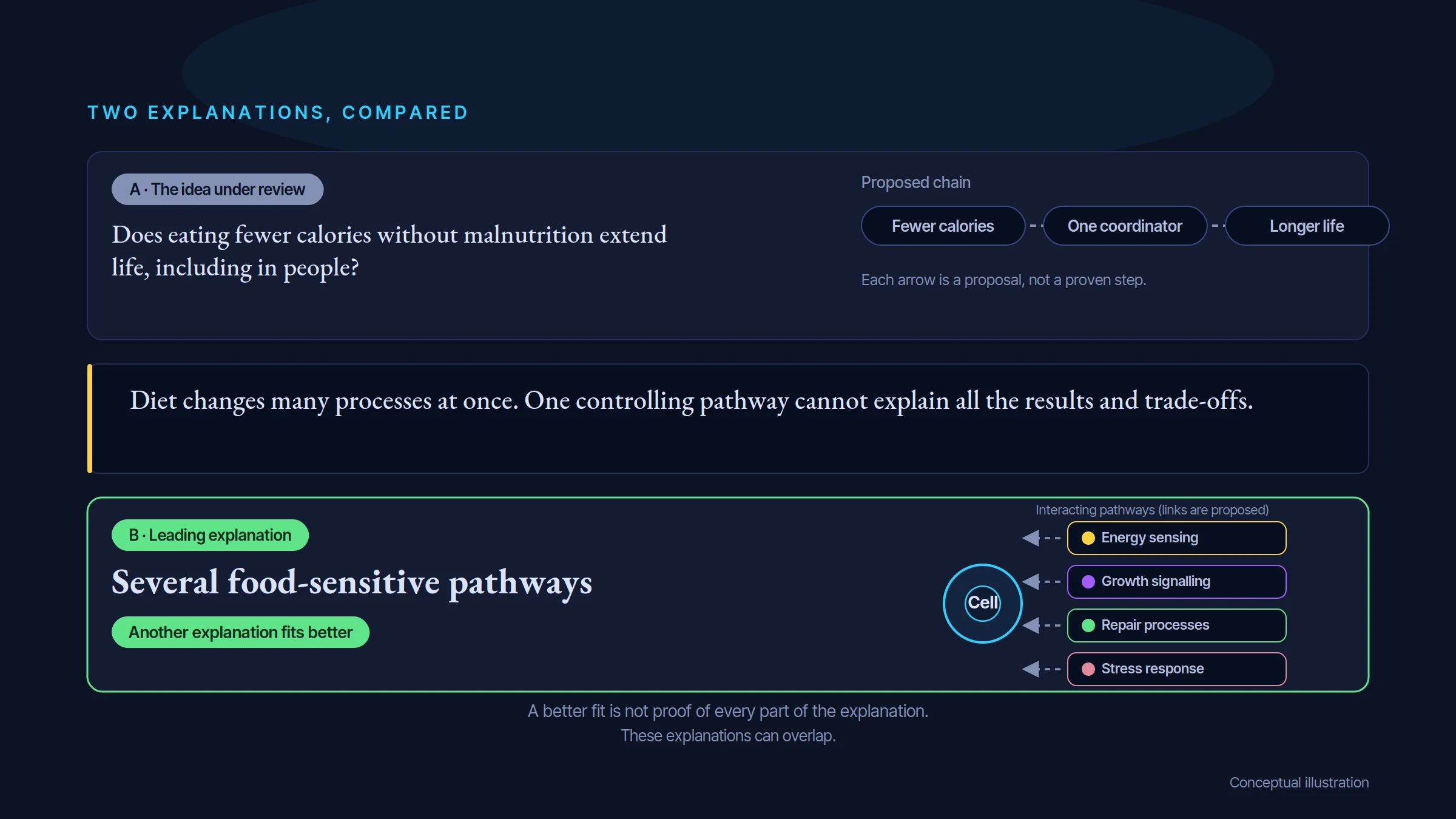
TWO EXPLANATIONS, COMPARED
A · The idea under review
Does eating fewer calories without malnutrition extend life, including in people?
Proposed chain
Fewer calories
One coordinator
Longer life
Each arrow is a proposal, not a proven step.
Diet changes many processes at once. One controlling pathway cannot explain all the results and trade-offs.
B · Leading explanation
Several food-sensitive pathways
Another explanation fits better
Cell
Energy sensing
Growth signalling
Repair processes
Stress response
Interacting pathways (links are proposed)
A better fit is not proof of every part of the explanation.
These explanations can overlap.
Conceptual illustration
Plausible, not established for the stated claim.
Diet changes many processes at once. One controlling pathway cannot explain all the results and trade-offs.
These explanations can overlap. Ranking their fit to the evidence is separate from deciding how firmly a cause has been established.
Rank 1: Parallel nutrient-sensing and repair pathways — Diet alters several partially overlapping pathways and physiological tradeoffs.
Rank 2: Meal timing/fasting and dietary composition — Feeding phase and fasting explain additional effects beyond calorie amount.
Rank 3: Specific nutrient restriction — Individual nutrient balance can change longevity independent of generic calorie dose.
Rank 4: Hormetic stress response — Moderate stress responses support protection under selected protocols.
Rank 5: One unified nutrient-sensing coordinator — A single conserved node explains all CR lifespan effects.
Evidence rating: Γ · Moderate confidence. How the evidence was assessed.
Diet changes many processes at once. One controlling pathway cannot explain all the results and trade-offs.
This is an assessment of a causal explanation, not proof that a particular supplement, diet, test, or treatment improves health. A treatment claim needs studies that test the intervention in people and measure meaningful benefits and harms. These findings can help frame research and informed clinical questions, but they do not identify what is right for one person.
Look for the proposed factor and the outcome, in the people or systems covered by the claim.
Several food-sensitive pathways. Diet changes many processes at once. One controlling pathway cannot explain all the results and trade-offs.
Separate calorie amount from meal timing, testing which pathways are needed for benefit.
These illustrations show the key questions tested in the review. They are conceptual drawings, not microscope images or experimental results.
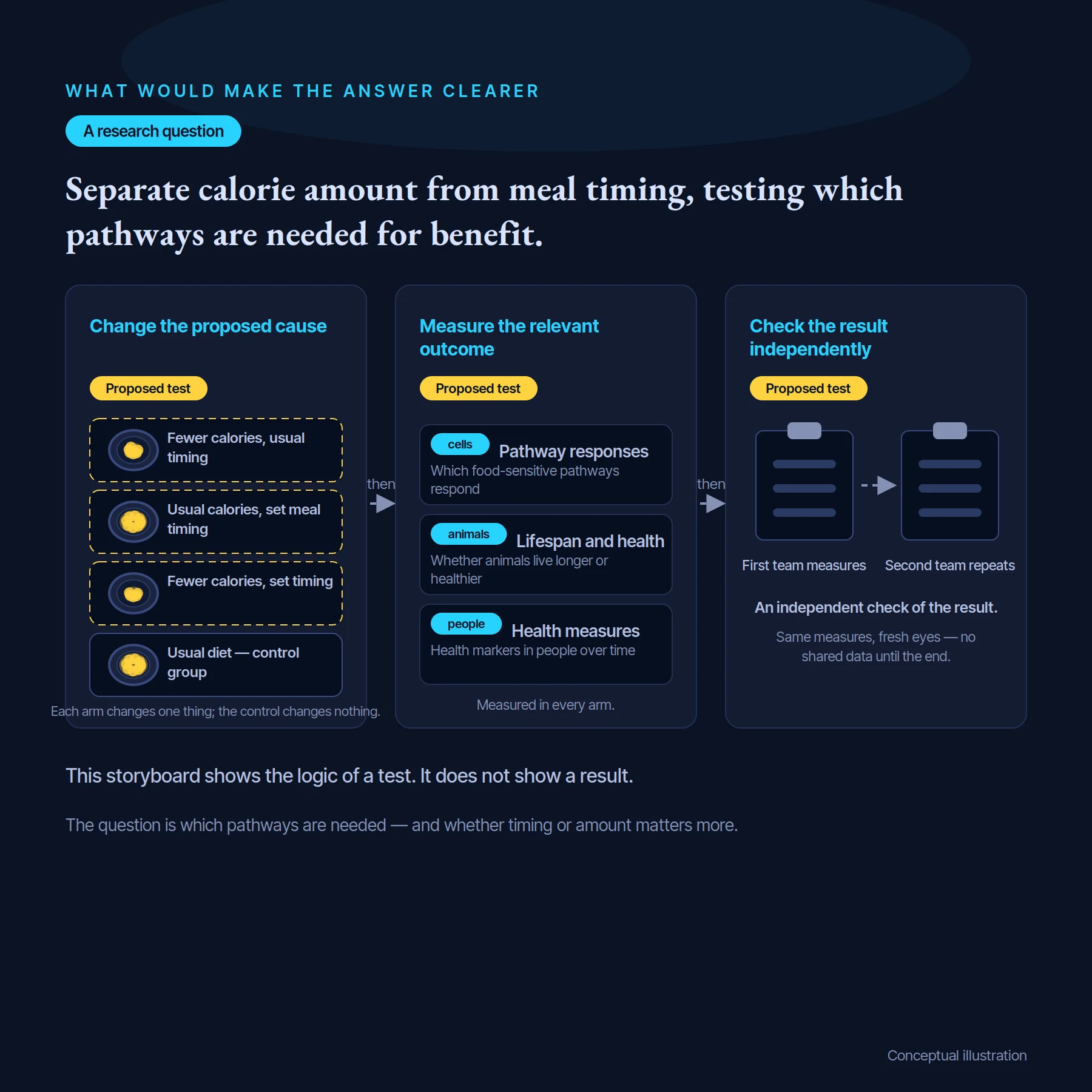
WHAT WOULD MAKE THE ANSWER CLEARER
A research question
Separate calorie amount from meal timing, testing which pathways are needed for benefit.
then
then
Change the proposed cause
Proposed test
Fewer calories, usual timing
Usual calories, set meal timing
Fewer calories, set timing
Usual diet — control group
Each arm changes one thing; the control changes nothing.
Measure the relevant outcome
Proposed test
cells
Pathway responses
Which food-sensitive pathways respond
animals
Lifespan and health
Whether animals live longer or healthier
people
Health measures
Health markers in people over time
Measured in every arm.
Check the result independently
Proposed test
First team measures
Second team repeats
An independent check of the result.
Same measures, fresh eyes — no shared data until the end.
This storyboard shows the logic of a test. It does not show a result.
The question is which pathways are needed — and whether timing or amount matters more.
Conceptual illustration
Separate calorie amount from meal timing, testing which pathways are needed for benefit.
Check that the intended change really happened.
Allow for other factors and compare with suitable controls.
Look for independent confirmation and the limits of the effect.
These are questions for research, not a claim that the proposed studies have already succeeded.
Proposed tests: 1 test design(s) are registered in the scorecard.
In plain terms, researchers would change the proposed cause, check that it changed as intended, then measure a meaningful outcome while controlling plausible alternatives. The result should be able to support or count against the claim—not only show that a pathway exists.
Study design: Follow a predeclared human restriction contrast long enough for adjudicated incident disease, disability and mortality, with measured intake, nutrient adequacy, adherence and competing harms. In parallel, validate whether intervention-induced changes in candidate aging measures mediate those outcomes across independent exposure contrasts; lifelong natural experiments or defensible exposure instruments can complement randomized follow-up.
What would be measured: Adjudicated survival, multimorbidity, disability, physical function and fractures, with candidate surrogate mediation
Important controls: Baseline age/BMI/sex and nutrient adequacy; distinguish feeding timing and composition; account for adherence without selecting post-outcome responders
Result that would support the claim: Reproducible favorable human clinical aging trajectories attributable to restriction, with independently validated mediator or exposure specificity
Result that would count against it: Adequate sustained exposure without clinical benefit, harms offsetting benefit, or marker changes failing to mediate hard outcomes
Follow the studies, detailed comparisons and evidence ratings behind this guide.
Open the scientific review →