The question
Must a DNA control region keep touching a gene's starting region while that gene is being read?
This is the specific idea being tested.
Do a gene's control regions have to keep touching?
Must a DNA control region keep touching a gene's starting region while that gene is being read?
What you need to knowGenes can be active without a continuously detectable DNA contact; brief contacts and effects at particular genes remain possible.Relative explanatory fit: Alternative ranked ahead
Why the alternative fits better: Artificially bringing DNA regions together can activate particular genes. Measurements inside cells challenge the idea that contact must continue throughout gene activity, although very brief or small contacts can escape detection.
Why this matters: Forced DNA looping has increased fetal haemoglobin in sickle-cell laboratory models. That is a useful example at a particular gene, not proof that all genes need a lasting loop or that this research has established a treatment for patients.
Claim assessed: Physical enhancer-promoter looping is required to initiate and maintain transcriptional bursting rather than being a correlate of activity.
Finding: The registered primary SC3 necessity gate is Β: partial mechanistic plausibility is capped at Γ, then one endogenous-prediction falsification pattern lowers it one rung. Native Sox2 simultaneous imaging and orthogonal neural Shh/estrogen distance findings oppose the universal sustained-contact prediction within detection limits. This is neither proof that brief contacts never occur nor a denial of causal enhancer function. Exact index additionally restricts synthetic SC2 sufficiency to Γ; broad SC4 graded frequency remains Γ because its strongest controlled tests use synthetic tethers/landscapes and snapshot or inferred kinetics.
Evidence scope: 57 primary reports; literature cutoff 2026-10-09; source examination UTC date 2026-10-12; bounded critical review, not exhaustive systematic review.
The grade applies to the stated claim. Model rankings and individual subclaim grades remain separate from the overall causal-evidence grade.
Full scientific assessment and references · Scorecard (JSON) · Review source (Markdown)
HYPOTHESIS CRITIC  /  REVIEW EXPLAINER
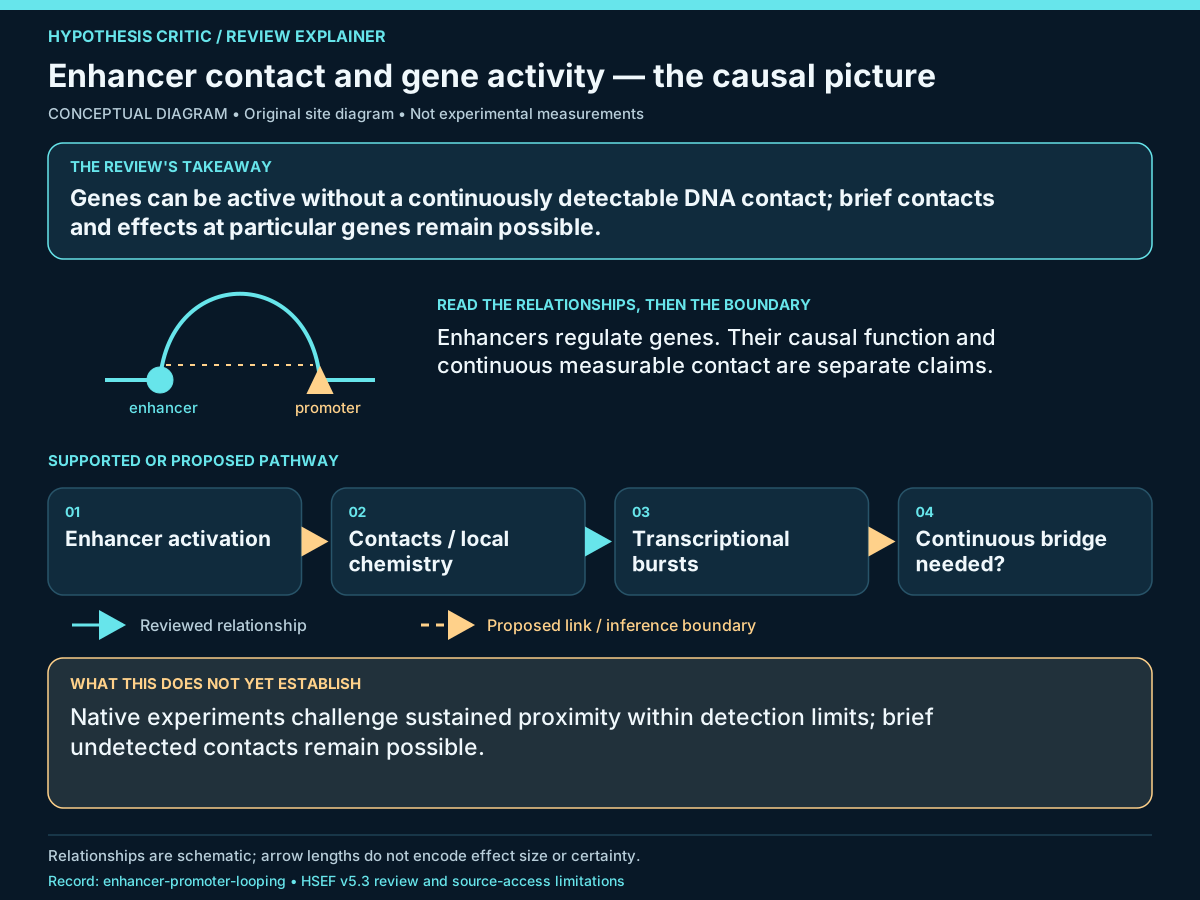
Enhancer contact and gene activity — the causal picture
CONCEPTUAL DIAGRAM  •  Original site diagram  •  Not experimental measurements
THE REVIEW'S TAKEAWAY
Genes can be active without a continuously detectable DNA contact; brief contacts and effects at particular genes remain possible.
enhancer
promoter
READ THE RELATIONSHIPS, THEN THE BOUNDARY
Enhancers regulate genes. Their causal function and continuous measurable contact are separate claims.
SUPPORTED OR PROPOSED PATHWAY
01
Enhancer activation
02
Contacts / local chemistry
03
Transcriptional bursts
04
Continuous bridge needed?
Reviewed relationship
Proposed link / inference boundary
WHAT THIS DOES NOT YET ESTABLISH
Native experiments challenge sustained proximity within detection limits; brief undetected contacts remain possible.
Relationships are schematic; arrow lengths do not encode effect size or certainty.
Record: enhancer-promoter-looping  •  HSEF v5.3 review and source-access limitations
This is the specific idea being tested.
Artificially bringing DNA regions together can activate particular genes. Measurements inside cells challenge the idea that contact must continue throughout gene activity, although very brief or small contacts can escape detection.
A higher rank means a better fit to the evidence in this comparison. It does not prove every part of the leading explanation.
The reviewed hypothesis ranks 5 among 5 models compared; 1 alternative model(s) hold first rank for this stated claim.
Claim under review: rank 5 among 5 compared models.
Leading explanation: Topological corral and context-specific architecture.
Position in this comparison: Last recorded rank.
The causal grade asks how well the stated causal claim is established. This comparison asks which of the assessed explanations fits the reviewed findings better. A leading explanation can remain unproven. Models can overlap or include the tested mechanism; an alternative ahead does not make that mechanism irrelevant. These ordinal ranks apply within this review; they do not measure the size of a difference or rank scientific strength across topics.
HYPOTHESIS CRITIC  /  REVIEW EXPLAINER
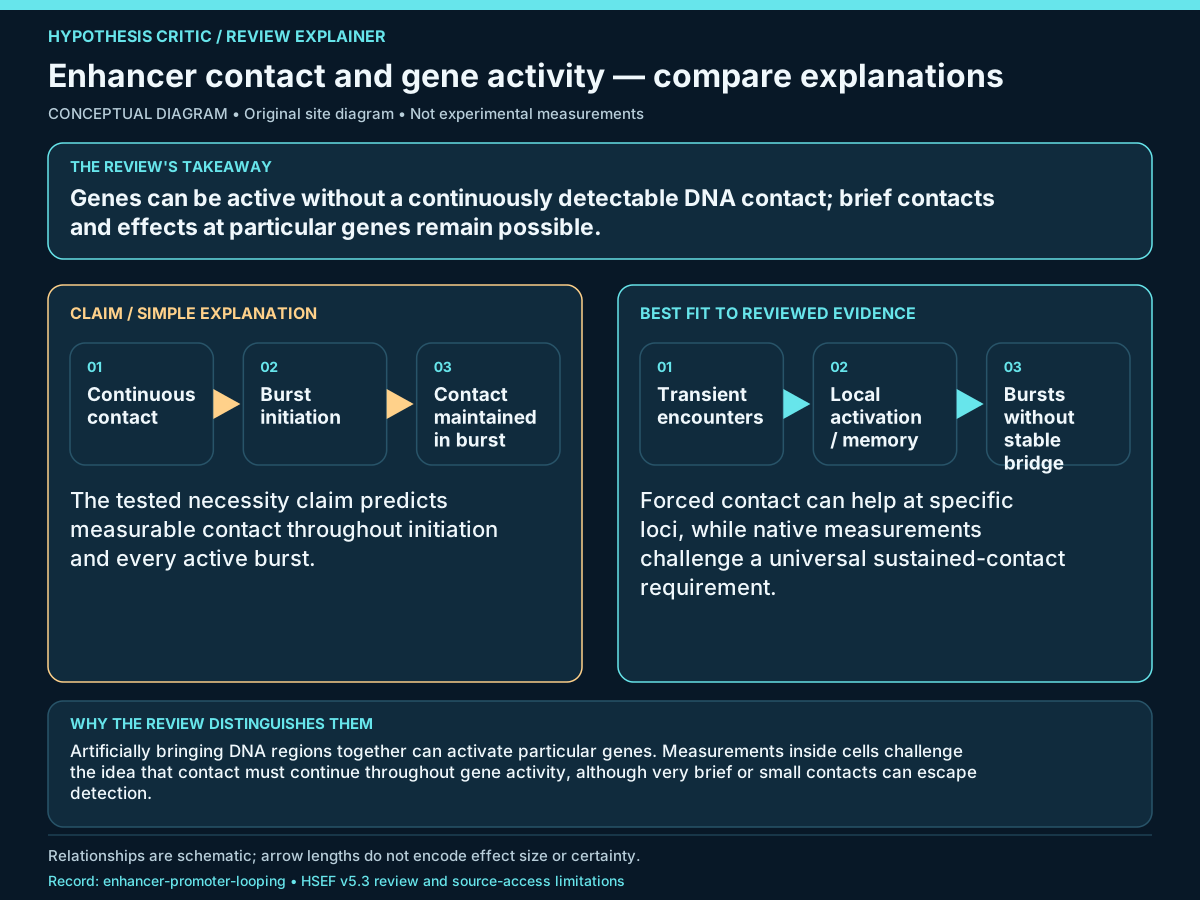
Enhancer contact and gene activity — compare explanations
CONCEPTUAL DIAGRAM  •  Original site diagram  •  Not experimental measurements
THE REVIEW'S TAKEAWAY
Genes can be active without a continuously detectable DNA contact; brief contacts and effects at particular genes remain possible.
CLAIM / SIMPLE EXPLANATION
01
Continuous contact
02
Burst initiation
03
Contact maintained in burst
The tested necessity claim predicts measurable contact throughout initiation and every active burst.
BEST FIT TO REVIEWED EVIDENCE
01
Transient encounters
02
Local activation / memory
03
Bursts without stable bridge
Forced contact can help at specific loci, while native measurements challenge a universal sustained-contact requirement.
WHY THE REVIEW DISTINGUISHES THEM
Artificially bringing DNA regions together can activate particular genes. Measurements inside cells challenge the idea that contact must continue throughout gene activity, although very brief or small contacts can escape detection.
Relationships are schematic; arrow lengths do not encode effect size or certainty.
Record: enhancer-promoter-looping  •  HSEF v5.3 review and source-access limitations
Association only for the stated claim.
Artificially bringing DNA regions together can activate particular genes. Measurements inside cells challenge the idea that contact must continue throughout gene activity, although very brief or small contacts can escape detection.
These explanations can overlap. Ranking their fit to the evidence is separate from deciding how firmly a cause has been established.
Rank 1: Topological corral and context-specific architecture — Architecture and local environments reinforce selected long-range regulation without a persistent contact switch.
Rank 2: Cohesin biochemical coupling and pause regulation — Cohesin changes regulatory-factor delivery, recruitment and pausing beyond average DNA proximity.
Rank 3: Contact-probability modulation — Encounters affect entry into active promoter states with transcriptional memory after contact ends.
Rank 4: Transcription-factor activity gradient — Mobile regulatory factors mediate nearby enhancer-promoter influence without sustained DNA contact.
Rank 5: Continuous physical contact necessary — Uninterrupted enhancer-promoter contact is required during burst initiation and maintenance.
Evidence rating: Β · Moderate confidence. How the evidence was assessed.
Artificially bringing DNA regions together can activate particular genes. Measurements inside cells challenge the idea that contact must continue throughout gene activity, although very brief or small contacts can escape detection.
Forced DNA looping has increased fetal haemoglobin in sickle-cell laboratory models. That is a useful example at a particular gene, not proof that all genes need a lasting loop or that this research has established a treatment for patients.
Further reading: Primary study: forced looping in sickle cells.
Enhancer: A DNA region that can help increase a gene's activity.
Promoter: The DNA region where the machinery that reads a gene starts.
Looping: Bringing DNA regions closer together as the chromosome folds.
Gene-activity burst: A period in which a gene produces RNA, separated from quieter periods.
Look for the proposed factor and the outcome, in the people or systems covered by the claim.
Brief encounters and local chemical signals can help activate a gene without a lasting physical bridge. Artificially bringing DNA regions together can activate particular genes. Measurements inside cells challenge the idea that contact must continue throughout gene activity, although very brief or small contacts can escape detection.
Track DNA contact and gene activity together, then selectively release the contact without changing the control region's other functions.
HYPOTHESIS CRITIC  /  REVIEW EXPLAINER
Enhancer contact and gene activity — evidence and next test
CONCEPTUAL DIAGRAM  •  Original site diagram  •  Not experimental measurements
THE REVIEW'S TAKEAWAY
Genes can be active without a continuously detectable DNA contact; brief contacts and effects at particular genes remain possible.
DIFFERENT EVIDENCE ANSWERS DIFFERENT QUESTIONS
Forced looping
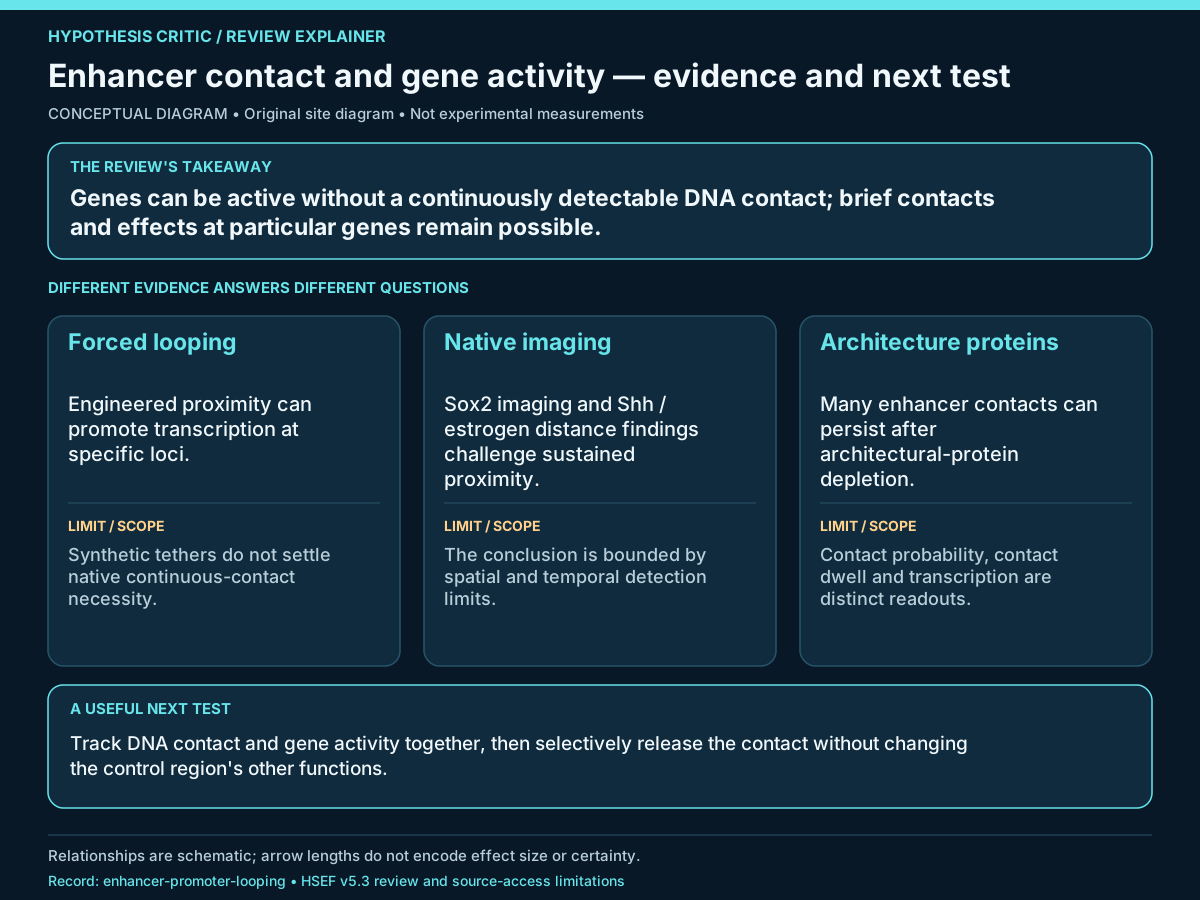
Engineered proximity can promote transcription at specific loci.
LIMIT / SCOPE
Synthetic tethers do not settle native continuous-contact necessity.
Native imaging
Sox2 imaging and Shh / estrogen distance findings challenge sustained proximity.
LIMIT / SCOPE
The conclusion is bounded by spatial and temporal detection limits.
Architecture proteins
Many enhancer contacts can persist after architectural-protein depletion.
LIMIT / SCOPE
Contact probability, contact dwell and transcription are distinct readouts.
A USEFUL NEXT TEST
Track DNA contact and gene activity together, then selectively release the contact without changing the control region's other functions.
Relationships are schematic; arrow lengths do not encode effect size or certainty.
Record: enhancer-promoter-looping  •  HSEF v5.3 review and source-access limitations
Track DNA contact and gene activity together, then selectively release the contact without changing the control region's other functions.
Check that the intended change really happened.
Allow for other factors and compare with suitable controls.
Look for independent confirmation and the limits of the effect.
These are questions for research, not a claim that the proposed studies have already succeeded.
Proposed tests: 1 test design(s) are registered in the scorecard.
In plain terms, researchers would change the proposed cause, check that it changed as intended, then measure a meaningful outcome while controlling plausible alternatives. The result should be able to support or count against the claim—not only show that a pathway exists.
Study design: At several prespecified native mammalian loci, combine molecular-resolution same-allele contact and nascent initiation tracking with rapidly reversible contact-selective tether release while preserving enhancer activity, local factor occupancy and transcriptional competence.
What would be measured: Contact dwell, initiation time, active burst duration and nascent output after selective release and restoration
Important controls: Orthogonal labels, calibrated label offsets and encounter detection, inactive tether and enhancer-deletion controls, matched factor occupancy and viability
Result that would support the claim: Contact loss immediately prevents initiation and terminates active bursts across prespecified loci, with specific reversible rescue
Result that would count against it: New bursts or maintenance persist after verified contact loss with competent machinery, or only encounter probability rather than sustained dwell controls output
Follow the studies, detailed comparisons and evidence ratings behind this guide.
Open the scientific review →