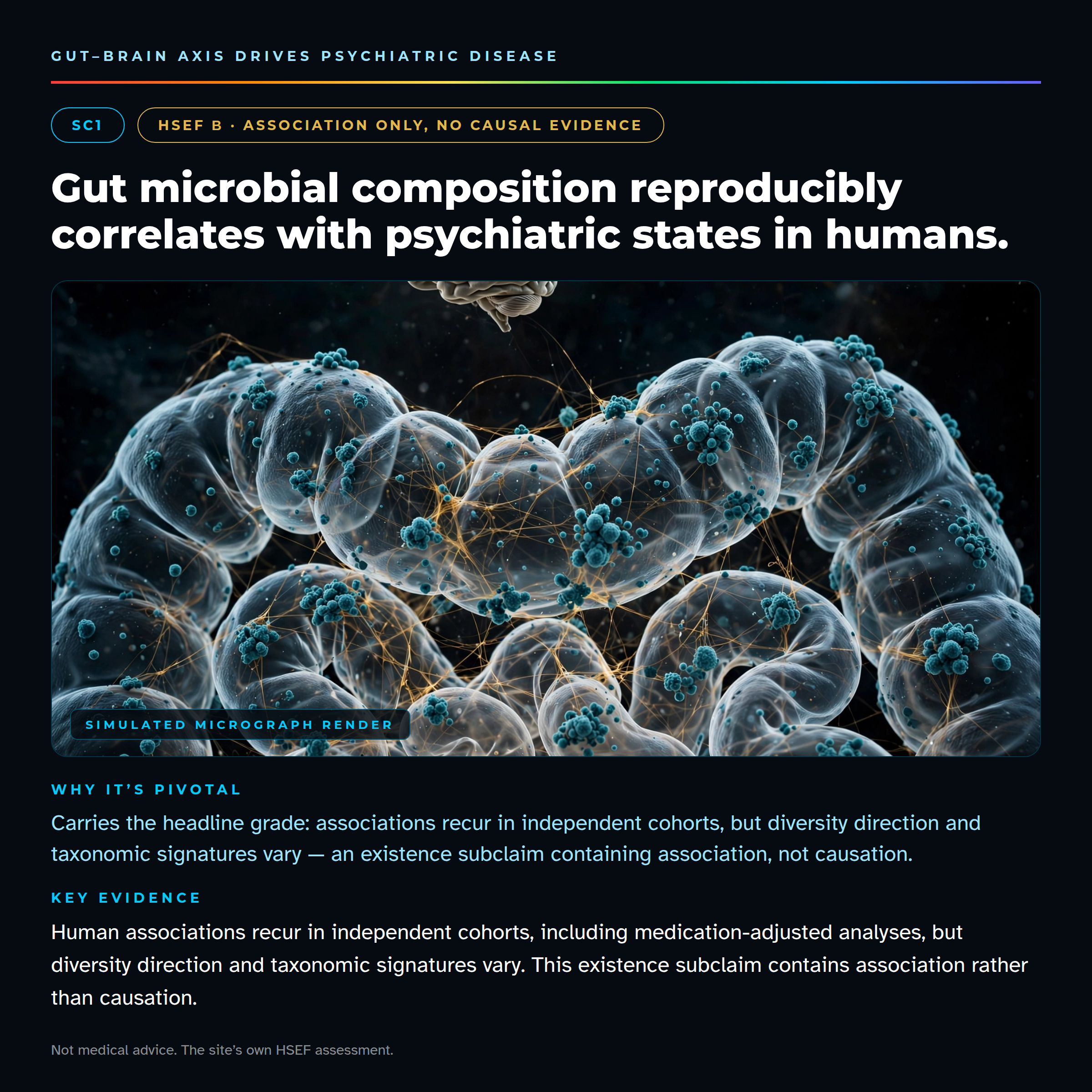
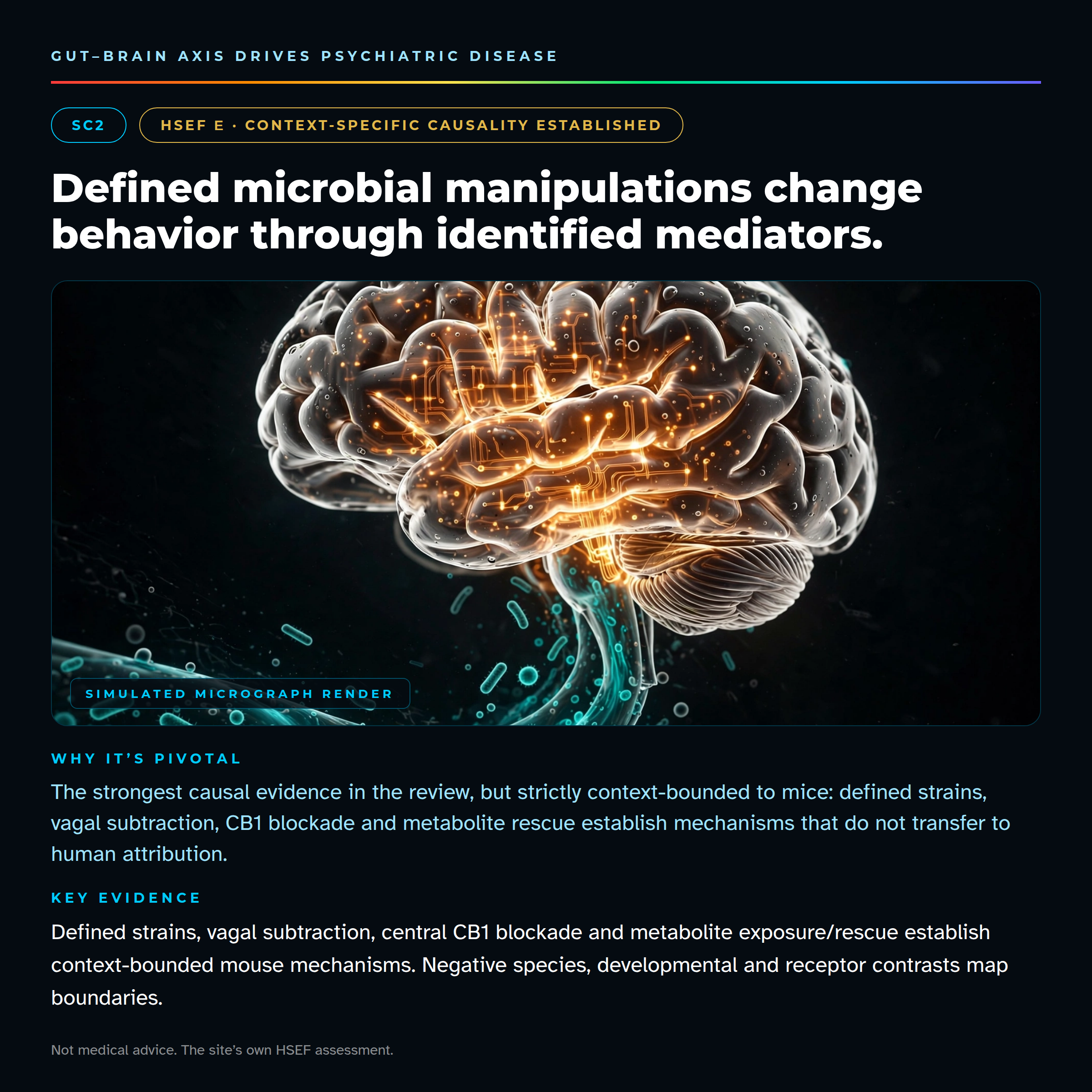
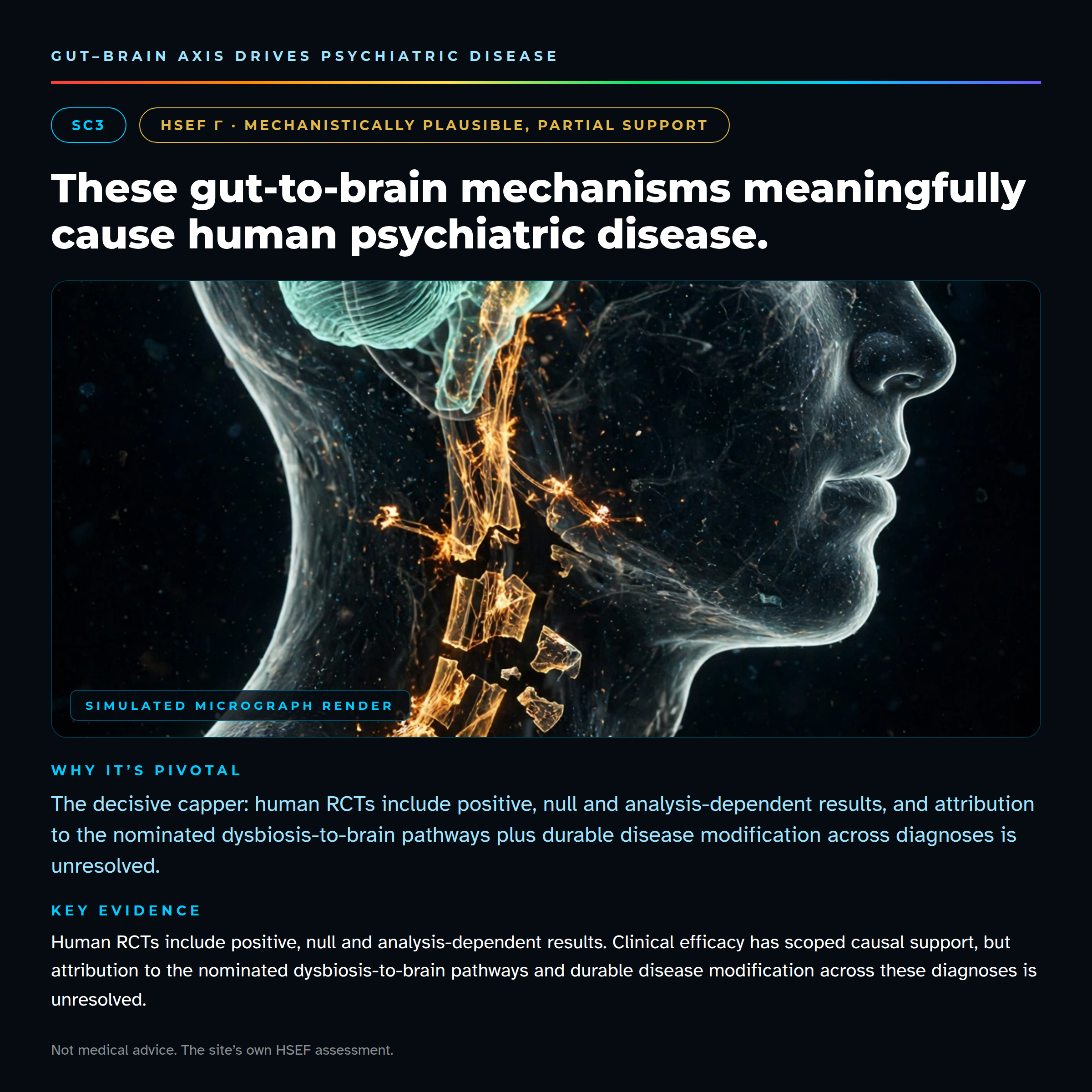
The question
Are disturbed gut microbes an upstream cause of psychiatric disease?
This is the specific idea being tested.
Are disturbed gut microbes an upstream cause of psychiatric disease?
What you need to knowGut microbes may influence some responses, but are not established as a primary cause of psychiatric disease.Relative explanatory fit: Alternative ranked ahead
Why the alternative fits better: Microbial effects depend on stress, diet or development. This fits better than a universal microbial cause.
Claim assessed: Gut microbial dysbiosis is an upstream cause of human psychiatric disease, acting through microbial metabolites, immune and vagal pathways, and correction of dysbiosis is disease-modifying.
Finding: The preregistered weakest-link aggregation returns Β because SC1 is descriptive association. This is a consequence of that conjunction and does not downgrade the demonstrated animal mechanisms to association. Primary-subclaim and scope-matched sensitivities return Γ for SC3. Positive human treatment comparisons warrant causal credit for the tested treatment; they do not alone establish that the specified microbial mechanisms are an upstream general cause. No necessity requirement is imposed on a merely contributory mechanism.
Evidence scope: 62 primary reports; cutoff 2026-10-05; bounded critical review, not exhaustive systematic review.
The grade applies to the stated claim. Model rankings and individual subclaim grades remain separate from the overall causal-evidence grade.
Full scientific assessment and references · Scorecard (JSON) · Review source (Markdown)
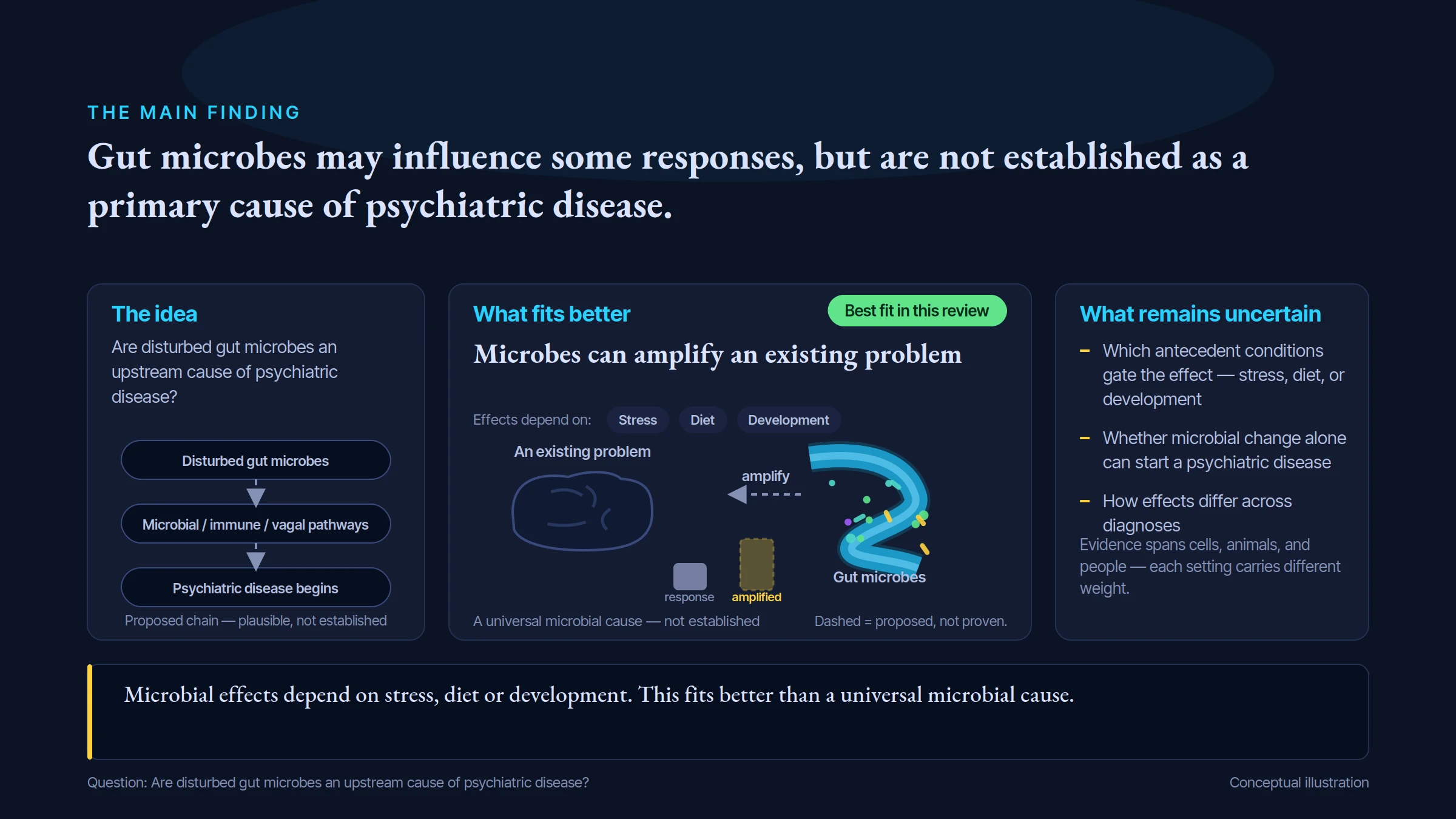
THE MAIN FINDING
Gut microbes may influence some responses, but are not established as a primary cause of psychiatric disease.
The idea
Are disturbed gut microbes an upstream cause of psychiatric disease?
Disturbed gut microbes
Microbial / immune / vagal pathways
Psychiatric disease begins
Proposed chain — plausible, not established
What fits better
Best fit in this review
Microbes can amplify an existing problem
Effects depend on:
Stress
Diet
Development
An existing problem
response
amplified
Gut microbes
amplify
A universal microbial cause — not established
Dashed = proposed, not proven.
What remains uncertain
Which antecedent conditions gate the effect — stress, diet, or development
Whether microbial change alone can start a psychiatric disease
How effects differ across diagnoses
Evidence spans cells, animals, and people — each setting carries different weight.
Microbial effects depend on stress, diet or development. This fits better than a universal microbial cause.
Conceptual illustration
Question: Are disturbed gut microbes an upstream cause of psychiatric disease?
This is the specific idea being tested.
Microbial effects depend on stress, diet or development. This fits better than a universal microbial cause.
A higher rank means a better fit to the evidence in this comparison. It does not prove every part of the leading explanation.
The reviewed hypothesis ranks 5 among 5 models compared; 1 alternative model(s) hold first rank for this stated claim.
Claim under review: rank 5 among 5 compared models.
Leading explanation: Bounded microbial amplification.
Position in this comparison: Last recorded rank.
The causal grade asks how well the stated causal claim is established. This comparison asks which of the assessed explanations fits the reviewed findings better. A leading explanation can remain unproven. Models can overlap or include the tested mechanism; an alternative ahead does not make that mechanism irrelevant. These ordinal ranks apply within this review; they do not measure the size of a difference or rank scientific strength across topics.
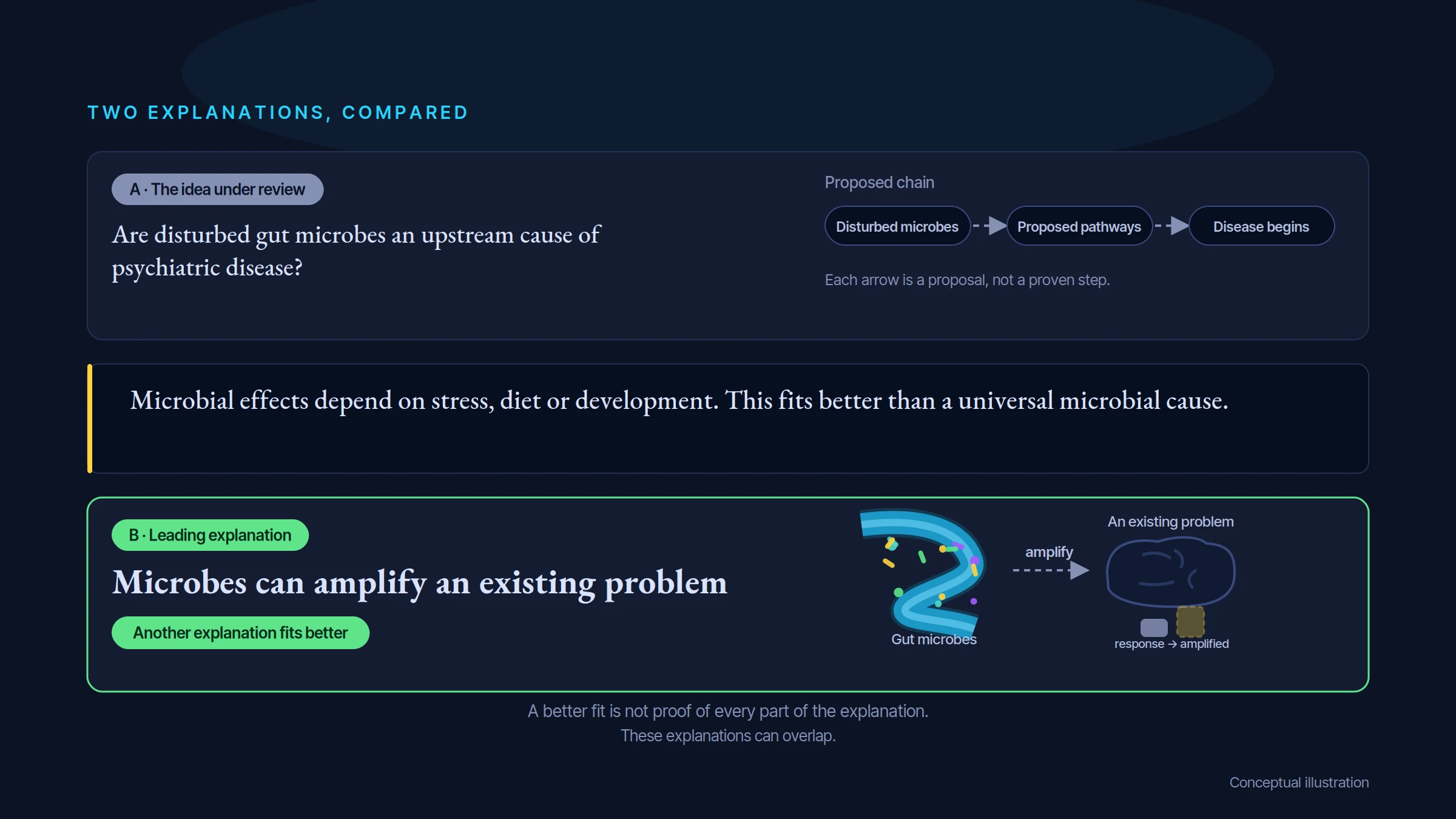
TWO EXPLANATIONS, COMPARED
A · The idea under review
Are disturbed gut microbes an upstream cause of psychiatric disease?
Proposed chain
Disturbed microbes
Proposed pathways
Disease begins
Each arrow is a proposal, not a proven step.
Microbial effects depend on stress, diet or development. This fits better than a universal microbial cause.
B · Leading explanation
Microbes can amplify an existing problem
Another explanation fits better
Gut microbes
amplify
An existing problem
response → amplified
A better fit is not proof of every part of the explanation.
These explanations can overlap.
Conceptual illustration
Association only for the stated claim.
Microbial effects depend on stress, diet or development. This fits better than a universal microbial cause.
These explanations can overlap. Ranking their fit to the evidence is separate from deciding how firmly a cause has been established.
Rank 1: Bounded microbial amplification — Microbial functions influence specific behaviours under defined antecedent stress, diet or developmental conditions.
Rank 2: Stress-to-brain and stress-to-gut feedback — An upstream host state changes microbial ecology, which can feed back on brain function.
Rank 3: Medication-related dysbiosis — Psychotropics directly alter microbial growth and community composition.
Rank 4: Diet, transit and illness-state confounding — Host behaviour and GI physiology create microbial associations with diagnosis.
Rank 5: General upstream microbial psychiatric cause — Dysbiosis initiates psychiatric disease and its correction durably modifies disease.
Evidence rating: Β · Moderate confidence. How the evidence was assessed.
Microbial effects depend on stress, diet or development. This fits better than a universal microbial cause.
This is an assessment of a causal explanation, not proof that a particular supplement, diet, test, or treatment improves health. A treatment claim needs studies that test the intervention in people and measure meaningful benefits and harms. These findings can help frame research and informed clinical questions, but they do not identify what is right for one person.
Look for the proposed factor and the outcome, in the people or systems covered by the claim.
Microbes can amplify an existing problem. Microbial effects depend on stress, diet or development. This fits better than a universal microbial cause.
Test microbial changes separately from stress and diet, measuring meaningful psychiatric outcomes.
These illustrations show the key questions tested in the review. They are conceptual drawings, not microscope images or experimental results.
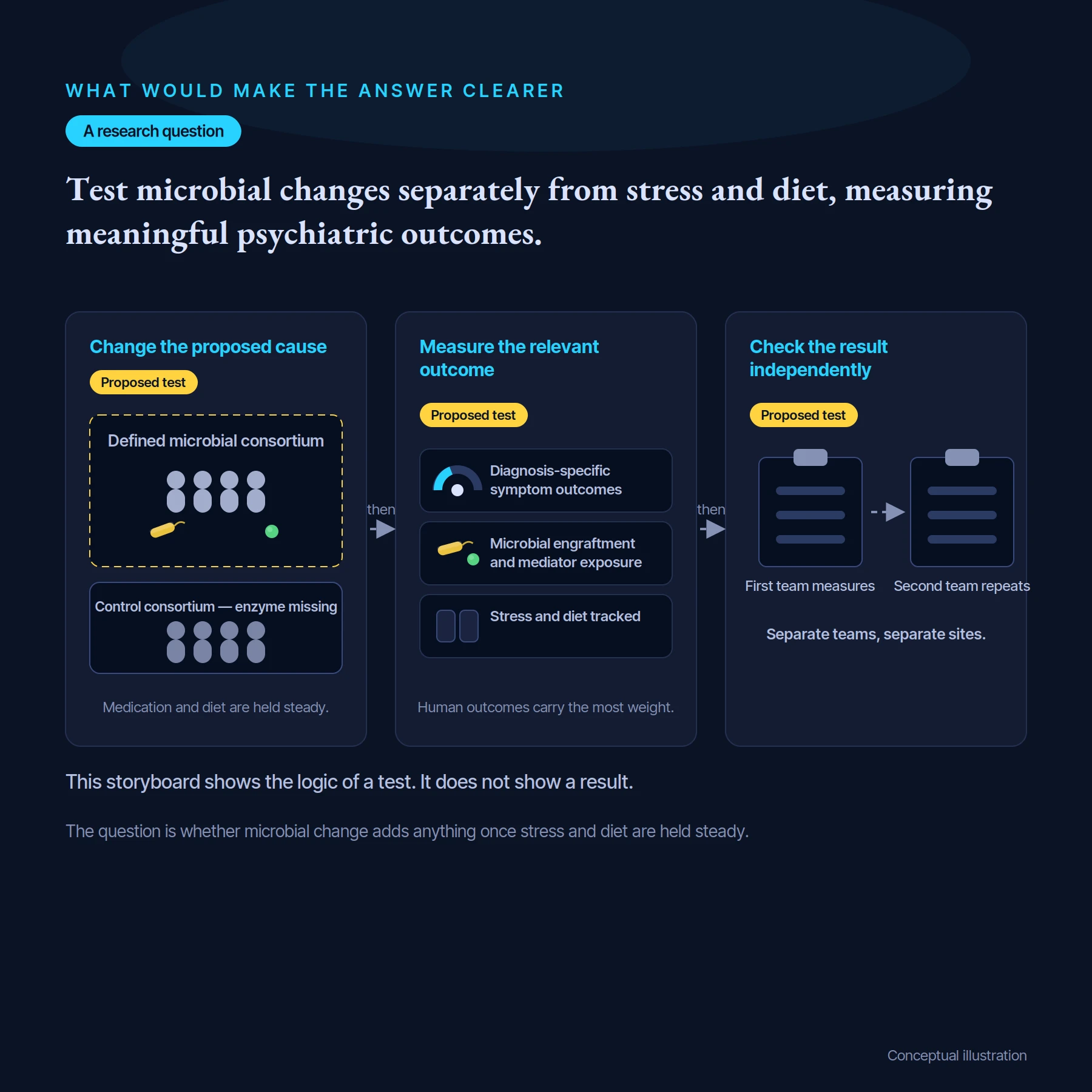
WHAT WOULD MAKE THE ANSWER CLEARER
A research question
Test microbial changes separately from stress and diet, measuring meaningful psychiatric outcomes.
then
then
Change the proposed cause
Proposed test
Defined microbial consortium
Control consortium — enzyme missing
Medication and diet are held steady.
Measure the relevant outcome
Proposed test
Diagnosis-specific symptom outcomes
Microbial engraftment and mediator exposure
Stress and diet tracked
Human outcomes carry the most weight.
Check the result independently
Proposed test
First team measures
Second team repeats
Separate teams, separate sites.
This storyboard shows the logic of a test. It does not show a result.
The question is whether microbial change adds anything once stress and diet are held steady.
Conceptual illustration
Test microbial changes separately from stress and diet, measuring meaningful psychiatric outcomes.
Check that the intended change really happened.
Allow for other factors and compare with suitable controls.
Look for independent confirmation and the limits of the effect.
These are questions for research, not a claim that the proposed studies have already succeeded.
Proposed tests: 1 test design(s) are registered in the scorecard.
In plain terms, researchers would change the proposed cause, check that it changed as intended, then measure a meaningful outcome while controlling plausible alternatives. The result should be able to support or count against the claim—not only show that a pathway exists.
Study design: Randomize prospectively defined MDD or first-episode psychosis participants to a functionally characterized consortium versus an otherwise matched consortium lacking the nominated microbial enzyme, with an add-back arm, stable medication and diet, and independent multisite replication. Register diagnosis-specific primary endpoints, engraftment, mediator exposure, masking, missing-data policy and follow-up before enrollment.
What would be measured: Sustained psychiatric symptoms and functioning plus time-resolved microbial function, serum mediator and CNS-relevant target engagement
Important controls: Matched consortia, off-target and GI symptom controls, credible masking, stable psychotropics, measured diet/transit, randomized mediator function and baseline strata fixed before outcomes
Result that would support the claim: Benefit follows the nominated microbial function, disappears with selective subtraction and returns with add-back, without being explained by GI comfort or altered drug exposure
Result that would count against it: Adequate target engagement leaves the registered psychiatric endpoint unchanged, or equivalent benefit occurs with the function-deleted comparator
Follow the studies, detailed comparisons and evidence ratings behind this guide.
Open the scientific review →