The question
Is too much dopamine in one particular brain pathway the main cause of psychotic symptoms in schizophrenia?
This is the specific idea being tested.

Is too much dopamine in one particular brain pathway the main cause of psychotic symptoms in schizophrenia?
What you need to knowDopamine matters for symptoms, but one dopamine pathway is not established as the main cause across schizophrenia.Relative explanatory fit: Alternative ranked ahead
Why the alternative fits better: Brain imaging often finds its stronger signal in a different part of the striatum than the classic pathway claim predicts. A medicine's benefit shows that a signal can affect symptoms; it does not by itself prove that signal is the original cause in every patient.
For health decisions: Treatments can relieve psychotic symptoms even while the illness's original causes remain uncertain; a treatment response does not prove one universal dopamine cause.
Claim assessed: Excess dopamine transmission at D2 receptors in mesolimbic pathways is the primary cause of psychotic symptoms in schizophrenia.
Finding: Overall Γ follows registered SC3, with association SC1 at Β and a conservative Γ for the strictly audited SC2 mechanism gate. The nominal claim fixes mesolimbic anatomy and unselected primacy, whereas strong human findings often concern associative striatum or symptom-responsive contexts. Clinical symptom modulation remains supported; the unresolved exact causal-primacy claim cannot be rescued by changing the anatomical label or retrospectively selecting responders.
Evidence scope: 50 primary reports; literature cutoff 2026-10-09; source examination UTC date 2026-10-12; bounded critical review, not exhaustive systematic review.
The grade applies to the stated claim. Model rankings and individual subclaim grades remain separate from the overall causal-evidence grade.
Full scientific assessment and references · Scorecard (JSON) · Review source (Markdown)
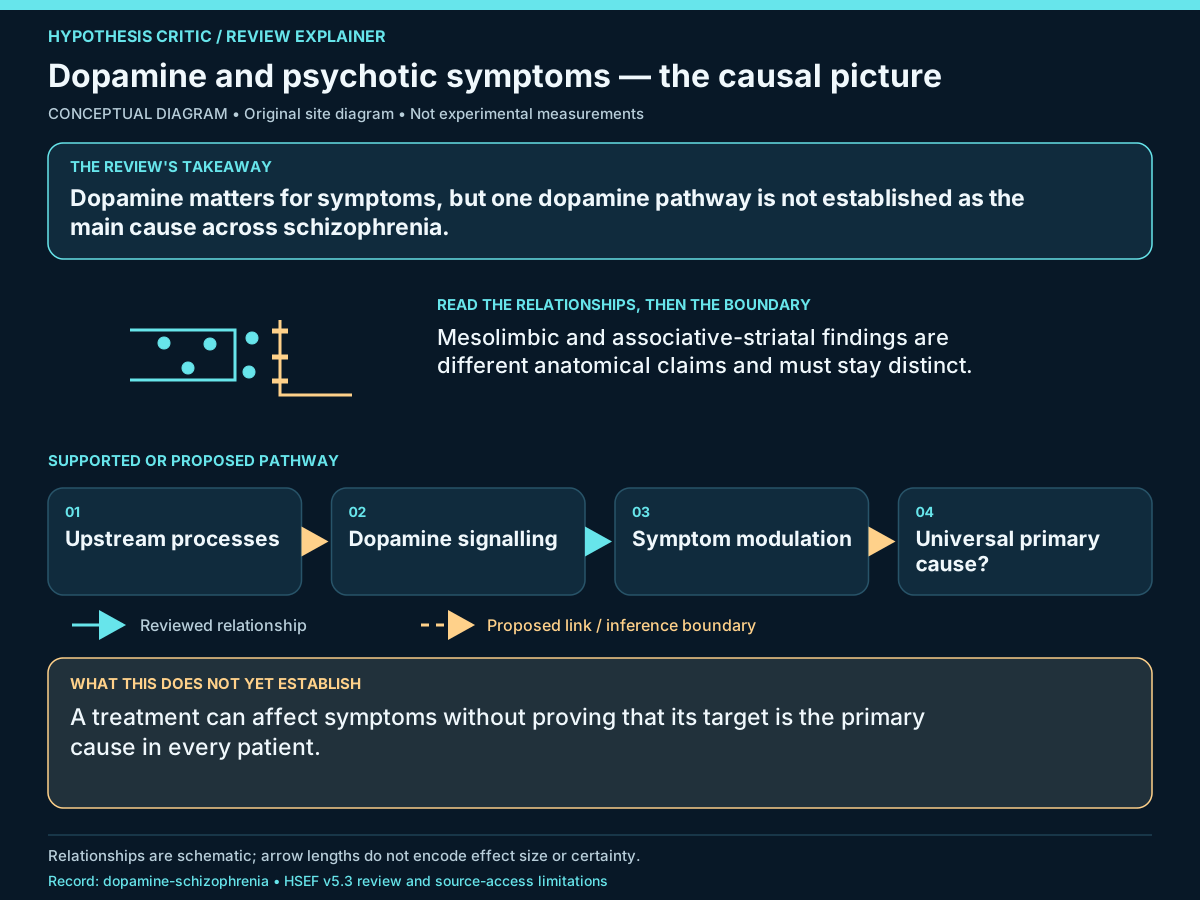
HYPOTHESIS CRITIC  /  REVIEW EXPLAINER
Dopamine and psychotic symptoms — the causal picture
CONCEPTUAL DIAGRAM  •  Original site diagram  •  Not experimental measurements
THE REVIEW'S TAKEAWAY
Dopamine matters for symptoms, but one dopamine pathway is not established as the main cause across schizophrenia.
READ THE RELATIONSHIPS, THEN THE BOUNDARY
Mesolimbic and associative-striatal findings are different anatomical claims and must stay distinct.
SUPPORTED OR PROPOSED PATHWAY
01
Upstream processes
02
Dopamine signalling
03
Symptom modulation
04
Universal primary cause?
Reviewed relationship
Proposed link / inference boundary
WHAT THIS DOES NOT YET ESTABLISH
A treatment can affect symptoms without proving that its target is the primary cause in every patient.
Relationships are schematic; arrow lengths do not encode effect size or certainty.
Record: dopamine-schizophrenia  •  HSEF v5.3 review and source-access limitations
This is the specific idea being tested.
Brain imaging often finds its stronger signal in a different part of the striatum than the classic pathway claim predicts. A medicine's benefit shows that a signal can affect symptoms; it does not by itself prove that signal is the original cause in every patient.
A higher rank means a better fit to the evidence in this comparison. It does not prove every part of the leading explanation.
The reviewed hypothesis ranks 4 among 4 models compared; 1 alternative model(s) hold first rank for this stated claim.
Claim under review: rank 4 among 4 compared models.
Leading explanation: Heterogeneous psychosis pathways.
Position in this comparison: Last recorded rank.
The causal grade asks how well the stated causal claim is established. This comparison asks which of the assessed explanations fits the reviewed findings better. A leading explanation can remain unproven. Models can overlap or include the tested mechanism; an alternative ahead does not make that mechanism irrelevant. These ordinal ranks apply within this review; they do not measure the size of a difference or rank scientific strength across topics.
HYPOTHESIS CRITIC  /  REVIEW EXPLAINER
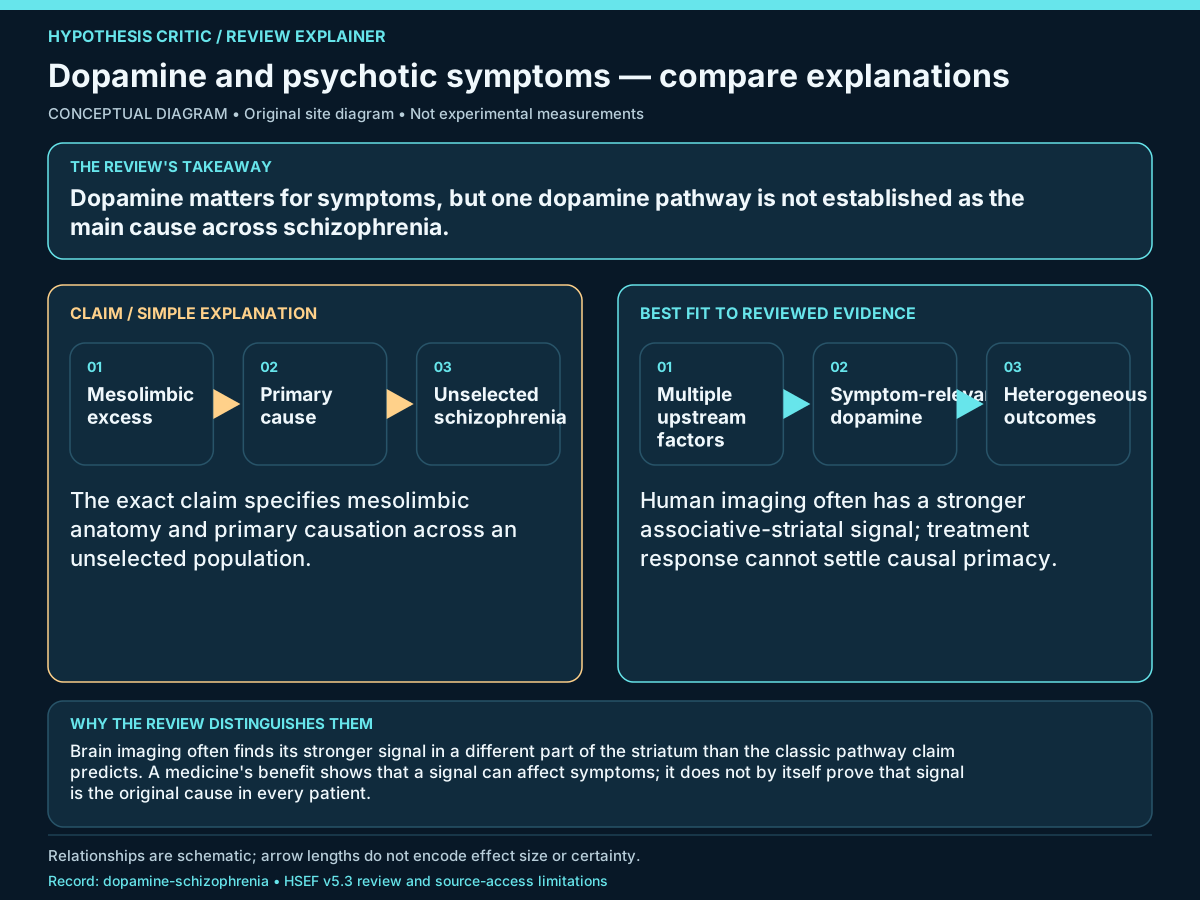
Dopamine and psychotic symptoms — compare explanations
CONCEPTUAL DIAGRAM  •  Original site diagram  •  Not experimental measurements
THE REVIEW'S TAKEAWAY
Dopamine matters for symptoms, but one dopamine pathway is not established as the main cause across schizophrenia.
CLAIM / SIMPLE EXPLANATION
01
Mesolimbic excess
02
Primary cause
03
Unselected schizophrenia
The exact claim specifies mesolimbic anatomy and primary causation across an unselected population.
BEST FIT TO REVIEWED EVIDENCE
01
Multiple upstream factors
02
Symptom-relevant dopamine
03
Heterogeneous outcomes
Human imaging often has a stronger associative-striatal signal; treatment response cannot settle causal primacy.
WHY THE REVIEW DISTINGUISHES THEM
Brain imaging often finds its stronger signal in a different part of the striatum than the classic pathway claim predicts. A medicine's benefit shows that a signal can affect symptoms; it does not by itself prove that signal is the original cause in every patient.
Relationships are schematic; arrow lengths do not encode effect size or certainty.
Record: dopamine-schizophrenia  •  HSEF v5.3 review and source-access limitations
Plausible, not established for the stated claim.
Brain imaging often finds its stronger signal in a different part of the striatum than the classic pathway claim predicts. A medicine's benefit shows that a signal can affect symptoms; it does not by itself prove that signal is the original cause in every patient.
These explanations can overlap. Ranking their fit to the evidence is separate from deciding how firmly a cause has been established.
Rank 1: Heterogeneous psychosis pathways — Different states/subgroups combine dopamine and other circuit mechanisms.
Rank 2: Downstream dopamine mediator — Upstream circuit/developmental changes converge partly on dopamine-mediated positive symptoms.
Rank 3: Glutamate/neurodevelopmental upstream mechanisms — Cortical/hippocampal dysfunction can generate downstream dopamine changes.
Rank 4: Mesolimbic D2 primacy — Excess mesolimbic D2 signalling primarily causes schizophrenia psychotic symptoms.
Evidence rating: Γ · Moderate confidence. How the evidence was assessed.
Brain imaging often finds its stronger signal in a different part of the striatum than the classic pathway claim predicts. A medicine's benefit shows that a signal can affect symptoms; it does not by itself prove that signal is the original cause in every patient.
Antipsychotic medicines can reduce psychotic symptoms, and treatment may also include psychological and practical support. Their benefit does not establish that excess dopamine in one specific pathway originally caused every patient's illness. The unresolved cause claim is therefore not a reason, on its own, to change a treatment that is helping; treatment decisions should account for symptoms, benefits and side effects with the care team.
Further reading: NIMH: schizophrenia treatment.
Look for the proposed factor and the outcome, in the people or systems covered by the claim.
Several underlying processes can change dopamine signalling and contribute to symptoms. Brain imaging often finds its stronger signal in a different part of the striatum than the classic pathway claim predicts. A medicine's benefit shows that a signal can affect symptoms; it does not by itself prove that signal is the original cause in every patient.
Follow symptoms over time and verify a selective dopamine change, using controls that can distinguish a symptom-related contribution from the broader claim of a primary cause.
HYPOTHESIS CRITIC  /  REVIEW EXPLAINER
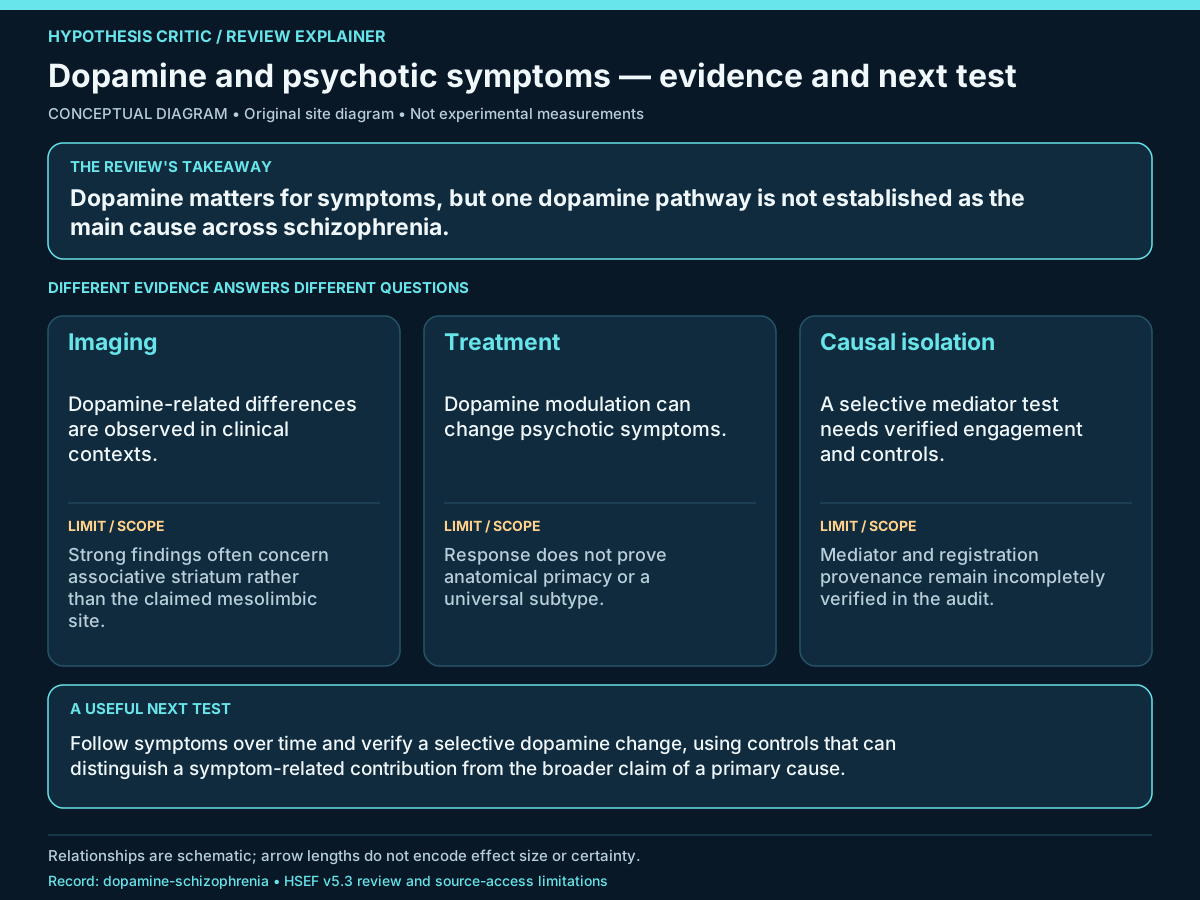
Dopamine and psychotic symptoms — evidence and next test
CONCEPTUAL DIAGRAM  •  Original site diagram  •  Not experimental measurements
THE REVIEW'S TAKEAWAY
Dopamine matters for symptoms, but one dopamine pathway is not established as the main cause across schizophrenia.
DIFFERENT EVIDENCE ANSWERS DIFFERENT QUESTIONS
Imaging
Dopamine-related differences are observed in clinical contexts.
LIMIT / SCOPE
Strong findings often concern associative striatum rather than the claimed mesolimbic site.
Treatment
Dopamine modulation can change psychotic symptoms.
LIMIT / SCOPE
Response does not prove anatomical primacy or a universal subtype.
Causal isolation
A selective mediator test needs verified engagement and controls.
LIMIT / SCOPE
Mediator and registration provenance remain incompletely verified in the audit.
A USEFUL NEXT TEST
Follow symptoms over time and verify a selective dopamine change, using controls that can distinguish a symptom-related contribution from the broader claim of a primary cause.
Relationships are schematic; arrow lengths do not encode effect size or certainty.
Record: dopamine-schizophrenia  •  HSEF v5.3 review and source-access limitations
Follow symptoms over time and verify a selective dopamine change, using controls that can distinguish a symptom-related contribution from the broader claim of a primary cause.
Check that the intended change really happened.
Allow for other factors and compare with suitable controls.
Look for independent confirmation and the limits of the effect.
These are questions for research, not a claim that the proposed studies have already succeeded.
Proposed tests: 1 test design(s) are registered in the scorecard.
In plain terms, researchers would change the proposed cause, check that it changed as intended, then measure a meaningful outcome while controlling plausible alternatives. The result should be able to support or count against the claim—not only show that a pathway exists.
Study design: Prospectively register a selective human dopamine/D2 mediator comparison in anatomically and clinically predefined psychosis strata, measure target engagement and acute-effect expectancy/blinding, use blinded symptom trajectories and an orthogonal nondopaminergic comparator, and prospectively test responses without selecting eligibility from observed treatment outcome.
What would be measured: Prespecified positive-psychotic symptom course and anatomy-specific engagement, with functional outcome as a separate endpoint
Important controls: Expectancy, acute subjective effects, rater blinding, medication history, adherence and competing-pathway engagement
Result that would support the claim: Selective pathway perturbation predicts and changes symptoms across the fixed unselected scope, with initiating precedence and rate-limiting evidence
Result that would count against it: Symptoms persist despite adequate selective engagement, anatomy fails prospective prediction, or independent competing-pathway effects explain trajectory without required dopamine change
Follow the studies, detailed comparisons and evidence ratings behind this guide.
Open the scientific review →