The question
Is cancer a return to an ancient, single-cell survival programme?
This is the specific idea being tested.
Is cancer a return to an ancient, single-cell survival programme?
What you need to knowCancer cells can reuse ancient genes. That does not establish one ancient programme as the explanation for cancer.Relative explanatory fit: Alternative ranked ahead
Why the alternative fits better: Changed growth control and selection of surviving cells explain recurring cancer behaviours without requiring one ancestral programme.
Claim assessed: Cancer is the re-expression of a coherent, pre-existing ancestral pre-metazoan gene-regulatory program, and that program drives tumorigenesis.
Finding: Preregistered primary SC3 returns Γ. The mandatory paired SC2/SC3 minimum also returns Γ; weakest-link returns Β because SC1/SC4 remain associative, and scope-matched primacy returns Γ. The score concerns the distinctive coherent-program driver, not the proven existence of ancient genes or selected oncogene dependencies.
Evidence scope: 59 primary reports; literature cutoff 2026-10-08; source examination UTC date 2026-10-08; bounded critical review, not exhaustive systematic review.
The grade applies to the stated claim. Model rankings and individual subclaim grades remain separate from the overall causal-evidence grade.
Full scientific assessment and references · Scorecard (JSON) · Review source (Markdown)
THE MAIN FINDING
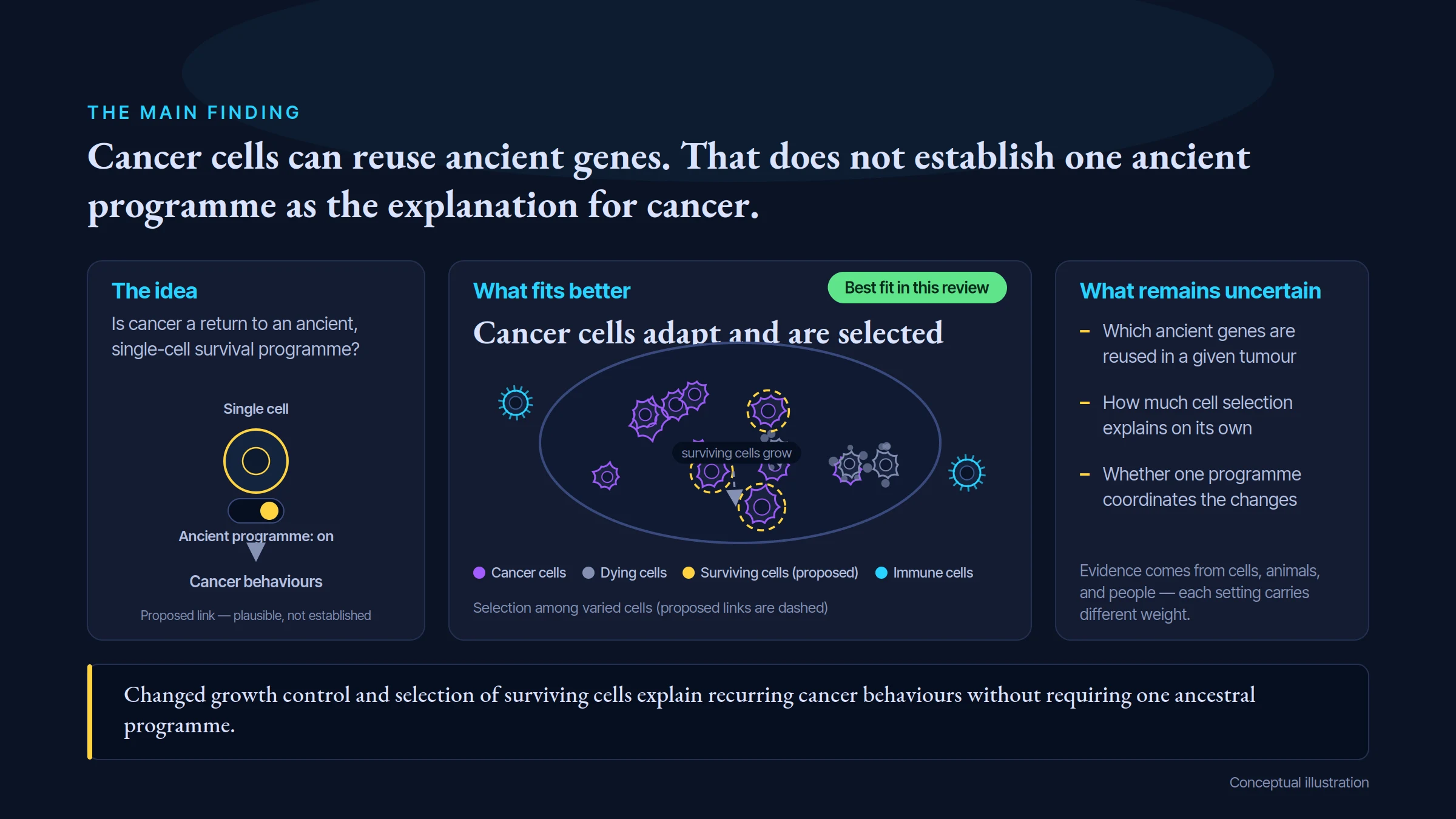
Cancer cells can reuse ancient genes. That does not establish one ancient programme as the explanation for cancer.
The idea
Is cancer a return to an ancient, single-cell survival programme?
Single cell
Ancient programme: on
Cancer behaviours
Proposed link — plausible, not established
What fits better
Cancer cells adapt and are selected
Best fit in this review
surviving cells grow
Cancer cells
Dying cells
Immune cells
Cancer cells
Dying cells
Surviving cells (proposed)
Immune cells
Selection among varied cells (proposed links are dashed)
What remains uncertain
Which ancient genes are reused in a given tumour
How much cell selection explains on its own
Whether one programme coordinates the changes
Evidence comes from cells, animals, and people — each setting carries different weight.
Changed growth control and selection of surviving cells explain recurring cancer behaviours without requiring one ancestral programme.
Conceptual illustration
This is the specific idea being tested.
Changed growth control and selection of surviving cells explain recurring cancer behaviours without requiring one ancestral programme.
A higher rank means a better fit to the evidence in this comparison. It does not prove every part of the leading explanation.
The reviewed hypothesis ranks 4 among 5 models compared; 1 alternative model(s) hold first rank for this stated claim.
Claim under review: rank 4 among 5 compared models.
Leading explanation: Somatic selection after disrupted multicellular constraints.
Position in this comparison: Between leading and last ranks.
The causal grade asks how well the stated causal claim is established. This comparison asks which of the assessed explanations fits the reviewed findings better. A leading explanation can remain unproven. Models can overlap or include the tested mechanism; an alternative ahead does not make that mechanism irrelevant. These ordinal ranks apply within this review; they do not measure the size of a difference or rank scientific strength across topics.
TWO EXPLANATIONS, COMPARED
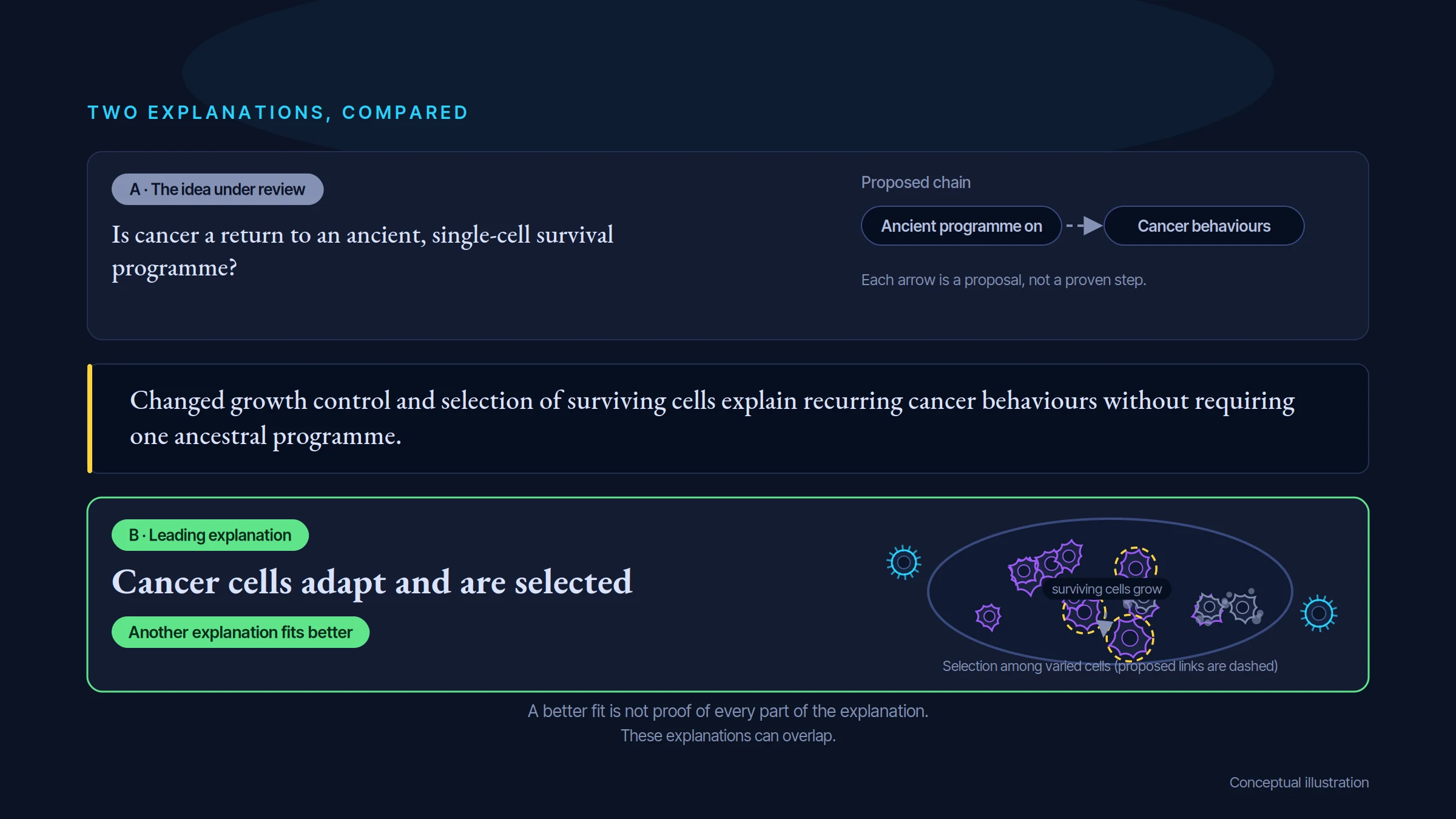
A · The idea under review
Is cancer a return to an ancient, single-cell survival programme?
Proposed chain
Ancient programme on
Cancer behaviours
Each arrow is a proposal, not a proven step.
Changed growth control and selection of surviving cells explain recurring cancer behaviours without requiring one ancestral programme.
B · Leading explanation
Cancer cells adapt and are selected
Another explanation fits better
surviving cells grow
Cancer cells
Dying cells
Immune cells
Selection among varied cells (proposed links are dashed)
A better fit is not proof of every part of the explanation.
These explanations can overlap.
Conceptual illustration
Plausible, not established for the stated claim.
Changed growth control and selection of surviving cells explain recurring cancer behaviours without requiring one ancestral programme.
These explanations can overlap. Ranking their fit to the evidence is separate from deciding how firmly a cause has been established.
Rank 1: Somatic selection after disrupted multicellular constraints — Selected regulators and loss of growth constraints cause context-specific tumors and recurrent escape.
Rank 2: Forward ecological adaptation — Tumors remodel regulatory and metabolic states in response to lineage, nutrients and treatment.
Rank 3: Proliferation and homology confounding — Growth and gene-age inference can create part of the apparent ancient-state shift.
Rank 4: Coherent ancestral program — A preserved pre-metazoan regulatory module is re-executed and drives tumors.
Rank 5: Serial metabolic atavism — Tumors progress through a prescribed sequence of historically older metabolic states.
Evidence rating: Γ · Moderate confidence. How the evidence was assessed.
Changed growth control and selection of surviving cells explain recurring cancer behaviours without requiring one ancestral programme.
A result about how a disease works is a separate question from whether a treatment improves health.
Look for the proposed factor and the outcome, in the people or systems covered by the claim.
Cancer cells adapt and are selected. Changed growth control and selection of surviving cells explain recurring cancer behaviours without requiring one ancestral programme.
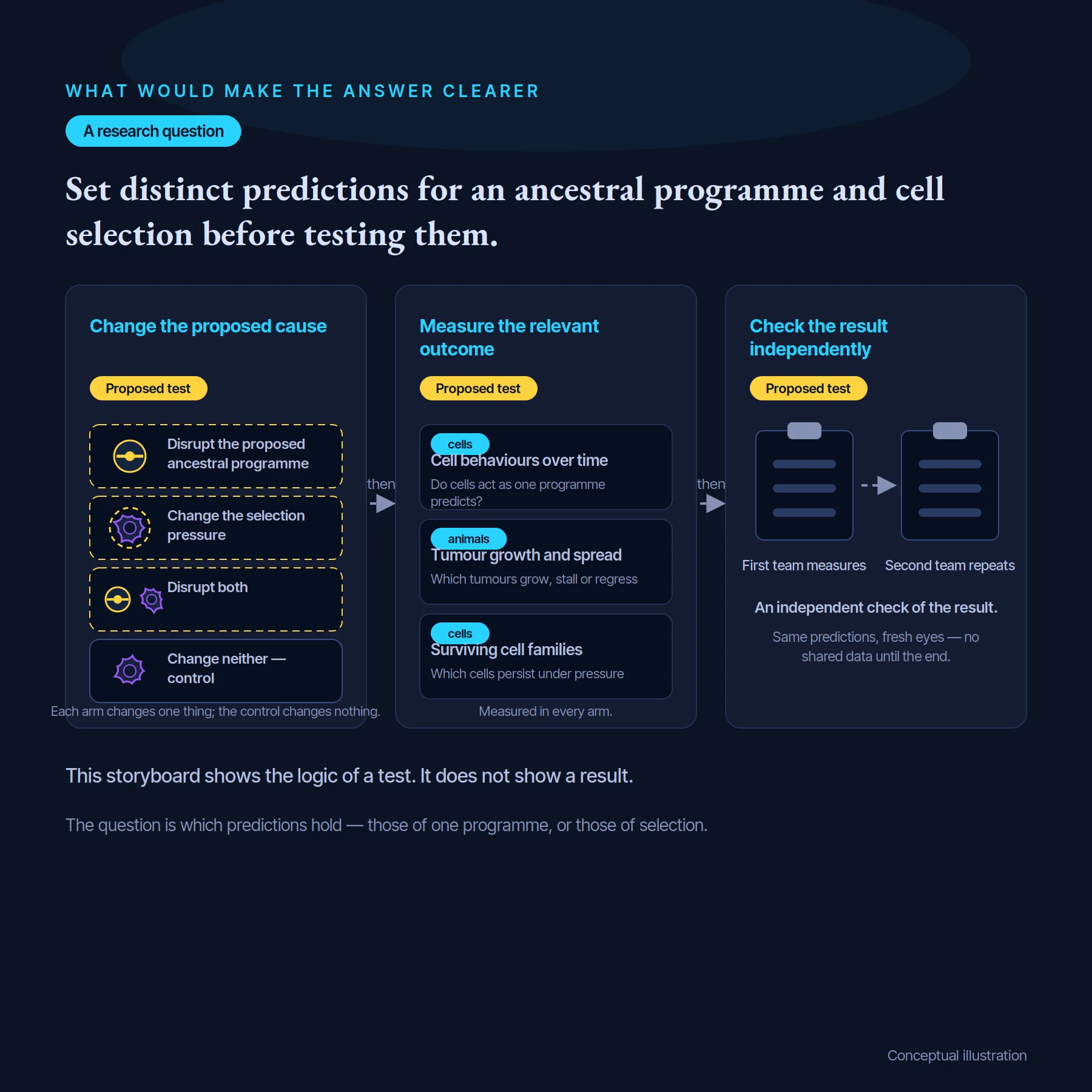
Set distinct predictions for an ancestral programme and cell selection before testing them.
WHAT WOULD MAKE THE ANSWER CLEARER
A research question
Set distinct predictions for an ancestral programme and cell selection before testing them.
then
then
Change the proposed cause
Proposed test
Disrupt the proposed ancestral programme
Change the selection pressure
Disrupt both
Change neither — control
Each arm changes one thing; the control changes nothing.
Measure the relevant outcome
Proposed test
cells
Cell behaviours over time
Do cells act as one programme predicts?
animals
Tumour growth and spread
Which tumours grow, stall or regress
cells
Surviving cell families
Which cells persist under pressure
Measured in every arm.
Check the result independently
Proposed test
First team measures
Second team repeats
An independent check of the result.
Same predictions, fresh eyes — no shared data until the end.
This storyboard shows the logic of a test. It does not show a result.
The question is which predictions hold — those of one programme, or those of selection.
Conceptual illustration
Set distinct predictions for an ancestral programme and cell selection before testing them.
Check that the intended change really happened.
Allow for other factors and compare with suitable controls.
Look for independent confirmation and the limits of the effect.
These are questions for research, not a claim that the proposed studies have already succeeded.
Proposed tests: 1 test design(s) are registered in the scorecard.
In plain terms, researchers would change the proposed cause, check that it changed as intended, then measure a meaningful outcome while controlling plausible alternatives. The result should be able to support or count against the claim—not only show that a pathway exists.
Study design: Preregister an orthology-robust ancestral edge-defined network, then selectively sever its proposed conserved regulatory edges in autochthonous lineage-matched tumors and growth-matched normal tissues, rescue with edge-specific restoration, and track initiation, maintenance and relapse separately.
What would be measured: Single-cell ancestry-aware edge activity, clonal tumor burden/relapse, growth and viability with metabolic flux and target engagement
Important controls: Comparable basal replication, normal proliferating lineage, matched nonancestral edges, off-target resistant rescue and alternative rewiring predictions
Result that would support the claim: Selective ancestral-network loss consistently removes tumor dependency and matched restoration rescues without simply restoring generic proliferation
Result that would count against it: Tumors persist after confirmed network interruption, normal proliferating cells fail equally, or new context-dependent edges better predict response
Follow the studies, detailed comparisons and evidence ratings behind this guide.
Open the scientific review →