The question
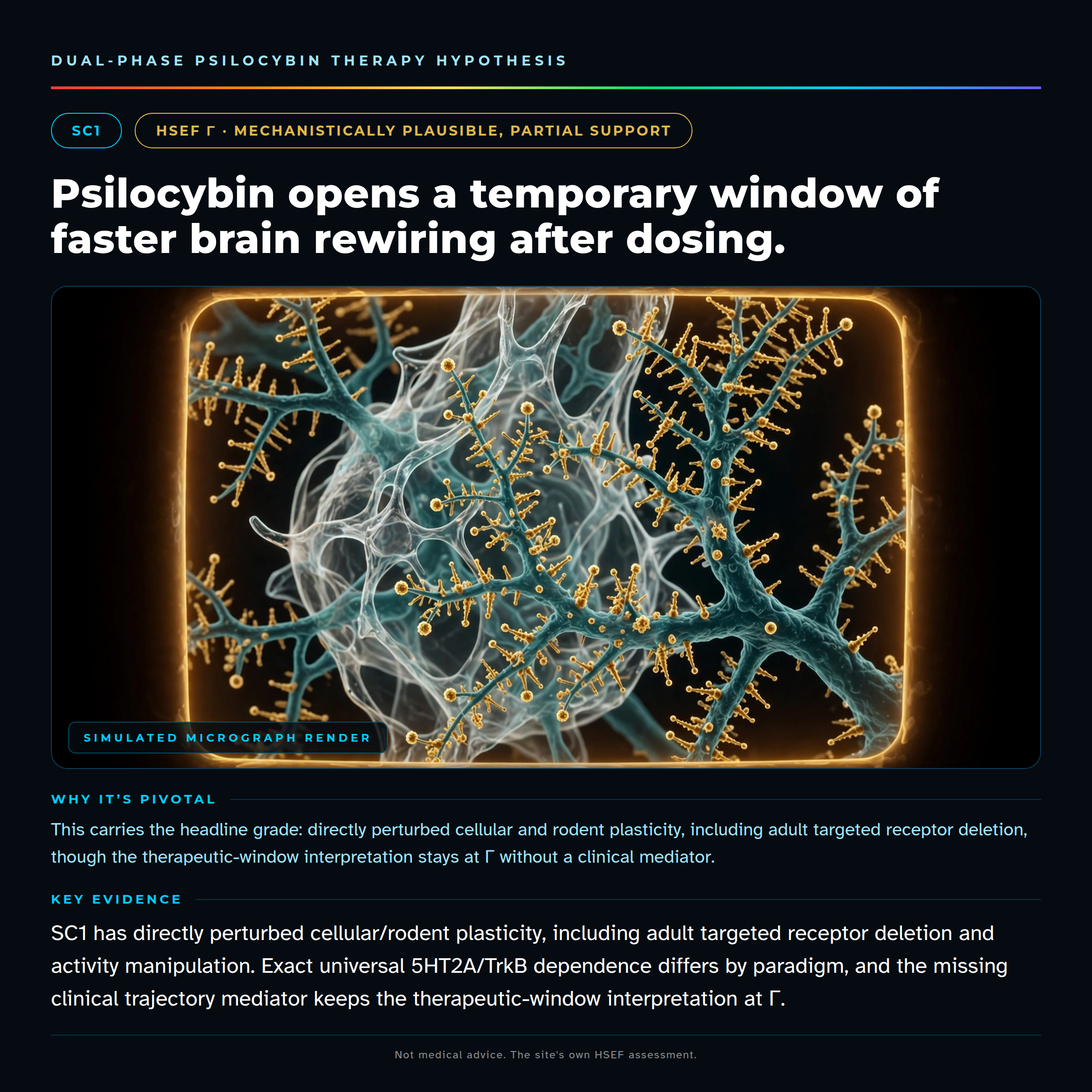
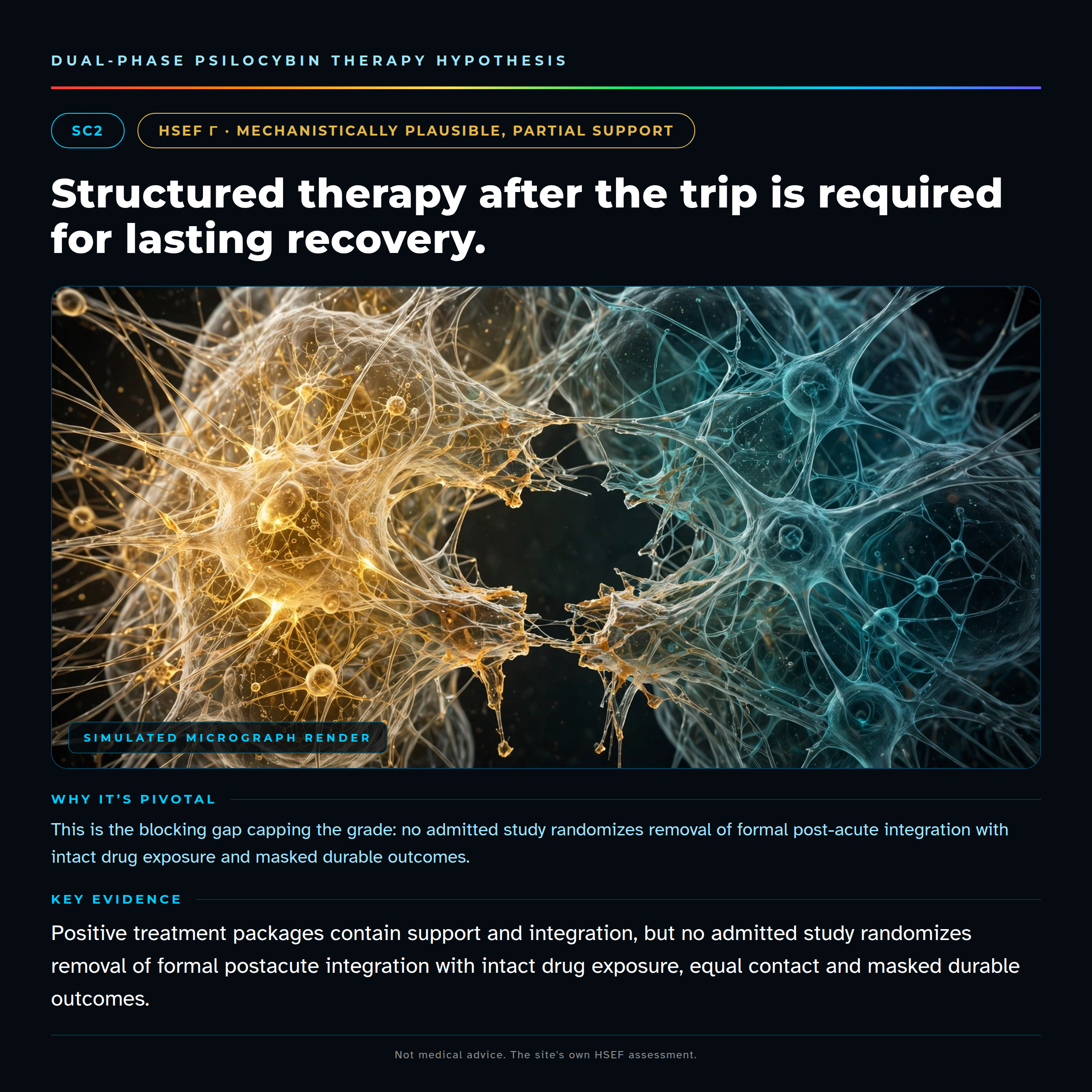
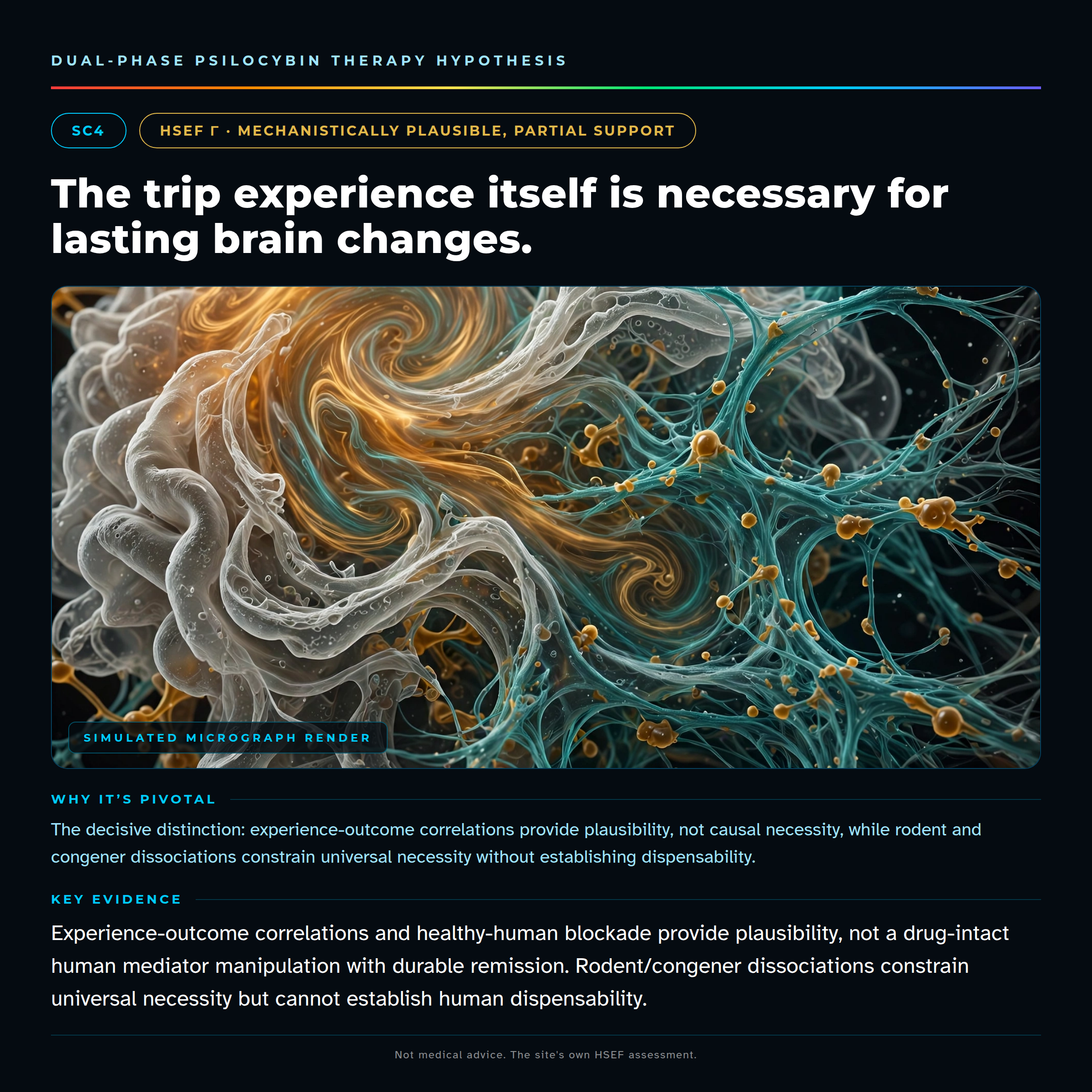
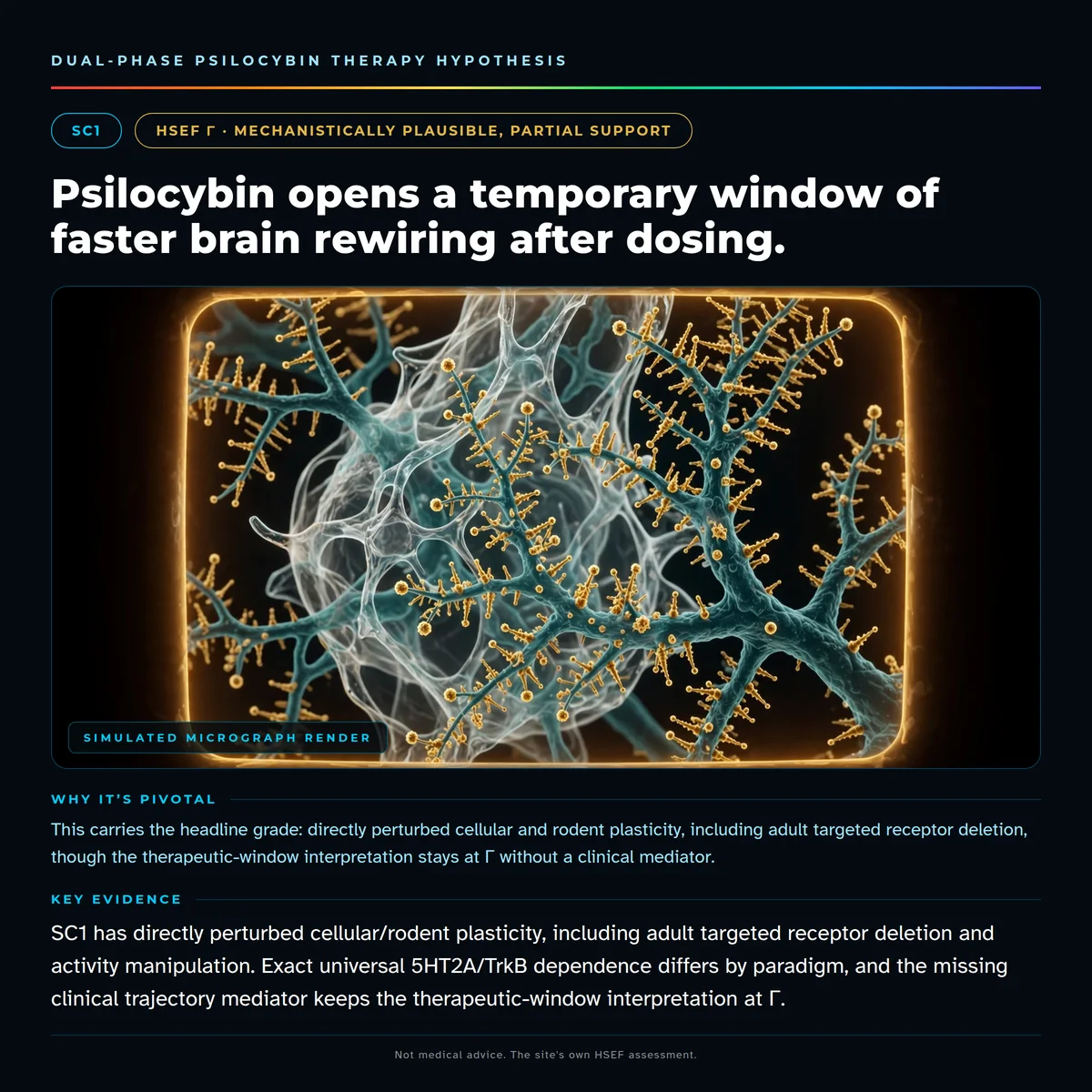
Must psilocybin open a brain-change window followed by therapy for lasting improvement?
This is the specific idea being tested.
Must psilocybin open a brain-change window followed by therapy for lasting improvement?
What you need to knowLasting benefit is not established as requiring the proposed two-step mechanism.Relative explanatory fit: Alternative ranked ahead
Why the alternative fits better: Drug-related changes interact with activity and environment without proving formal later therapy is a required link.
Claim assessed: Psilocybin works best as psilocybin-assisted psychotherapy: the drug rapidly opens a neurodevelopmental-like window of synaptic plasticity, and formal post-acute psychotherapeutic integration is causally required to consolidate that state into lasting clinical remission.
Finding: The registered weakest-link conjunction returns Γ. All four therapeutic/mechanism clauses remain Γ under rubric 07, though cell/rodent plasticity and some clinical package effects are empirically positive. Primary-SC2 and scope-matched sensitivities also return Γ. The unresolved content is required formal consolidation, not whether the drug ever changes synapses or symptoms.
Evidence scope: 60 primary reports; cutoff 2026-10-04; bounded critical review, not exhaustive systematic review.
The grade applies to the stated claim. Model rankings and individual subclaim grades remain separate from the overall causal-evidence grade.
Full scientific assessment and references · Scorecard (JSON) · Review source (Markdown)
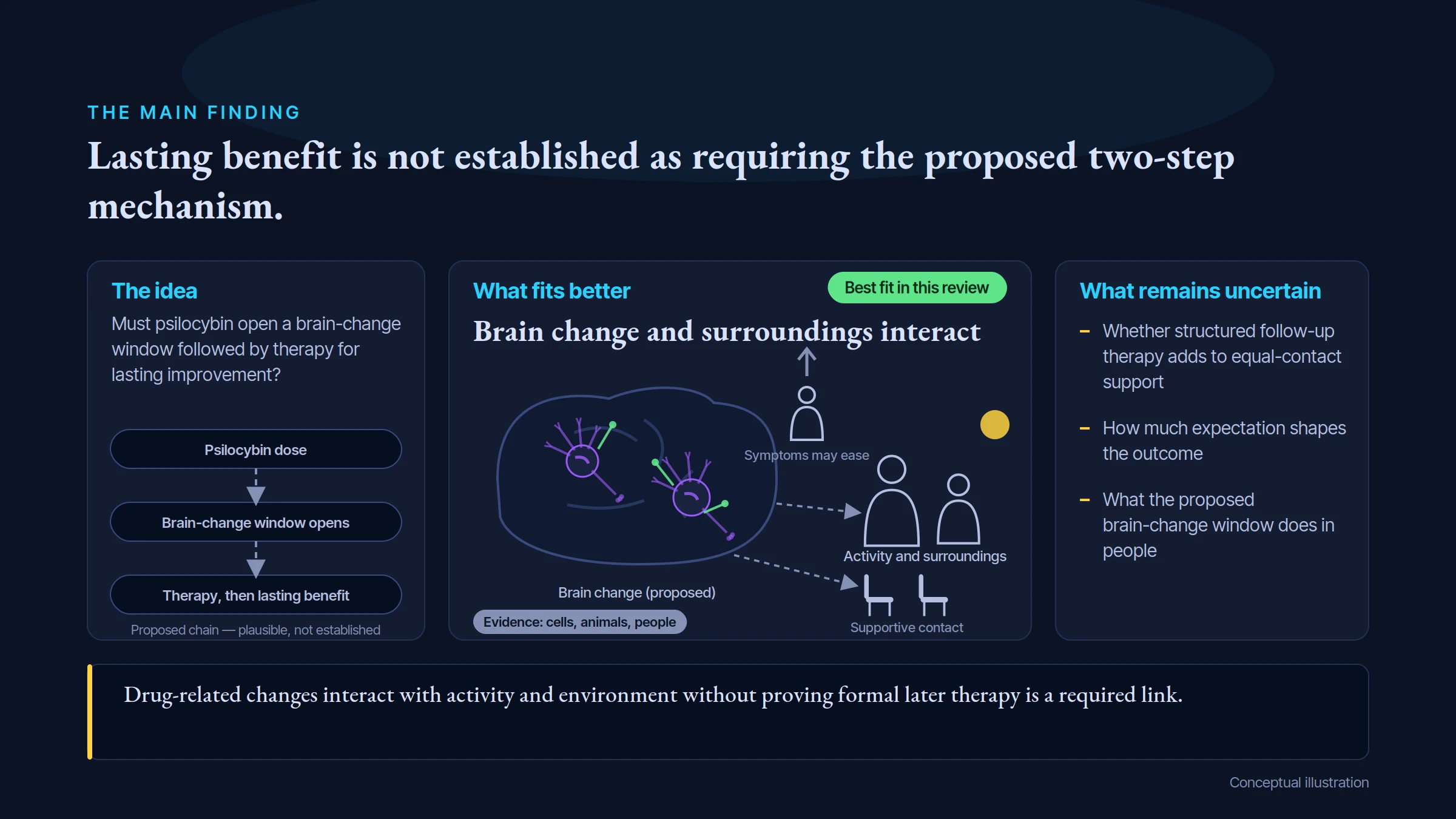
THE MAIN FINDING
Lasting benefit is not established as requiring the proposed two-step mechanism.
The idea
Must psilocybin open a brain-change window followed by therapy for lasting improvement?
Psilocybin dose
Brain-change window opens
Therapy, then lasting benefit
Proposed chain — plausible, not established
What fits better
Brain change and surroundings interact
Best fit in this review
Brain change (proposed)
Evidence: cells, animals, people
Symptoms may ease
Activity and surroundings
Supportive contact
What remains uncertain
Whether structured follow-up therapy adds to equal-contact support
How much expectation shapes the outcome
What the proposed brain-change window does in people
Drug-related changes interact with activity and environment without proving formal later therapy is a required link.
Conceptual illustration
This is the specific idea being tested.
Drug-related changes interact with activity and environment without proving formal later therapy is a required link.
A higher rank means a better fit to the evidence in this comparison. It does not prove every part of the leading explanation.
The reviewed hypothesis ranks 5 among 5 models compared; 1 alternative model(s) hold first rank for this stated claim.
Claim under review: rank 5 among 5 compared models.
Leading explanation: Generic plasticity plus environment.
Position in this comparison: Last recorded rank.
The causal grade asks how well the stated causal claim is established. This comparison asks which of the assessed explanations fits the reviewed findings better. A leading explanation can remain unproven. Models can overlap or include the tested mechanism; an alternative ahead does not make that mechanism irrelevant. These ordinal ranks apply within this review; they do not measure the size of a difference or rank scientific strength across topics.
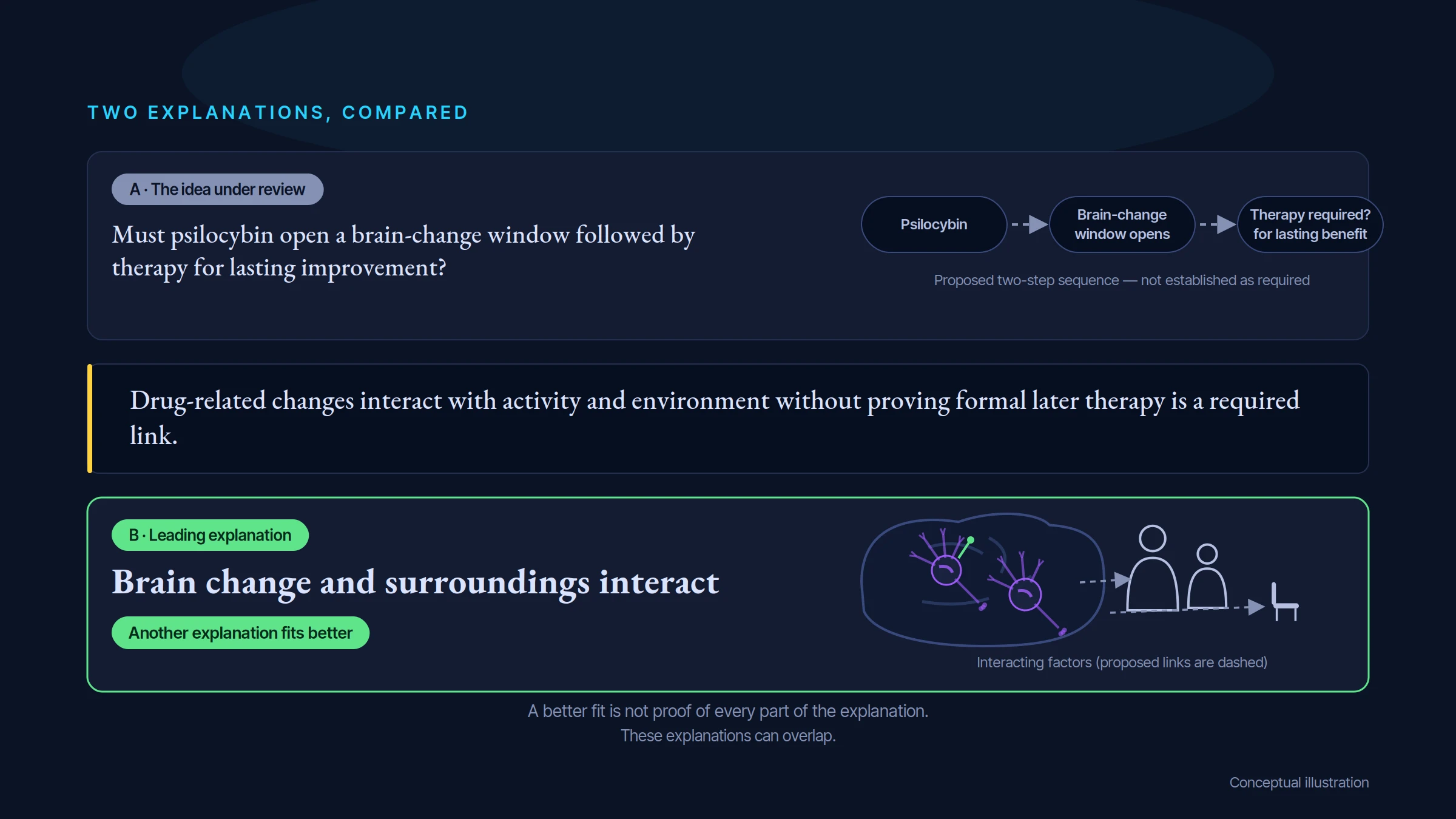
TWO EXPLANATIONS, COMPARED
A · The idea under review
Must psilocybin open a brain-change window followed by therapy for lasting improvement?
Psilocybin
Brain-change window opens
Therapy required? for lasting benefit
Proposed two-step sequence — not established as required
Drug-related changes interact with activity and environment without proving formal later therapy is a required link.
B · Leading explanation
Brain change and surroundings interact
Another explanation fits better
Interacting factors (proposed links are dashed)
A better fit is not proof of every part of the explanation.
These explanations can overlap.
Conceptual illustration
Plausible, not established for the stated claim.
Drug-related changes interact with activity and environment without proving formal later therapy is a required link.
These explanations can overlap. Ranking their fit to the evidence is separate from deciding how firmly a cause has been established.
Rank 1: Generic plasticity plus environment — Drug-induced neural susceptibility interacts with activity and environment.
Rank 2: Dose/receptor occupancy — Dose and receptor exposure explain pharmacodynamic changes and some package response.
Rank 3: Autonomous pharmacological reset — A pharmacological change can persist without a required conscious or formal consolidation process.
Rank 4: Expectancy/functional unblinding — Expectancy, contact and allocation inference contribute to symptoms.
Rank 5: Required psychotherapeutic consolidation — Formal integration is necessary to convert drug-induced plasticity into lasting remission.
Evidence rating: Γ · Moderate confidence. How the evidence was assessed.
Drug-related changes interact with activity and environment without proving formal later therapy is a required link.
This is an assessment of a causal explanation, not proof that a particular supplement, diet, test, or treatment improves health. A treatment claim needs studies that test the intervention in people and measure meaningful benefits and harms. These findings can help frame research and informed clinical questions, but they do not identify what is right for one person.
Look for the proposed factor and the outcome, in the people or systems covered by the claim.
Brain change and surroundings interact. Drug-related changes interact with activity and environment without proving formal later therapy is a required link.
Compare structured follow-up therapy with equal-contact support, accounting for expectations and drug exposure.
These illustrations show the key questions tested in the review. They are conceptual drawings, not microscope images or experimental results.
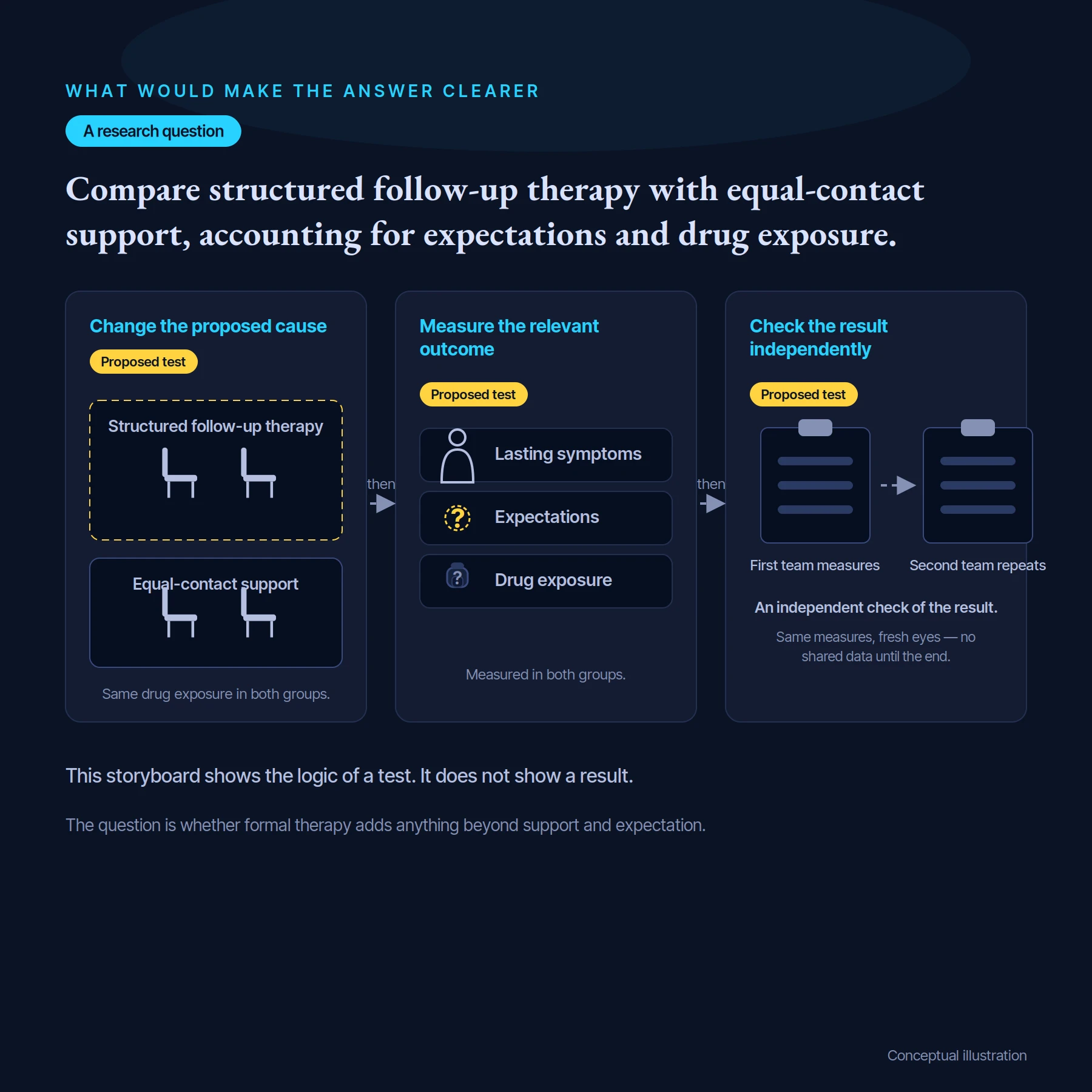
WHAT WOULD MAKE THE ANSWER CLEARER
A research question
Compare structured follow-up therapy with equal-contact support, accounting for expectations and drug exposure.
then
then
Change the proposed cause
Proposed test
Structured follow-up therapy
Equal-contact support
Same drug exposure in both groups.
Measure the relevant outcome
Proposed test
Lasting symptoms
Expectations
Drug exposure
Measured in both groups.
Check the result independently
Proposed test
First team measures
Second team repeats
An independent check of the result.
Same measures, fresh eyes — no shared data until the end.
This storyboard shows the logic of a test. It does not show a result.
The question is whether formal therapy adds anything beyond support and expectation.
Conceptual illustration
Compare structured follow-up therapy with equal-contact support, accounting for expectations and drug exposure.
Check that the intended change really happened.
Allow for other factors and compare with suitable controls.
Look for independent confirmation and the limits of the effect.
These are questions for research, not a claim that the proposed studies have already succeeded.
Proposed tests: 1 test design(s) are registered in the scorecard.
In plain terms, researchers would change the proposed cause, check that it changed as intended, then measure a meaningful outcome while controlling plausible alternatives. The result should be able to support or count against the claim—not only show that a pathway exists.
Study design: Randomize baseline-defined depressed/anxious participants receiving the same psilocybin dose and preparation to formal postacute integration versus equal-contact supportive follow-up, with balanced allegiance, explicit protocol/fidelity, participant/rater allocation guesses and masked central assessments at six and twelve months. Add a prespecified early-versus-delayed integration contrast and a separately controlled drug-intact experience-removal study to distinguish timing, therapy and subjective mechanisms.
What would be measured: Durable remission/relapse and independently assessed function, with validated plasticity measures as distinct mechanistic endpoints
Important controls: Equal drug exposure, safety support and contact; measured expectancy/alliance and masking integrity; fidelity; co-interventions and multiplicity
Result that would support the claim: Selective loss of durable remission when formal integration is removed or outside the validated window, with benefit restored by component rescue
Result that would count against it: Preserved durable remission under credible scaffold removal, with a prespecified adequately powered equivalence/noninferiority boundary
Follow the studies, detailed comparisons and evidence ratings behind this guide.
Open the scientific review →