The question
Are Alzheimer's amyloid deposits a protective response to brain infection?
This is the specific idea being tested.
Are Alzheimer's amyloid deposits a protective response to brain infection?
What you need to knowAmyloid can interact with microbes in the lab. That does not establish infection as the reason Alzheimer's deposits form.Relative explanatory fit: Alternative ranked ahead
Why the alternative fits better: Amyloid deposits and inflammation can arise after injury without a required microbial trigger.
Claim assessed: Amyloid-beta is an innate antimicrobial effector, and amyloid plaque deposition in Alzheimer disease is a protective pathogen-entrapment response rather than a primary pathological lesion.
Finding: The preregistered weakest-link rule yields Β from SC6. Direct human support for net protective pathogen-centered plaques is localization and ex vivo activity, without functional necessity, temporal demonstration or infection-stratified benefit. SC1–5 have mechanistic or simplified-model support (Γ); neither APP receptor immunity nor clinical antibody efficacy proves the nominal protective mechanism. This grade does not deny in vitro activity or refute all pathogen contributions.
Evidence scope: 61 primary reports; literature cutoff 2026-10-08; source examination UTC date 2026-10-09; bounded critical review, not exhaustive systematic review.
The grade applies to the stated claim. Model rankings and individual subclaim grades remain separate from the overall causal-evidence grade.
Full scientific assessment and references · Scorecard (JSON) · Review source (Markdown)
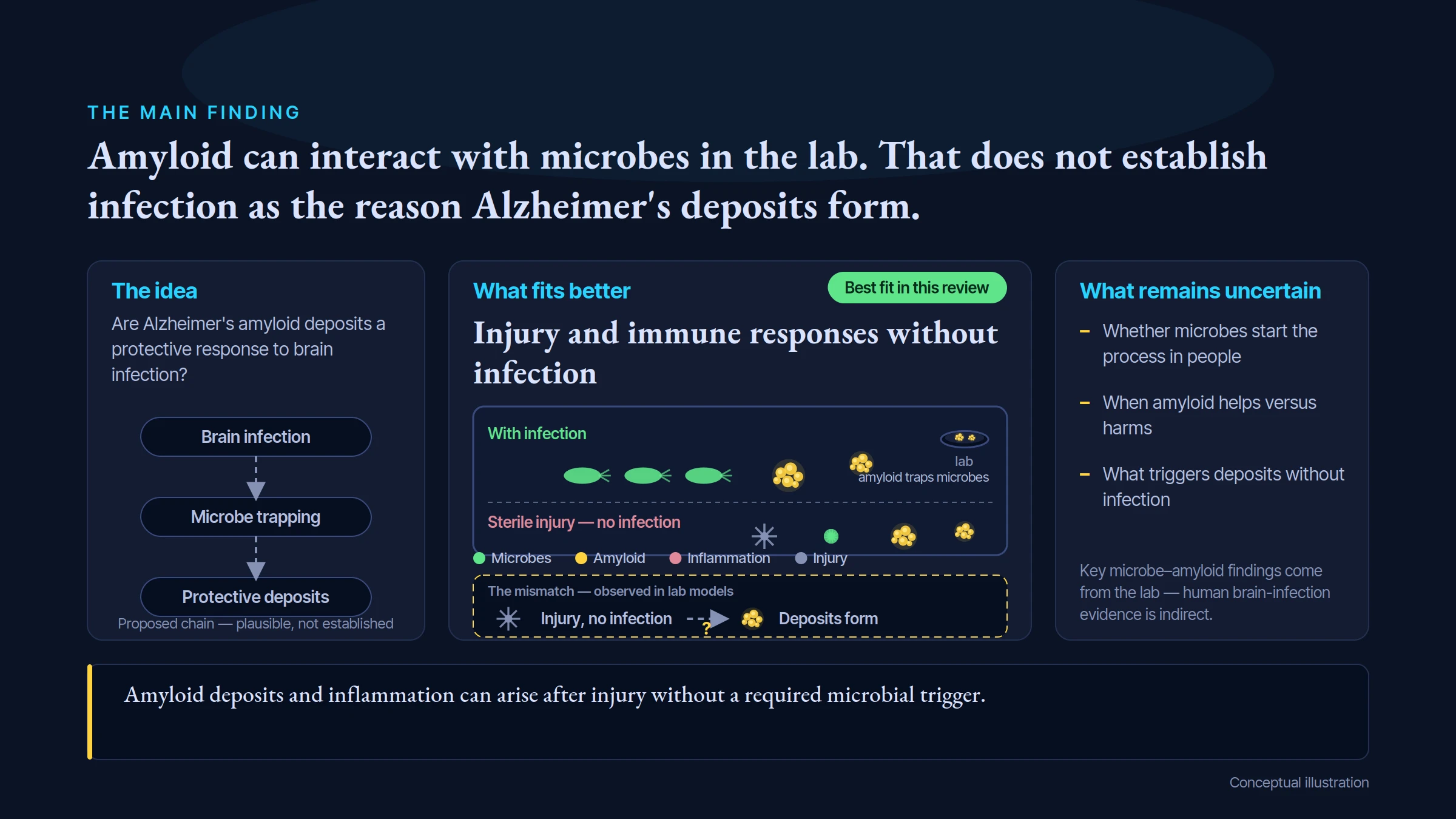
THE MAIN FINDING
Amyloid can interact with microbes in the lab. That does not establish infection as the reason Alzheimer's deposits form.
The idea
Are Alzheimer's amyloid deposits a protective response to brain infection?
Brain infection
Microbe trapping
Protective deposits
Proposed chain — plausible, not established
What fits better
Injury and immune responses without infection
Best fit in this review
With infection
amyloid traps microbes
Sterile injury — no infection
lab
Microbes
Amyloid
Inflammation
Injury
The mismatch — observed in lab models
Injury, no infection
Deposits form
What remains uncertain
Whether microbes start the process in people
When amyloid helps versus harms
What triggers deposits without infection
Key microbe–amyloid findings come from the lab — human brain-infection evidence is indirect.
Amyloid deposits and inflammation can arise after injury without a required microbial trigger.
Conceptual illustration
This is the specific idea being tested.
Amyloid deposits and inflammation can arise after injury without a required microbial trigger.
A higher rank means a better fit to the evidence in this comparison. It does not prove every part of the leading explanation.
The reviewed hypothesis ranks 5 among 5 models compared; 1 alternative model(s) hold first rank for this stated claim.
Claim under review: rank 5 among 5 compared models.
Leading explanation: Sterile innate alarm and injury amplification.
Position in this comparison: Last recorded rank.
The causal grade asks how well the stated causal claim is established. This comparison asks which of the assessed explanations fits the reviewed findings better. A leading explanation can remain unproven. Models can overlap or include the tested mechanism; an alternative ahead does not make that mechanism irrelevant. These ordinal ranks apply within this review; they do not measure the size of a difference or rank scientific strength across topics.
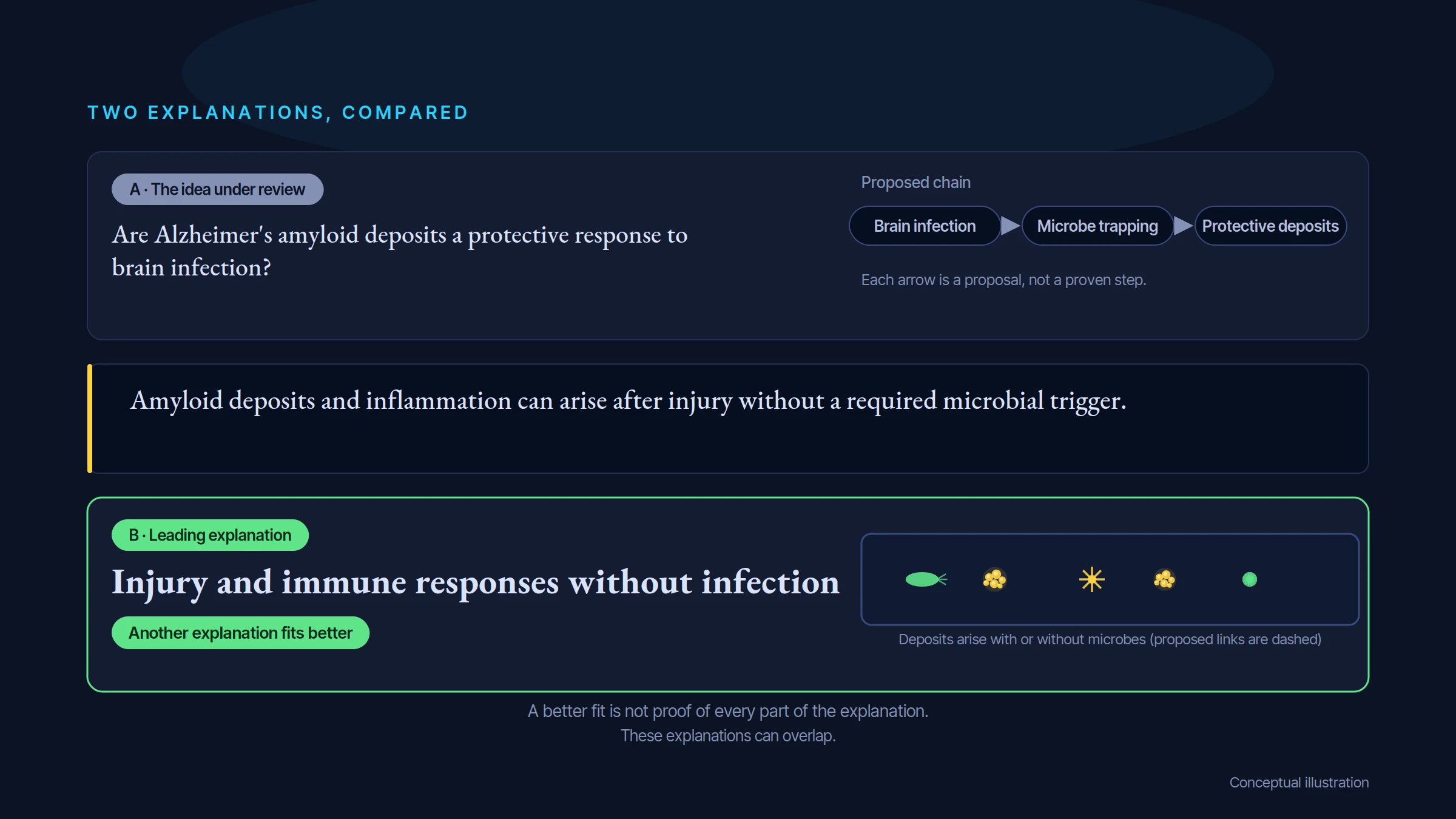
TWO EXPLANATIONS, COMPARED
A · The idea under review
Are Alzheimer's amyloid deposits a protective response to brain infection?
Proposed chain
Brain infection
Microbe trapping
Protective deposits
Each arrow is a proposal, not a proven step.
Amyloid deposits and inflammation can arise after injury without a required microbial trigger.
B · Leading explanation
Injury and immune responses without infection
Another explanation fits better
Deposits arise with or without microbes (proposed links are dashed)
A better fit is not proof of every part of the explanation.
These explanations can overlap.
Conceptual illustration
Association only for the stated claim.
Amyloid deposits and inflammation can arise after injury without a required microbial trigger.
These explanations can overlap. Ranking their fit to the evidence is separate from deciding how firmly a cause has been established.
Rank 1: Sterile innate alarm and injury amplification — Aβ-associated inflammation and deposition can participate in injury without microbial necessity.
Rank 2: Physiological neuromodulation with aggregation-dependent dysfunction — Native Aβ can support synapses while aggregate states are injurious.
Rank 3: Pathogen-triggered pathology with harmful amyloid — Some infections induce Aβ and injury rather than necessarily protective plaques.
Rank 4: Nonspecific amphipathic aggregation — Concentrated aggregation can bind complex surfaces without an evolved native defence role.
Rank 5: Protective antimicrobial amyloid in human AD — Aβ is an endogenous CNS antimicrobial effector and plaques are net protective pathogen traps.
Evidence rating: Β · Moderate confidence. How the evidence was assessed.
Amyloid deposits and inflammation can arise after injury without a required microbial trigger.
A result about how a disease works is a separate question from whether a treatment improves health.
Look for the proposed factor and the outcome, in the people or systems covered by the claim.
Injury and immune responses without infection. Amyloid deposits and inflammation can arise after injury without a required microbial trigger.
Compare responses to infection and injury without infection, testing amyloid's protective role separately.
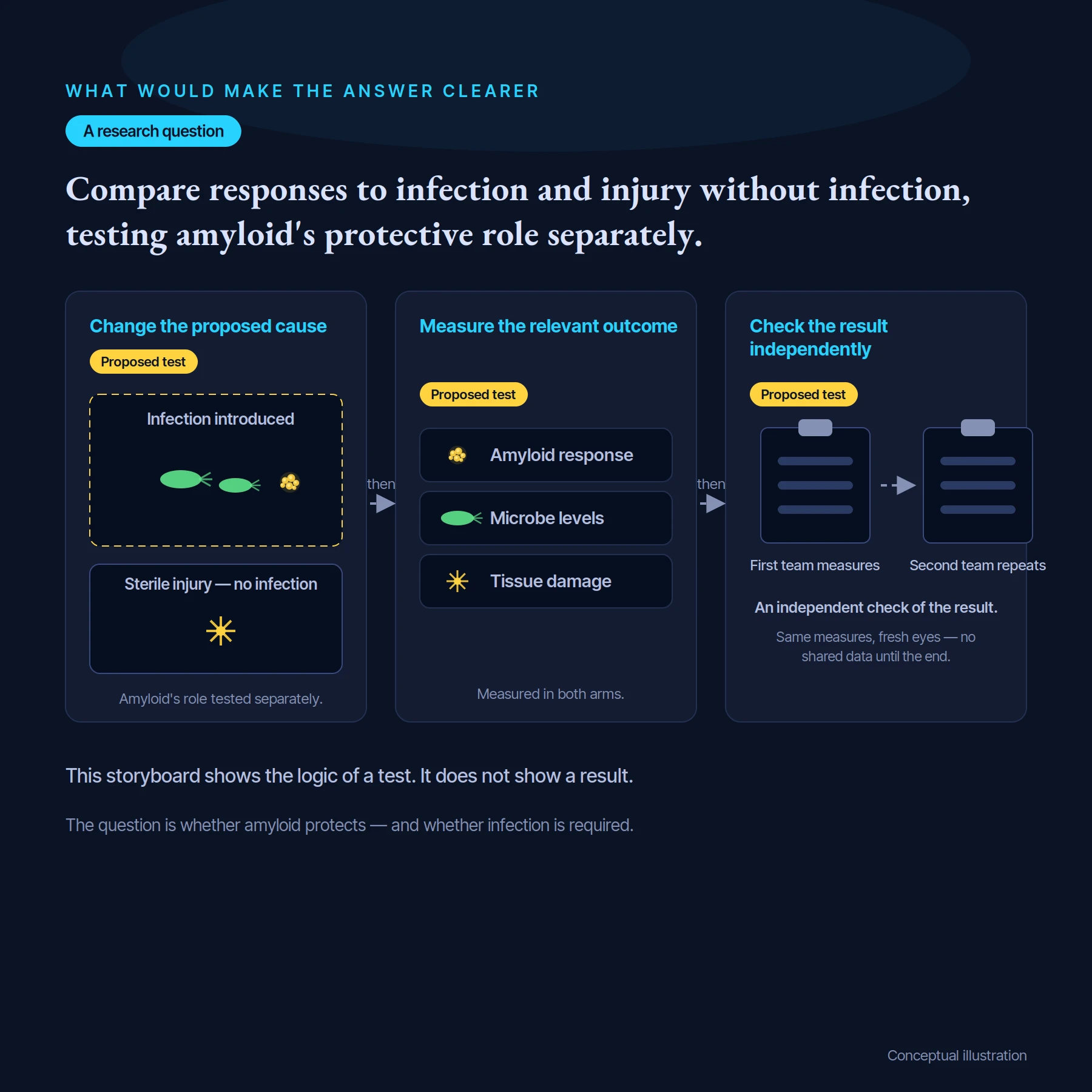
WHAT WOULD MAKE THE ANSWER CLEARER
A research question
Compare responses to infection and injury without infection, testing amyloid's protective role separately.
then
then
Change the proposed cause
Proposed test
Infection introduced
Sterile injury — no infection
Amyloid's role tested separately.
Measure the relevant outcome
Amyloid response
Microbe levels
Tissue damage
Measured in both arms.
Check the result independently
Proposed test
First team measures
Second team repeats
An independent check of the result.
Same measures, fresh eyes — no shared data until the end.
This storyboard shows the logic of a test. It does not show a result.
The question is whether amyloid protects — and whether infection is required.
Conceptual illustration
Compare responses to infection and injury without infection, testing amyloid's protective role separately.
Check that the intended change really happened.
Allow for other factors and compare with suitable controls.
Look for independent confirmation and the limits of the effect.
These are questions for research, not a claim that the proposed studies have already succeeded.
Proposed tests: 1 test design(s) are registered in the scorecard.
In plain terms, researchers would change the proposed cause, check that it changed as intended, then measure a meaningful outcome while controlling plausible alternatives. The result should be able to support or count against the claim—not only show that a pathway exists.
Study design: Use adult wild-type mice with inducible Aβ-selective production/neutralization preserving APP ectodomain functions, crossed with CNS infection and matched sterile inflammation; restore the measured native peptide dose using aggregation- and binding-matched variants. Pair with prospectively ascertained pathogen-positive human tissue/outcome cohorts.
What would be measured: Pathogen viable load, survival, synaptic injury and cognition alongside free/aggregate Aβ concentrations and spatial localization
Important controls: APP receptor competence, noninfected and sterile-injury cohorts, sequence/aggregate controls, uninfected staining controls, extraction blanks and prespecified strain/sex/age
Result that would support the claim: Selective loss worsens infection outcome and native-dose binding-intact rescue restores protection without increased neural injury; human pathogen-trapping predicts better tissue outcomes
Result that would count against it: Loss has no infection consequence, rescue works through non-Aβ APP or generic aggregation, or deposits track injury without net outcome benefit
Follow the studies, detailed comparisons and evidence ratings behind this guide.
Open the scientific review →