The question
Does blood-vessel damage start the amyloid and tau changes of Alzheimer's disease?
This is the specific idea being tested.
Does blood-vessel damage start the amyloid and tau changes of Alzheimer's disease?
What you need to knowBlood-vessel damage harms memory without establishing that it starts Alzheimer's protein changes.Relative explanatory fit: Alternative ranked ahead
Why the alternative fits better: Vascular injury and protein disease harm thinking independently or together. Improvement without changed amyloid separates these possibilities.
Claim assessed: Cerebrovascular dysfunction, including blood–brain barrier breakdown, pericyte loss and chronic hypoperfusion, initiates the Alzheimer amyloid and tau cascades and thereby dementia.
Finding: Preregistered scope-matched SC3 gives Γ. Vascular cognitive injury reaches Ζ through convergent endogenous perturbations, inherited vasculopathies and randomized human vascular prevention. Those successes do not establish the distinguishing vascular-first AD amyloid/tau sequence. Protein-first injury, rescue without amyloid change, and opposite tau responses remain discriminators.
Evidence scope: 69 primary reports; literature cutoff 2026-10-07; source examination UTC date 2026-10-07; bounded critical review, not exhaustive systematic review.
The grade applies to the stated claim. Model rankings and individual subclaim grades remain separate from the overall causal-evidence grade.
Full scientific assessment and references · Scorecard (JSON) · Review source (Markdown)
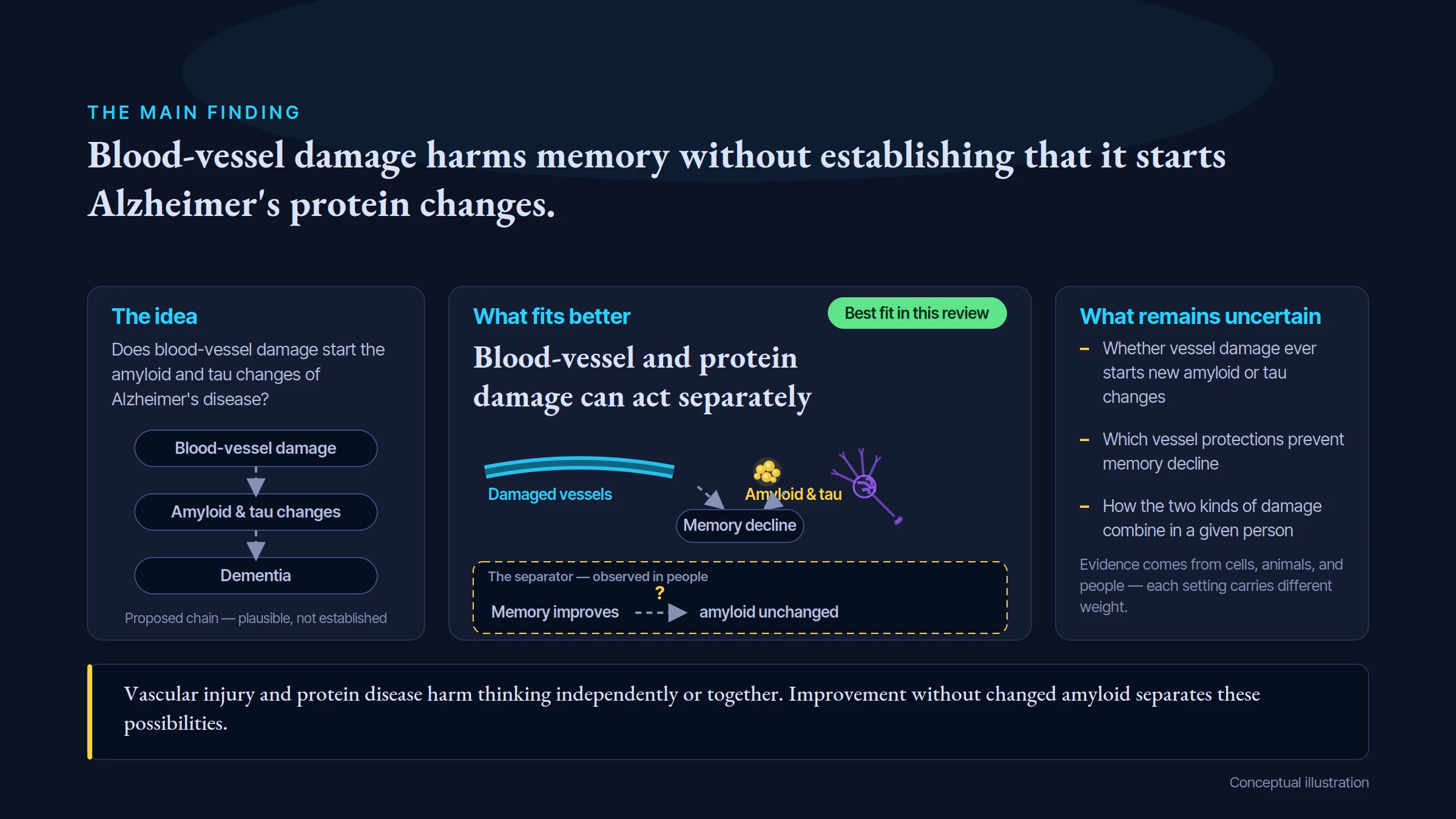
THE MAIN FINDING
Blood-vessel damage harms memory without establishing that it starts Alzheimer's protein changes.
The idea
Does blood-vessel damage start the amyloid and tau changes of Alzheimer's disease?
Blood-vessel damage
Amyloid & tau changes
Dementia
Proposed chain — plausible, not established
What fits better
Blood-vessel and protein damage can act separately
Best fit in this review
Damaged vessels
Amyloid and tau damage
Memory decline
The separator — observed in people
Memory improves
amyloid unchanged
What remains uncertain
Whether vessel damage ever starts new amyloid or tau changes
Which vessel protections prevent memory decline
How the two kinds of damage combine in a given person
Evidence comes from cells, animals, and people — each setting carries different weight.
Vascular injury and protein disease harm thinking independently or together. Improvement without changed amyloid separates these possibilities.
Conceptual illustration
This is the specific idea being tested.
Vascular injury and protein disease harm thinking independently or together. Improvement without changed amyloid separates these possibilities.
A higher rank means a better fit to the evidence in this comparison. It does not prove every part of the leading explanation.
The reviewed hypothesis ranks 4 among 5 models compared; 1 alternative model(s) hold first rank for this stated claim.
Claim under review: rank 4 among 5 compared models.
Leading explanation: Parallel independent pathologies.
Position in this comparison: Between leading and last ranks.
The causal grade asks how well the stated causal claim is established. This comparison asks which of the assessed explanations fits the reviewed findings better. A leading explanation can remain unproven. Models can overlap or include the tested mechanism; an alternative ahead does not make that mechanism irrelevant. These ordinal ranks apply within this review; they do not measure the size of a difference or rank scientific strength across topics.
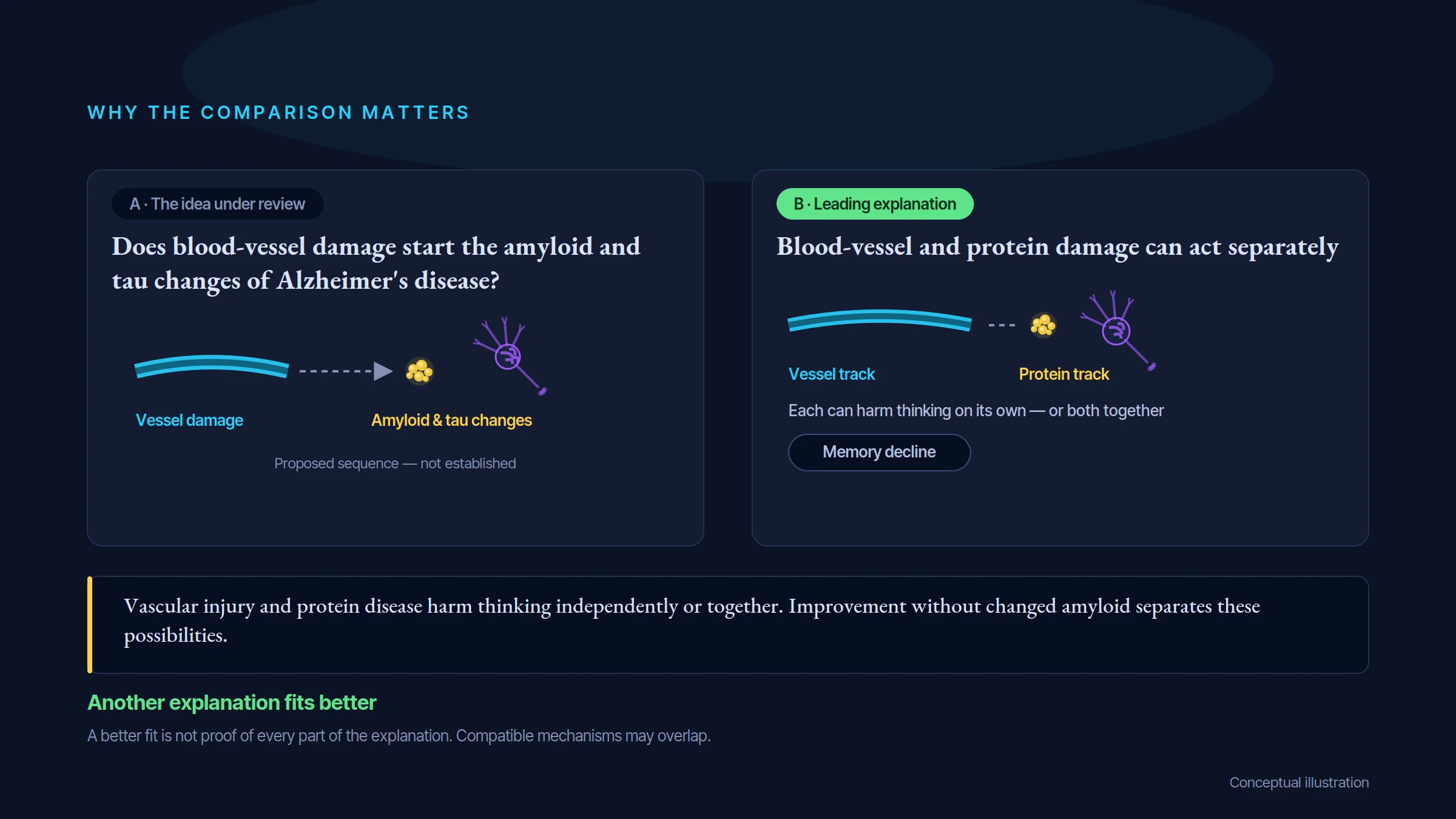
WHY THE COMPARISON MATTERS
A · The idea under review
Does blood-vessel damage start the amyloid and tau changes of Alzheimer's disease?
B · Leading explanation
Blood-vessel and protein damage can act separately
Vascular injury and protein disease harm thinking independently or together. Improvement without changed amyloid separates these possibilities.
Another explanation fits better
A better fit is not proof of every part of the explanation. Compatible mechanisms may overlap.
Conceptual illustration
Vessel damage
Amyloid and tau changes (proposed consequence)
Proposed sequence — not established
Vessel track
Protein track
Each can harm thinking on its own — or both together
Plausible, not established for the stated claim.
Vascular injury and protein disease harm thinking independently or together. Improvement without changed amyloid separates these possibilities.
These explanations can overlap. Ranking their fit to the evidence is separate from deciding how firmly a cause has been established.
Rank 1: Parallel independent pathologies — Vascular lesions and proteinopathies can injure cognition independently and jointly.
Rank 2: Proteinopathy-first vascular amplification — Proteins can impair vessels, which amplify established disease.
Rank 3: Amyloid-driven vascular injury — Amyloid vasculopathy produces cerebrovascular dysfunction and injury.
Rank 4: Two-Hit vascular initiation — Vascular dysfunction starts the AD amyloid/tau cascade and dementia.
Rank 5: Shared systemic inflammatory driver — Systemic exposures produce both vascular and protein injury.
Evidence rating: Γ · Moderate confidence. How the evidence was assessed.
Vascular injury and protein disease harm thinking independently or together. Improvement without changed amyloid separates these possibilities.
A result about how a disease works is a separate question from whether a treatment improves health.
Look for the proposed factor and the outcome, in the people or systems covered by the claim.
Blood-vessel and protein damage can act separately. Vascular injury and protein disease harm thinking independently or together. Improvement without changed amyloid separates these possibilities.
Protect blood vessels before disease, testing prevention of new protein changes as well as memory decline.
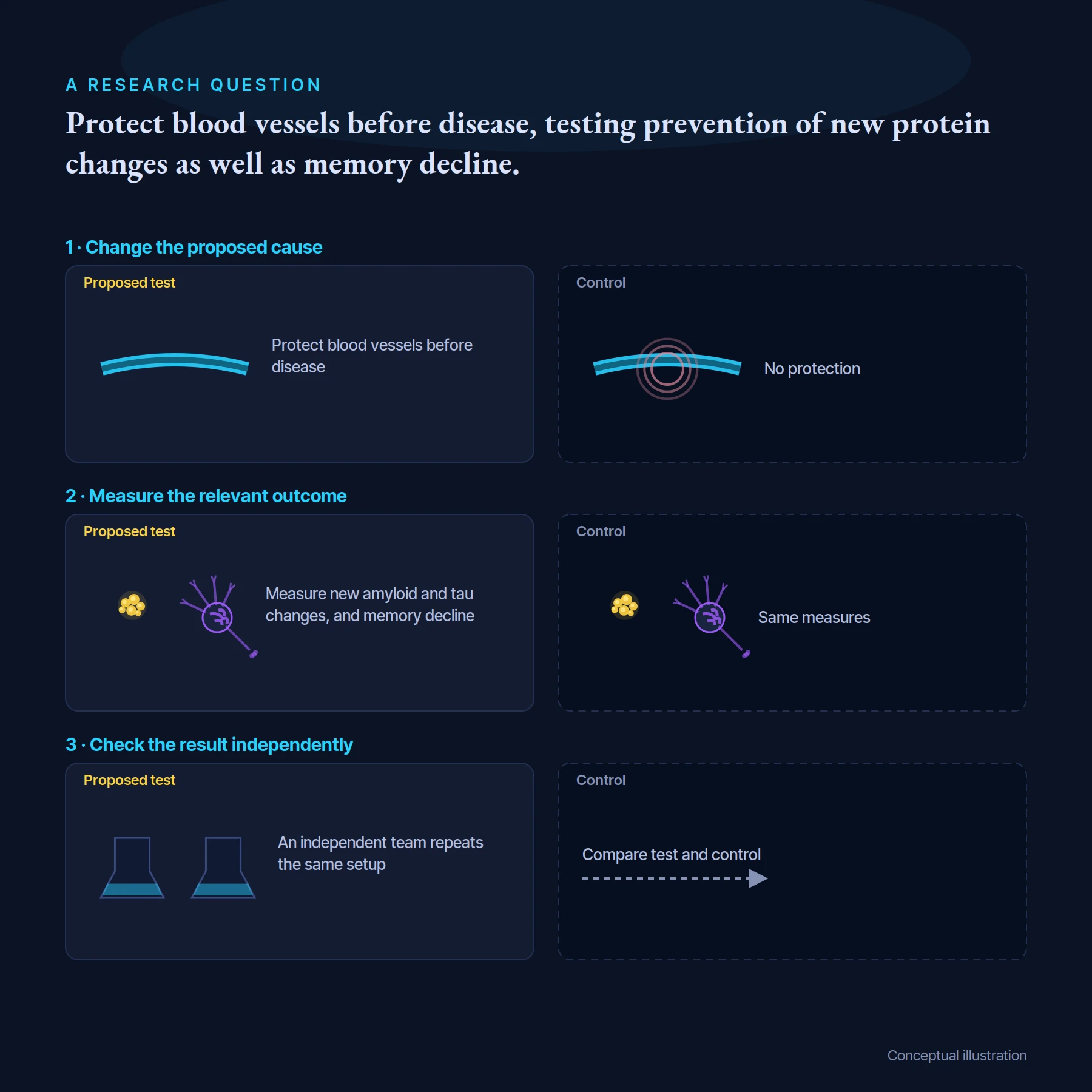
A research question
Protect blood vessels before disease, testing prevention of new protein changes as well as memory decline.
1 · Change the proposed cause
Proposed test
Control
Protect blood vessels before disease
No vessel protection
2 · Measure the relevant outcome
Proposed test
Control
Measure new amyloid and tau changes, and memory decline
Same measures in control
3 · Check the result independently
Proposed test
Control
An independent team repeats the same setup
Compare test and control
Conceptual illustration
Protect blood vessels before disease, testing prevention of new protein changes as well as memory decline.
Check that the intended change really happened.
Allow for other factors and compare with suitable controls.
Look for independent confirmation and the limits of the effect.
These are questions for research, not a claim that the proposed studies have already succeeded.
Proposed tests: 1 test design(s) are registered in the scorecard.
In plain terms, researchers would change the proposed cause, check that it changed as intended, then measure a meaningful outcome while controlling plausible alternatives. The result should be able to support or count against the claim—not only show that a pathway exists.
Study design: Enroll baseline vascular-risk and molecularly amyloid/tau-negative strata, then selectively correct the implicated endothelial/pericyte lesion with verified brain engagement. Combine with orthogonal protein-directed comparison and a non-APP-initiated endogenous model using mediator reinstatement. Follow new biomarker conversion, adjudicated disease and cognitive trajectory, with independent replication.
What would be measured: Incident amyloid/tau conversion, neuronal/white-matter integrity, dementia subtype and sustained cognition
Important controls: Baseline genotype/proteins, age, stroke, vascular lesion, BBB assay specificity, general hemodynamics, bundled care, mortality and attrition
Result that would support the claim: Engaged vascular preservation prevents new AD-specific proteins and disease, and matched lesion reinstatement reverses that protection in predicted strata
Result that would count against it: Adequate early vascular correction preserves cognition without changing protein onset, or protein-directed correction prevents vascular injury instead
Follow the studies, detailed comparisons and evidence ratings behind this guide.
Open the scientific review →