The question
Does less exposure to microbes early in life cause allergies and autoimmune disease?
This is the specific idea being tested.

Does less exposure to microbes early in life cause allergies and autoimmune disease?
What you need to knowSome microbial exposures shape immunity, but the broad claim across allergies and autoimmune disease is not established.Relative explanatory fit: Alternative ranked ahead
Why the alternative fits better: Farm and animal studies support some specific immune mechanisms. Human prevention trials include benefits for particular outcomes, no benefit on other main outcomes and harmful signals from some exposures; an immune-marker change alone is not disease prevention.
For health decisions: Specific early microbial exposures can have different effects; this is not a reason to abandon handwashing or seek infections to prevent allergies.
Claim assessed: Reduced early-life microbial exposure causally increases the incidence of allergic and autoimmune disease.
Finding: Overall Γ follows the registered complete human incidence SC3, with SC1 at Β and exposure-specific immune/clinical SC2 at Ε. Positive eczema trials and mechanistic recipient experiments are retained without claiming generalized protection from asthma or autoimmunity. Neither a universal biomarker cap nor a negative-trial veto is imposed on the narrow clinical successes; the broad conjunction has not crossed its own causal boundary.
Evidence scope: 63 primary reports; literature cutoff 2026-10-09; source examination UTC date 2026-10-12; bounded critical review, not exhaustive systematic review.
The grade applies to the stated claim. Model rankings and individual subclaim grades remain separate from the overall causal-evidence grade.
Full scientific assessment and references · Scorecard (JSON) · Review source (Markdown)
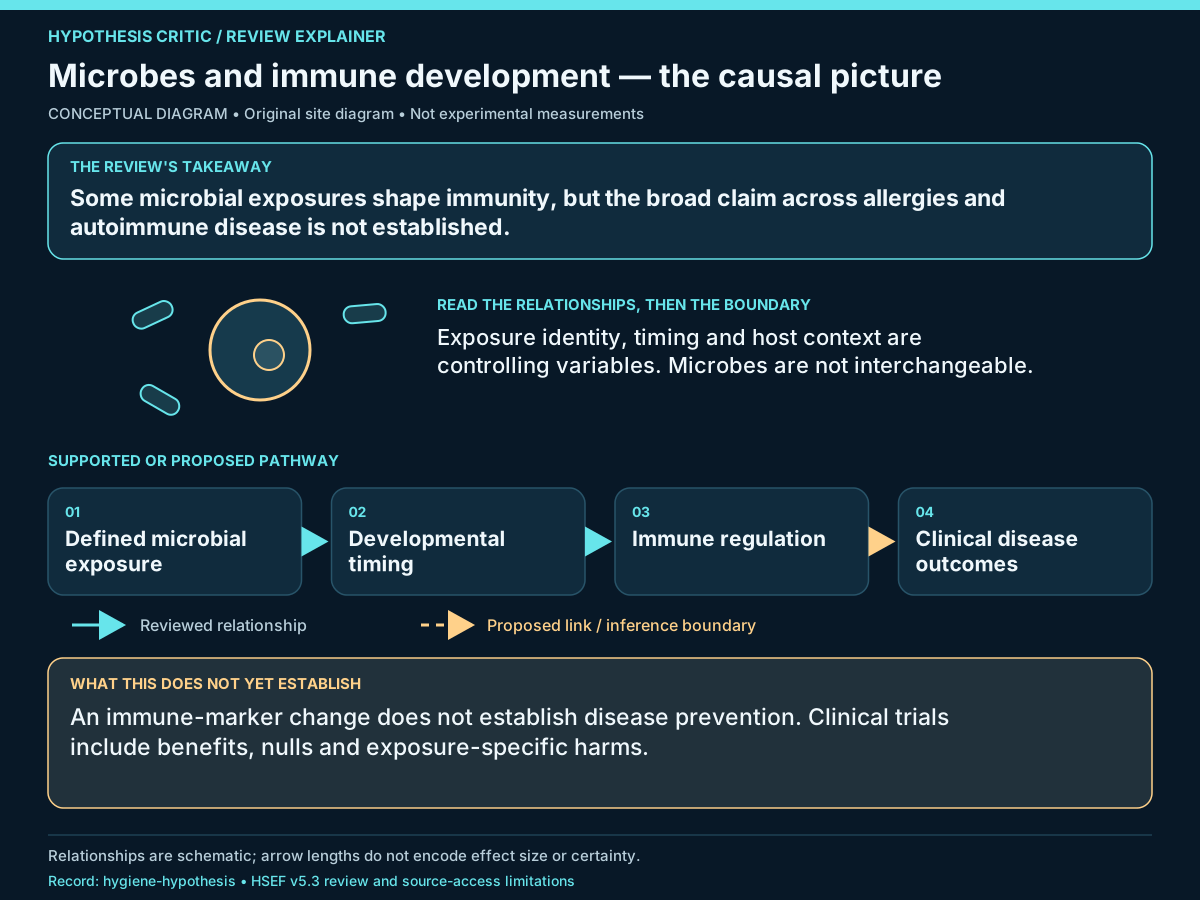
HYPOTHESIS CRITIC  /  REVIEW EXPLAINER
Microbes and immune development — the causal picture
CONCEPTUAL DIAGRAM  •  Original site diagram  •  Not experimental measurements
THE REVIEW'S TAKEAWAY
Some microbial exposures shape immunity, but the broad claim across allergies and autoimmune disease is not established.
READ THE RELATIONSHIPS, THEN THE BOUNDARY
Exposure identity, timing and host context are controlling variables. Microbes are not interchangeable.
SUPPORTED OR PROPOSED PATHWAY
01
Defined microbial exposure
02
Developmental timing
03
Immune regulation
04
Clinical disease outcomes
Reviewed relationship
Proposed link / inference boundary
WHAT THIS DOES NOT YET ESTABLISH
An immune-marker change does not establish disease prevention. Clinical trials include benefits, nulls and exposure-specific harms.
Relationships are schematic; arrow lengths do not encode effect size or certainty.
Record: hygiene-hypothesis  •  HSEF v5.3 review and source-access limitations
This is the specific idea being tested.
Farm and animal studies support some specific immune mechanisms. Human prevention trials include benefits for particular outcomes, no benefit on other main outcomes and harmful signals from some exposures; an immune-marker change alone is not disease prevention.
A higher rank means a better fit to the evidence in this comparison. It does not prove every part of the leading explanation.
The reviewed hypothesis ranks 3 among 4 models compared; 1 alternative model(s) hold first rank for this stated claim.
Claim under review: rank 3 among 4 compared models.
Leading explanation: Exposure-specific immune education.
Position in this comparison: Between leading and last ranks.
The causal grade asks how well the stated causal claim is established. This comparison asks which of the assessed explanations fits the reviewed findings better. A leading explanation can remain unproven. Models can overlap or include the tested mechanism; an alternative ahead does not make that mechanism irrelevant. These ordinal ranks apply within this review; they do not measure the size of a difference or rank scientific strength across topics.
HYPOTHESIS CRITIC  /  REVIEW EXPLAINER
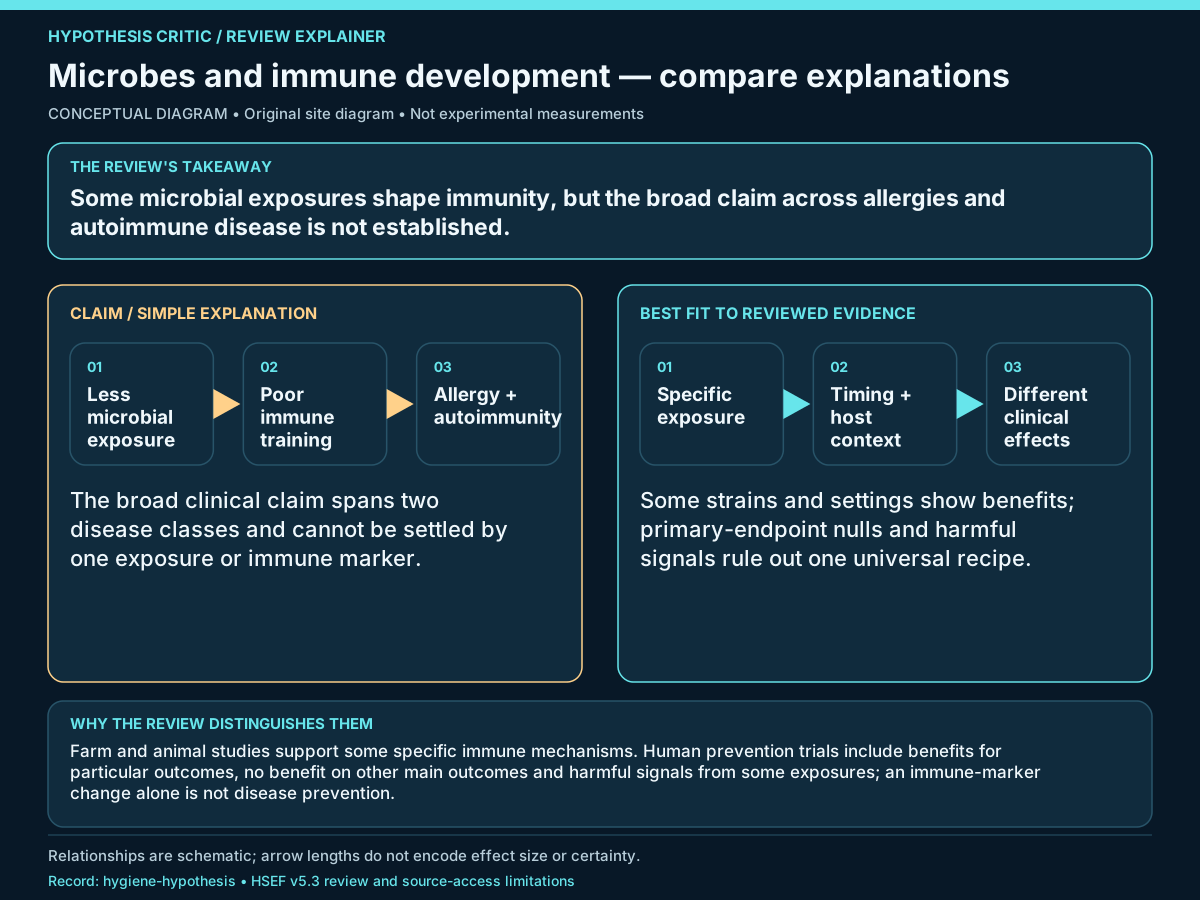
Microbes and immune development — compare explanations
CONCEPTUAL DIAGRAM  •  Original site diagram  •  Not experimental measurements
THE REVIEW'S TAKEAWAY
Some microbial exposures shape immunity, but the broad claim across allergies and autoimmune disease is not established.
CLAIM / SIMPLE EXPLANATION
01
Less microbial exposure
02
Poor immune training
03
Allergy + autoimmunity
The broad clinical claim spans two disease classes and cannot be settled by one exposure or immune marker.
BEST FIT TO REVIEWED EVIDENCE
01
Specific exposure
02
Timing + host context
03
Different clinical effects
Some strains and settings show benefits; primary-endpoint nulls and harmful signals rule out one universal recipe.
WHY THE REVIEW DISTINGUISHES THEM
Farm and animal studies support some specific immune mechanisms. Human prevention trials include benefits for particular outcomes, no benefit on other main outcomes and harmful signals from some exposures; an immune-marker change alone is not disease prevention.
Relationships are schematic; arrow lengths do not encode effect size or certainty.
Record: hygiene-hypothesis  •  HSEF v5.3 review and source-access limitations
Plausible, not established for the stated claim.
Farm and animal studies support some specific immune mechanisms. Human prevention trials include benefits for particular outcomes, no benefit on other main outcomes and harmful signals from some exposures; an immune-marker change alone is not disease prevention.
These explanations can overlap. Ranking their fit to the evidence is separate from deciding how firmly a cause has been established.
Rank 1: Exposure-specific immune education — Microbial factor, host pathway, dose and developmental window determine beneficial or harmful immune effects.
Rank 2: Barrier and antigen-specific tolerance — Food antigen timing and barrier/immune pathways can change selected allergy outcomes independently of microbial restoration.
Rank 3: General microbial deprivation — Reduced early microbial contact broadly causes allergic and autoimmune disease.
Rank 4: Shared environment and indication effects — Diet, barrier damage, genetics and infection/antibiotic indications generate part of the exposure-disease association.
Evidence rating: Γ · Moderate confidence. How the evidence was assessed.
Farm and animal studies support some specific immune mechanisms. Human prevention trials include benefits for particular outcomes, no benefit on other main outcomes and harmful signals from some exposures; an immune-marker change alone is not disease prevention.
Some human trials report prevention of particular eczema outcomes with particular microbial preparations, while other trials find no benefit or harmful signals. That does not establish protection from all allergies or autoimmune disease, and results for one preparation do not automatically apply to another. Ordinary hand hygiene remains an effective way to reduce infections; the review does not justify seeking infections as an immune-training treatment.
Further reading: CDC: handwashing and infection prevention.
Look for the proposed factor and the outcome, in the people or systems covered by the claim.
Which microbe, when exposure happens and who is exposed all affect whether an exposure helps or harms. Farm and animal studies support some specific immune mechanisms. Human prevention trials include benefits for particular outcomes, no benefit on other main outcomes and harmful signals from some exposures; an immune-marker change alone is not disease prevention.
Choose a specific microbial intervention in advance and follow actual disease outcomes, with enough time and suitable controls to detect both benefits and harms.
HYPOTHESIS CRITIC  /  REVIEW EXPLAINER
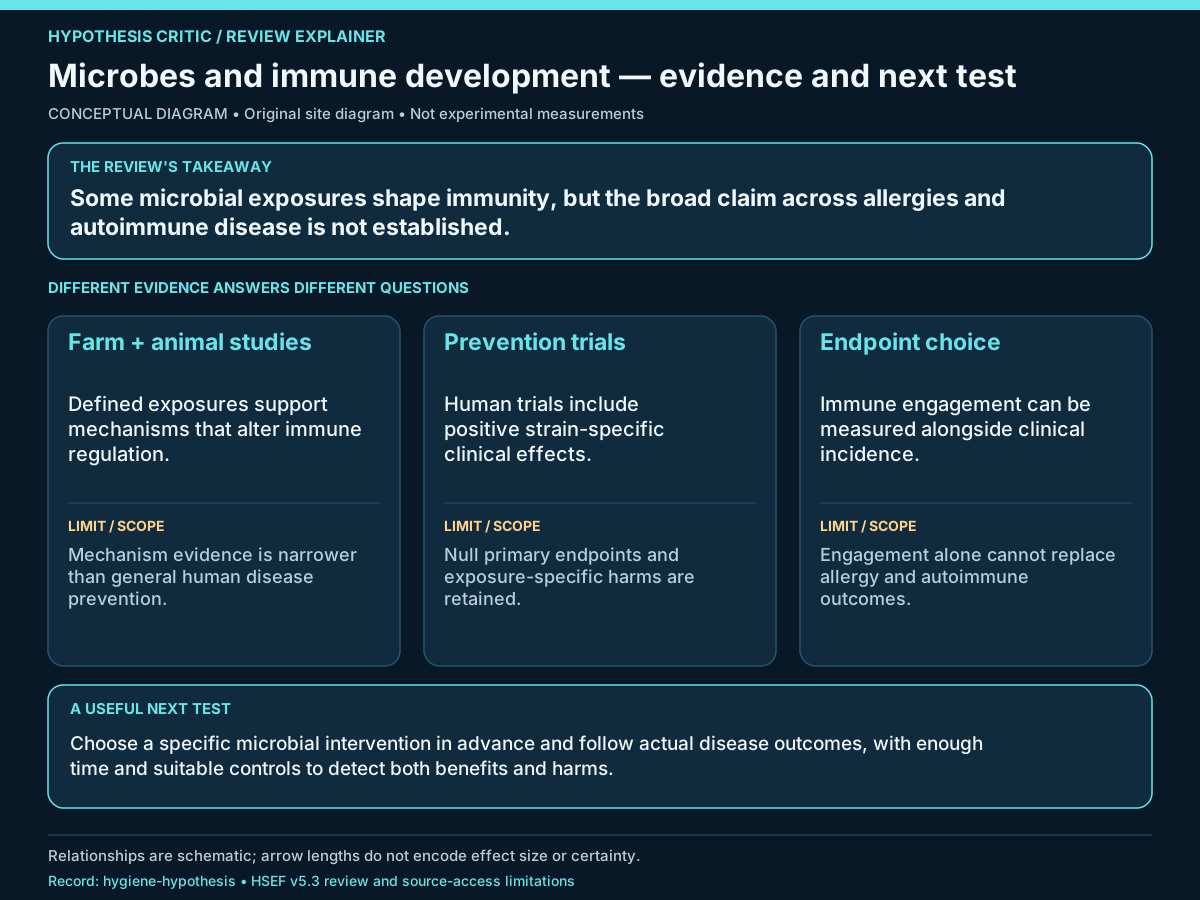
Microbes and immune development — evidence and next test
CONCEPTUAL DIAGRAM  •  Original site diagram  •  Not experimental measurements
THE REVIEW'S TAKEAWAY
Some microbial exposures shape immunity, but the broad claim across allergies and autoimmune disease is not established.
DIFFERENT EVIDENCE ANSWERS DIFFERENT QUESTIONS
Farm + animal studies
Defined exposures support mechanisms that alter immune regulation.
LIMIT / SCOPE
Mechanism evidence is narrower than general human disease prevention.
Prevention trials
Human trials include positive strain-specific clinical effects.
LIMIT / SCOPE
Null primary endpoints and exposure-specific harms are retained.
Endpoint choice
Immune engagement can be measured alongside clinical incidence.
LIMIT / SCOPE
Engagement alone cannot replace allergy and autoimmune outcomes.
A USEFUL NEXT TEST
Choose a specific microbial intervention in advance and follow actual disease outcomes, with enough time and suitable controls to detect both benefits and harms.
Relationships are schematic; arrow lengths do not encode effect size or certainty.
Record: hygiene-hypothesis  •  HSEF v5.3 review and source-access limitations
Choose a specific microbial intervention in advance and follow actual disease outcomes, with enough time and suitable controls to detect both benefits and harms.
Check that the intended change really happened.
Allow for other factors and compare with suitable controls.
Look for independent confirmation and the limits of the effect.
These are questions for research, not a claim that the proposed studies have already succeeded.
Proposed tests: 1 test design(s) are registered in the scorecard.
In plain terms, researchers would change the proposed cause, check that it changed as intended, then measure a meaningful outcome while controlling plausible alternatives. The result should be able to support or count against the claim—not only show that a pathway exists.
Study design: Register microbial-factor/consortium restoration in an objectively baseline-defined infant population, with credible placebo, measured exposure/engagement and immune mediation. Prespecify clinical eczema, asthma and separately powered autoimmune endpoints, retain all randomized participants, and independently replicate dose/window and host-genotype predictions. Include antigen/diet/barrier and infection-indication controls.
What would be measured: Prespecified clinical disease incidence and mediator engagement over sufficient pediatric follow-up
Important controls: Product identity/viability, dose, colonization versus transient exposure, maternal/infant timing, diet and allergens, barrier status, antibiotic indication, pathogen infection and familial risk
Result that would support the claim: Defined restoration changes clinical incidence with the predicted immune mediator and independently replicated baseline context
Result that would count against it: Adequate engagement changes only immune markers, fails clinical endpoints, or harms predefined groups; apparent benefit is confined to unregistered subgroup analyses
Follow the studies, detailed comparisons and evidence ratings behind this guide.
Open the scientific review →