The question
Are shortening chromosome ends the main cause of ordinary human aging?
This is the specific idea being tested.
Are shortening chromosome ends the main cause of ordinary human aging?
What you need to knowDamaged telomeres can cause tissue disease, but their role as the main driver of ordinary human aging remains unresolved.Relative explanatory fit: Alternative ranked ahead
Why the alternative fits better: Repairing telomere problems can rescue deficient animal models. Human genetic evidence also shows trade-offs involving cardiovascular disease and cancer, so changing a telomere measurement alone does not show that someone will live longer in good health.
For health decisions: A telomere-length result or a product that changes it does not by itself show that someone will age more slowly or live longer in good health.
Claim assessed: Progressive telomere attrition is a primary cause of organismal aging in humans rather than a marker of replicative history.
Finding: Registered primary-subclaim aggregation returns Γ from SC3, despite Ε for SC1 and SC2. Severe telomere dysfunction is a causal pathology in defined contexts. The positive model and syndrome results cannot establish that gradual attrition is a primary rate-limiting cause of ordinary human aging. Human genetic disease trade-offs and bounded negative functional/lifespan findings constrain scope; they do not show all telomere biology is causally irrelevant.
Evidence scope: 51 primary reports; literature cutoff 2026-10-09; source examination UTC date 2026-10-12; bounded critical review, not exhaustive systematic review.
The grade applies to the stated claim. Model rankings and individual subclaim grades remain separate from the overall causal-evidence grade.
Full scientific assessment and references · Scorecard (JSON) · Review source (Markdown)
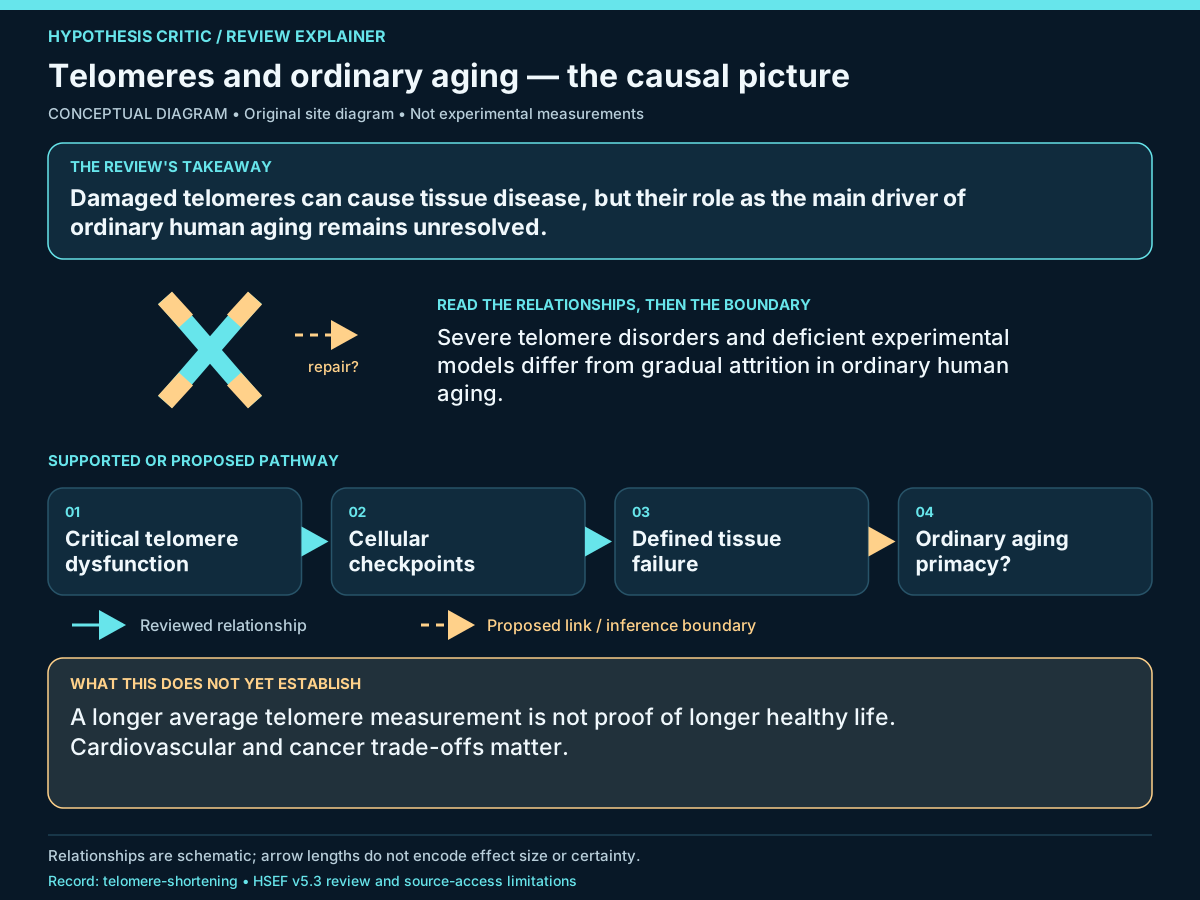
HYPOTHESIS CRITIC  /  REVIEW EXPLAINER
Telomeres and ordinary aging — the causal picture
CONCEPTUAL DIAGRAM  •  Original site diagram  •  Not experimental measurements
THE REVIEW'S TAKEAWAY
Damaged telomeres can cause tissue disease, but their role as the main driver of ordinary human aging remains unresolved.
repair?
READ THE RELATIONSHIPS, THEN THE BOUNDARY
Severe telomere disorders and deficient experimental models differ from gradual attrition in ordinary human aging.
SUPPORTED OR PROPOSED PATHWAY
01
Critical telomere dysfunction
02
Cellular checkpoints
03
Defined tissue failure
04
Ordinary aging primacy?
Reviewed relationship
Proposed link / inference boundary
WHAT THIS DOES NOT YET ESTABLISH
A longer average telomere measurement is not proof of longer healthy life. Cardiovascular and cancer trade-offs matter.
Relationships are schematic; arrow lengths do not encode effect size or certainty.
Record: telomere-shortening  •  HSEF v5.3 review and source-access limitations
This is the specific idea being tested.
Repairing telomere problems can rescue deficient animal models. Human genetic evidence also shows trade-offs involving cardiovascular disease and cancer, so changing a telomere measurement alone does not show that someone will live longer in good health.
A higher rank means a better fit to the evidence in this comparison. It does not prove every part of the leading explanation.
The reviewed hypothesis ranks 4 among 4 models compared; 1 alternative model(s) hold first rank for this stated claim.
Claim under review: rank 4 among 4 compared models.
Leading explanation: Context-dependent telomere pathology.
Position in this comparison: Last recorded rank.
The causal grade asks how well the stated causal claim is established. This comparison asks which of the assessed explanations fits the reviewed findings better. A leading explanation can remain unproven. Models can overlap or include the tested mechanism; an alternative ahead does not make that mechanism irrelevant. These ordinal ranks apply within this review; they do not measure the size of a difference or rank scientific strength across topics.
HYPOTHESIS CRITIC  /  REVIEW EXPLAINER
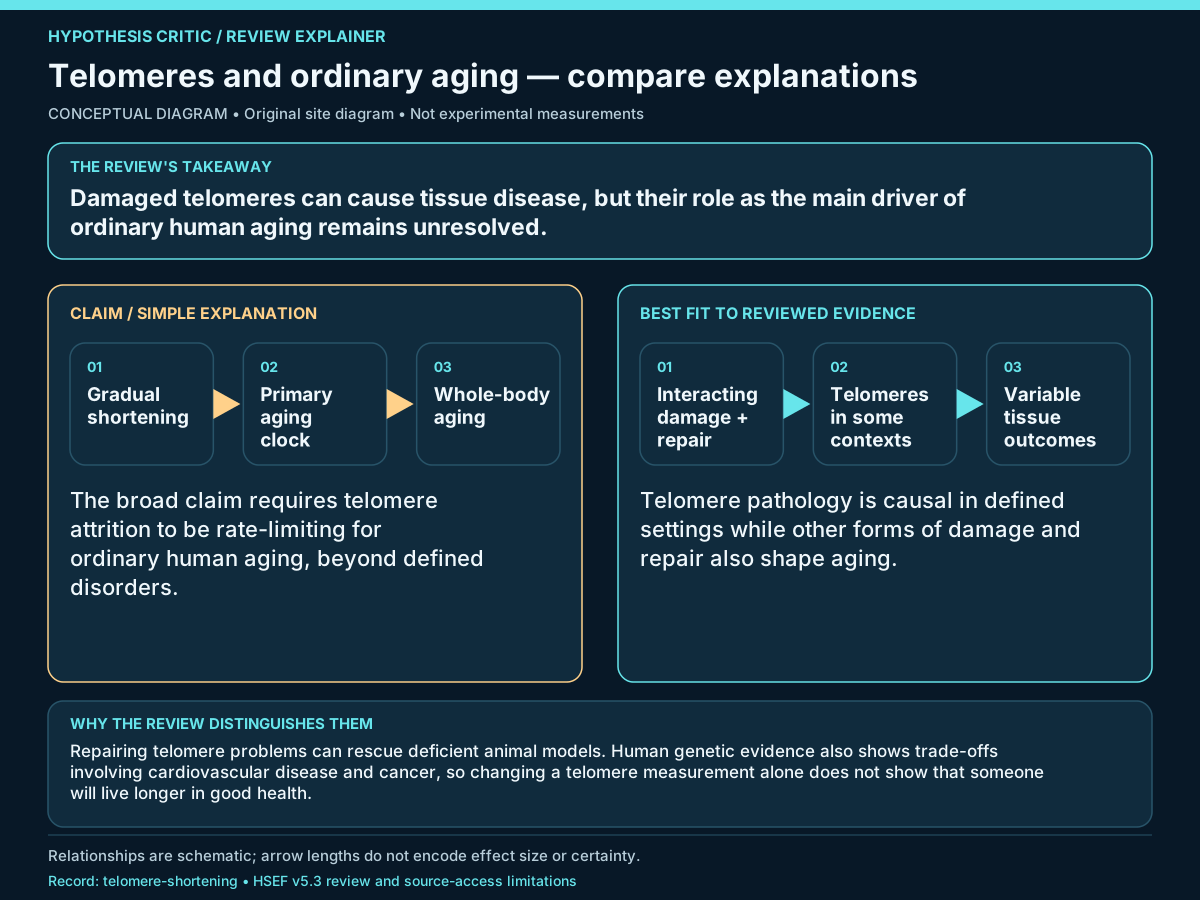
Telomeres and ordinary aging — compare explanations
CONCEPTUAL DIAGRAM  •  Original site diagram  •  Not experimental measurements
THE REVIEW'S TAKEAWAY
Damaged telomeres can cause tissue disease, but their role as the main driver of ordinary human aging remains unresolved.
CLAIM / SIMPLE EXPLANATION
01
Gradual shortening
02
Primary aging clock
03
Whole-body aging
The broad claim requires telomere attrition to be rate-limiting for ordinary human aging, beyond defined disorders.
BEST FIT TO REVIEWED EVIDENCE
01
Interacting damage + repair
02
Telomeres in some contexts
03
Variable tissue outcomes
Telomere pathology is causal in defined settings while other forms of damage and repair also shape aging.
WHY THE REVIEW DISTINGUISHES THEM
Repairing telomere problems can rescue deficient animal models. Human genetic evidence also shows trade-offs involving cardiovascular disease and cancer, so changing a telomere measurement alone does not show that someone will live longer in good health.
Relationships are schematic; arrow lengths do not encode effect size or certainty.
Record: telomere-shortening  •  HSEF v5.3 review and source-access limitations
Plausible, not established for the stated claim.
Repairing telomere problems can rescue deficient animal models. Human genetic evidence also shows trade-offs involving cardiovascular disease and cancer, so changing a telomere measurement alone does not show that someone will live longer in good health.
These explanations can overlap. Ranking their fit to the evidence is separate from deciding how firmly a cause has been established.
Rank 1: Context-dependent telomere pathology — Critical telomere damage limits regenerative tissues in defined genotypes and exposures.
Rank 2: Multifactorial aging and replicative history — Telomere measures partly reflect exposure, clonal composition and regenerative history within broader aging biology.
Rank 3: Cancer-surveillance trade-off — Telomere reserve balances proliferative capacity against malignant expansion.
Rank 4: Telomere primacy — Progressive shortening is the dominant ordinary-human organismal aging cause.
Evidence rating: Γ · Moderate confidence. How the evidence was assessed.
Repairing telomere problems can rescue deficient animal models. Human genetic evidence also shows trade-offs involving cardiovascular disease and cancer, so changing a telomere measurement alone does not show that someone will live longer in good health.
Severe telomere disorders are different from ordinary aging and can cause real tissue disease. That does not make a consumer telomere-length result a complete measure of a person's aging or establish that a lengthening product improves health. Studies need to measure function, illness and longevity directly and account for cancer-related trade-offs, rather than treating a longer telomere measurement as the benefit itself.
Look for the proposed factor and the outcome, in the people or systems covered by the claim.
Aging involves several interacting kinds of damage and repair; telomeres matter especially in certain conditions. Repairing telomere problems can rescue deficient animal models. Human genetic evidence also shows trade-offs involving cardiovascular disease and cancer, so changing a telomere measurement alone does not show that someone will live longer in good health.
Separate telomere repair from the enzyme's other effects and measure lasting function, disease outcomes and cancer risk in a clearly defined setting.
HYPOTHESIS CRITIC  /  REVIEW EXPLAINER
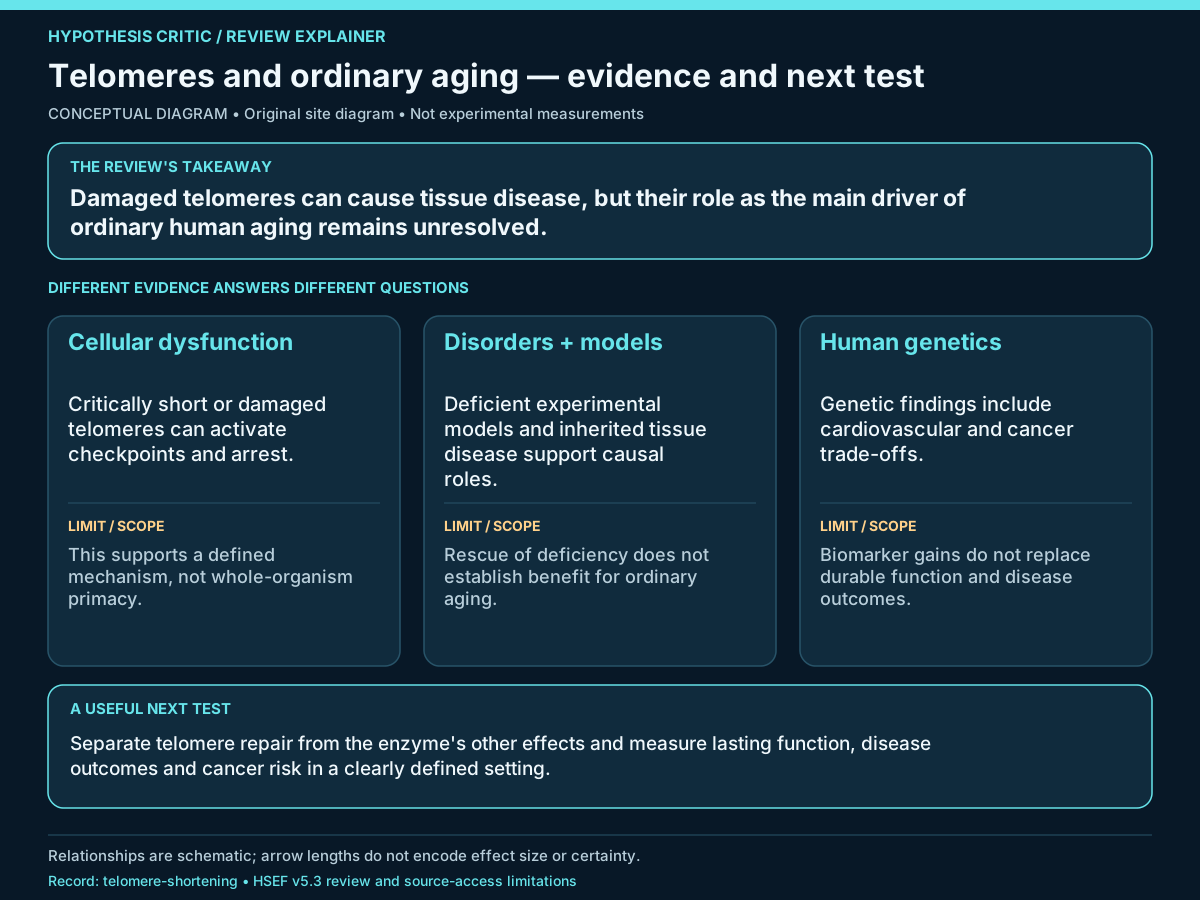
Telomeres and ordinary aging — evidence and next test
CONCEPTUAL DIAGRAM  •  Original site diagram  •  Not experimental measurements
THE REVIEW'S TAKEAWAY
Damaged telomeres can cause tissue disease, but their role as the main driver of ordinary human aging remains unresolved.
DIFFERENT EVIDENCE ANSWERS DIFFERENT QUESTIONS
Cellular dysfunction
Critically short or damaged telomeres can activate checkpoints and arrest.
LIMIT / SCOPE
This supports a defined mechanism, not whole-organism primacy.
Disorders + models
Deficient experimental models and inherited tissue disease support causal roles.
LIMIT / SCOPE
Rescue of deficiency does not establish benefit for ordinary aging.
Human genetics
Genetic findings include cardiovascular and cancer trade-offs.
LIMIT / SCOPE
Biomarker gains do not replace durable function and disease outcomes.
A USEFUL NEXT TEST
Separate telomere repair from the enzyme's other effects and measure lasting function, disease outcomes and cancer risk in a clearly defined setting.
Relationships are schematic; arrow lengths do not encode effect size or certainty.
Record: telomere-shortening  •  HSEF v5.3 review and source-access limitations
Separate telomere repair from the enzyme's other effects and measure lasting function, disease outcomes and cancer risk in a clearly defined setting.
Check that the intended change really happened.
Allow for other factors and compare with suitable controls.
Look for independent confirmation and the limits of the effect.
These are questions for research, not a claim that the proposed studies have already succeeded.
Proposed tests: 1 test design(s) are registered in the scorecard.
In plain terms, researchers would change the proposed cause, check that it changed as intended, then measure a meaningful outcome while controlling plausible alternatives. The result should be able to support or count against the claim—not only show that a pathway exists.
Study design: A randomized prospectively registered trial in older adults without telomere disorders, with tissue-specific critical-short-telomere engagement, a selective maintenance intervention and orthogonal mechanism controls, prespecified functional healthspan endpoints and sufficiently long cancer surveillance. Preclinical epistasis should first separate canonical telomere effects from noncanonical TERT actions.
What would be measured: Prespecified disability-free functional aging trajectory plus tissue-specific telomere dysfunction, not mean LTL alone
Important controls: Matched clinical attention, blinded functional assessment, nutritional/immune composition controls, off-target and canonical/noncanonical separation, competing cancer outcomes
Result that would support the claim: Engaged selective restoration improves function across the fixed ordinary-aging scope and supports temporal mediation
Result that would count against it: Adequate engagement without functional benefit, or benefit persisting when canonical telomere maintenance is prevented
Follow the studies, detailed comparisons and evidence ratings behind this guide.
Open the scientific review →