The question
Do liquid-like droplets explain how structures inside the cell nucleus form and work?
This is the specific idea being tested.
Do liquid-like droplets explain how structures inside the cell nucleus form and work?
What you need to knowSome nuclear structures behave like droplets, but several physical mechanisms can work together.Relative explanatory fit: Alternative ranked ahead
Why the alternative fits better: Liquid separation, networks, RNA and ongoing production contribute differently to different structures.
Claim assessed: Liquid–liquid phase separation assembles and organizes nuclear bodies in living cells, and the liquid state itself confers their compositional and functional properties.
Finding: Preregistered weakest-link aggregation returns Γ from SC3 common organizing physics, despite scoped SC1 Ε and SC2 Δ. Primary SC2 and its scope-matched sensitivity return Δ; broad class-general scope remains Γ. This does not downgrade genuine nucleolar demixing or functional material-property contributions.
Evidence scope: 63 primary reports; literature cutoff 2026-10-08; source examination UTC date 2026-10-08; bounded critical review, not exhaustive systematic review.
The grade applies to the stated claim. Model rankings and individual subclaim grades remain separate from the overall causal-evidence grade.
Full scientific assessment and references · Scorecard (JSON) · Review source (Markdown)
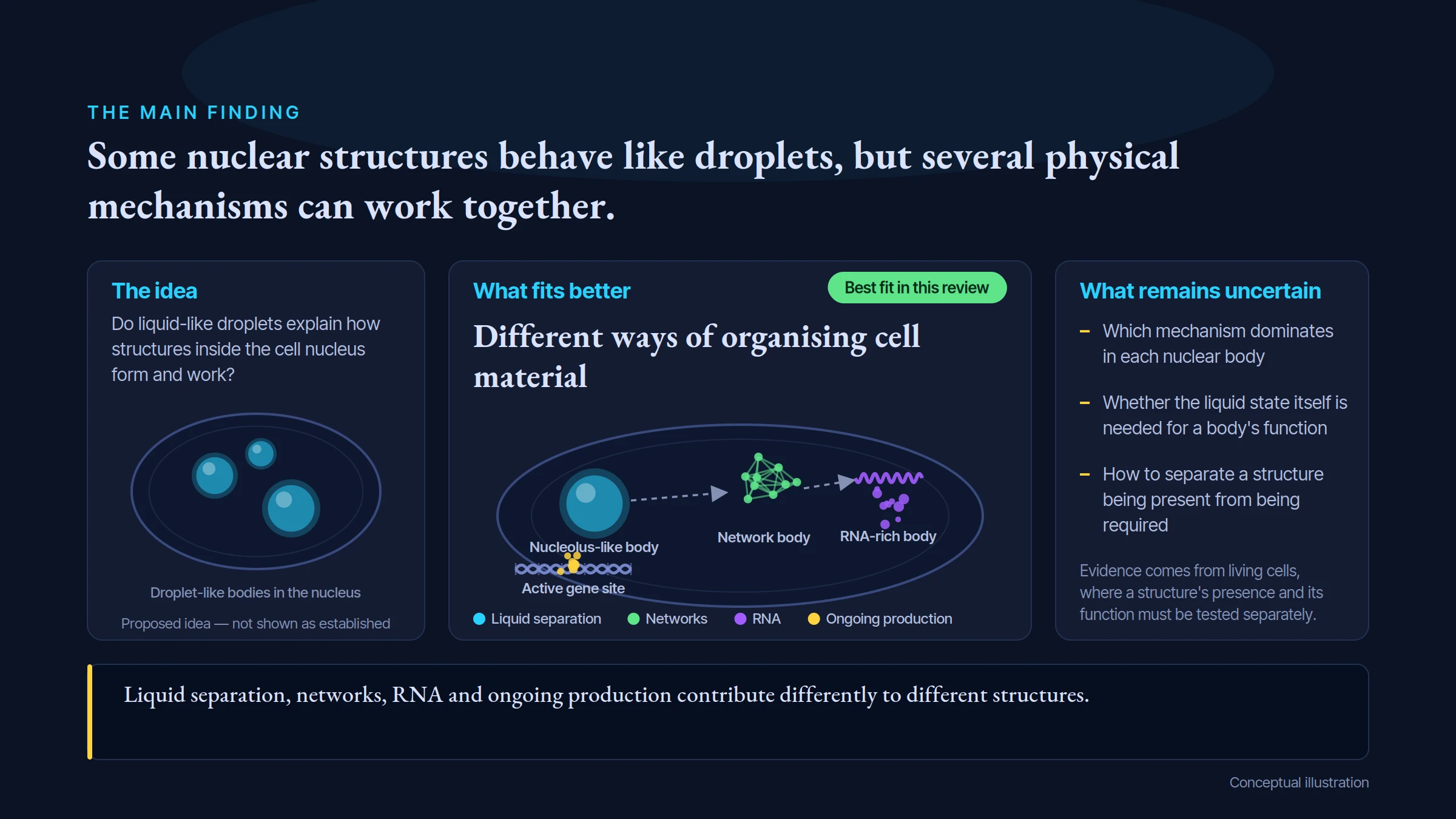
THE MAIN FINDING
Some nuclear structures behave like droplets, but several physical mechanisms can work together.
The idea
Do liquid-like droplets explain how structures inside the cell nucleus form and work?
Droplet-like bodies in the nucleus
Proposed idea — not shown as established
What fits better
Best fit in this review
Different ways of organising cell material
Nucleolus-like body (droplet)
Network body (polymer network)
RNA-rich body
Active gene site (ongoing production)
Liquid separation
Networks
RNA
Ongoing production
What remains uncertain
Which mechanism dominates in each nuclear body
Whether the liquid state itself is needed for a body's function
How to separate a structure being present from being required
Evidence comes from living cells, where a structure's presence and its function must be tested separately.
Liquid separation, networks, RNA and ongoing production contribute differently to different structures.
Conceptual illustration
This is the specific idea being tested.
Liquid separation, networks, RNA and ongoing production contribute differently to different structures.
A higher rank means a better fit to the evidence in this comparison. It does not prove every part of the leading explanation.
The reviewed hypothesis ranks 2 among 5 models compared; 1 alternative model(s) hold first rank for this stated claim.
Claim under review: rank 2 among 5 compared models.
Leading explanation: Pluralist soft-matter mechanisms.
Position in this comparison: Next after leading rank.
The causal grade asks how well the stated causal claim is established. This comparison asks which of the assessed explanations fits the reviewed findings better. A leading explanation can remain unproven. Models can overlap or include the tested mechanism; an alternative ahead does not make that mechanism irrelevant. These ordinal ranks apply within this review; they do not measure the size of a difference or rank scientific strength across topics.
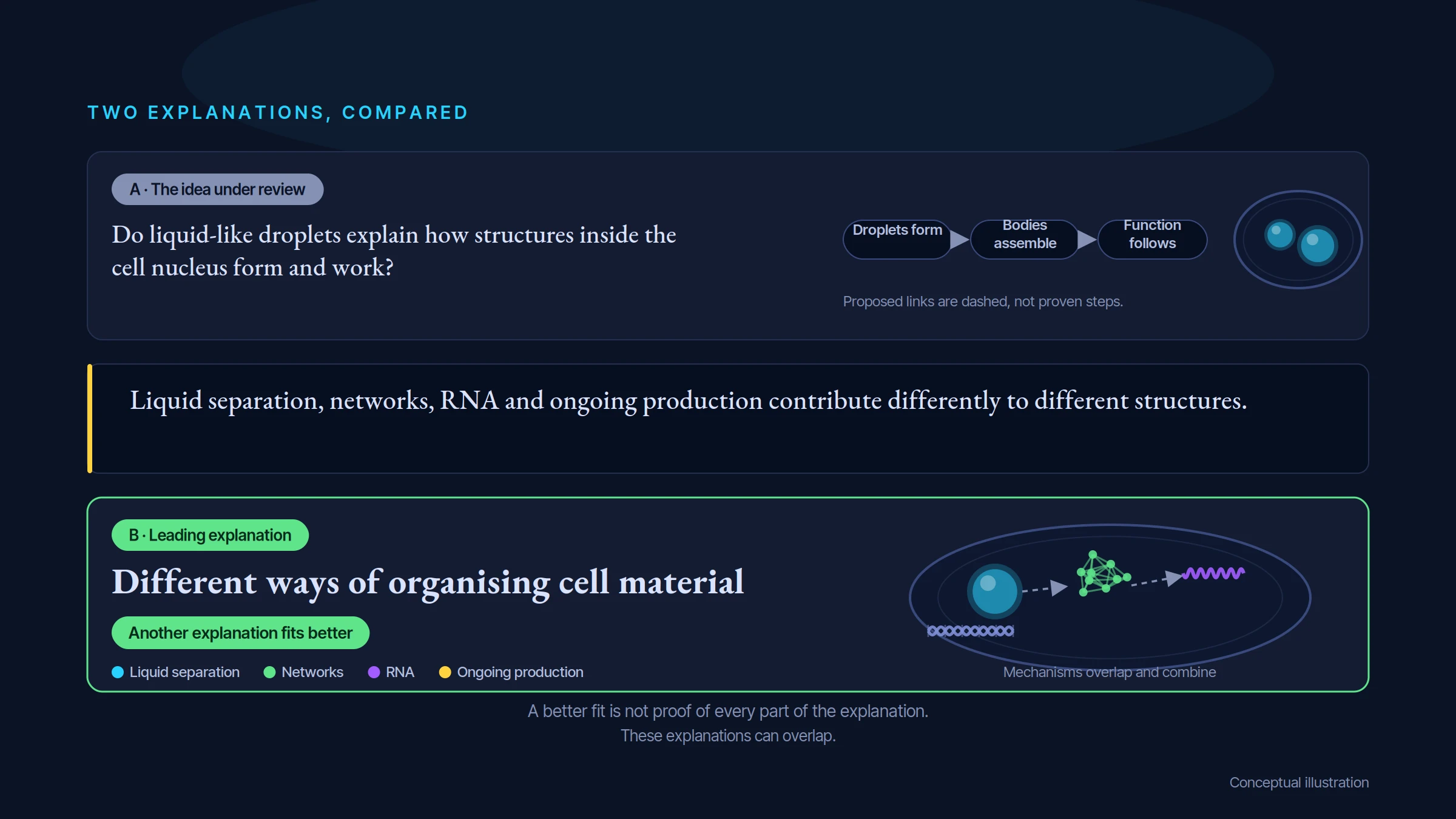
TWO EXPLANATIONS, COMPARED
A · The idea under review
Do liquid-like droplets explain how structures inside the cell nucleus form and work?
Droplets form
Bodies assemble
Function follows
Proposed links are dashed, not proven steps.
Liquid separation, networks, RNA and ongoing production contribute differently to different structures.
B · Leading explanation
Different ways of organising cell material
Another explanation fits better
Liquid separation
Networks
RNA
Ongoing production
Mechanisms overlap and combine
A better fit is not proof of every part of the explanation.
These explanations can overlap.
Conceptual illustration
Plausible, not established for the stated claim.
Liquid separation, networks, RNA and ongoing production contribute differently to different structures.
These explanations can overlap. Ranking their fit to the evidence is separate from deciding how firmly a cause has been established.
Rank 1: Pluralist soft-matter mechanisms — Demixing, percolation, polymer scaffolding, RNA maturation and active production cooperate differently by body/constituent.
Rank 2: Macroscopic LLPS — Common demixing and liquid material state organize all named nuclear-body classes.
Rank 3: RNA block-copolymer micelles — NEAT1 architecture constrains paraspeckle geometry through microphase separation.
Rank 4: Dynamic gel/polymer scaffolds — RNA/protein networks can support rapid small-protein diffusion while constraining large substrates.
Rank 5: Polymer bridging or clustered binding — DNA/RNA scaffolds can concentrate proteins without autonomous bulk demixing.
Evidence rating: Γ · Moderate confidence. How the evidence was assessed.
Liquid separation, networks, RNA and ongoing production contribute differently to different structures.
A result about how a disease works is a separate question from whether a treatment improves health.
Look for the proposed factor and the outcome, in the people or systems covered by the claim.
Different ways of organising cell material. Liquid separation, networks, RNA and ongoing production contribute differently to different structures.
Change liquid-like behaviour without changing ingredients, then test the structure's function.
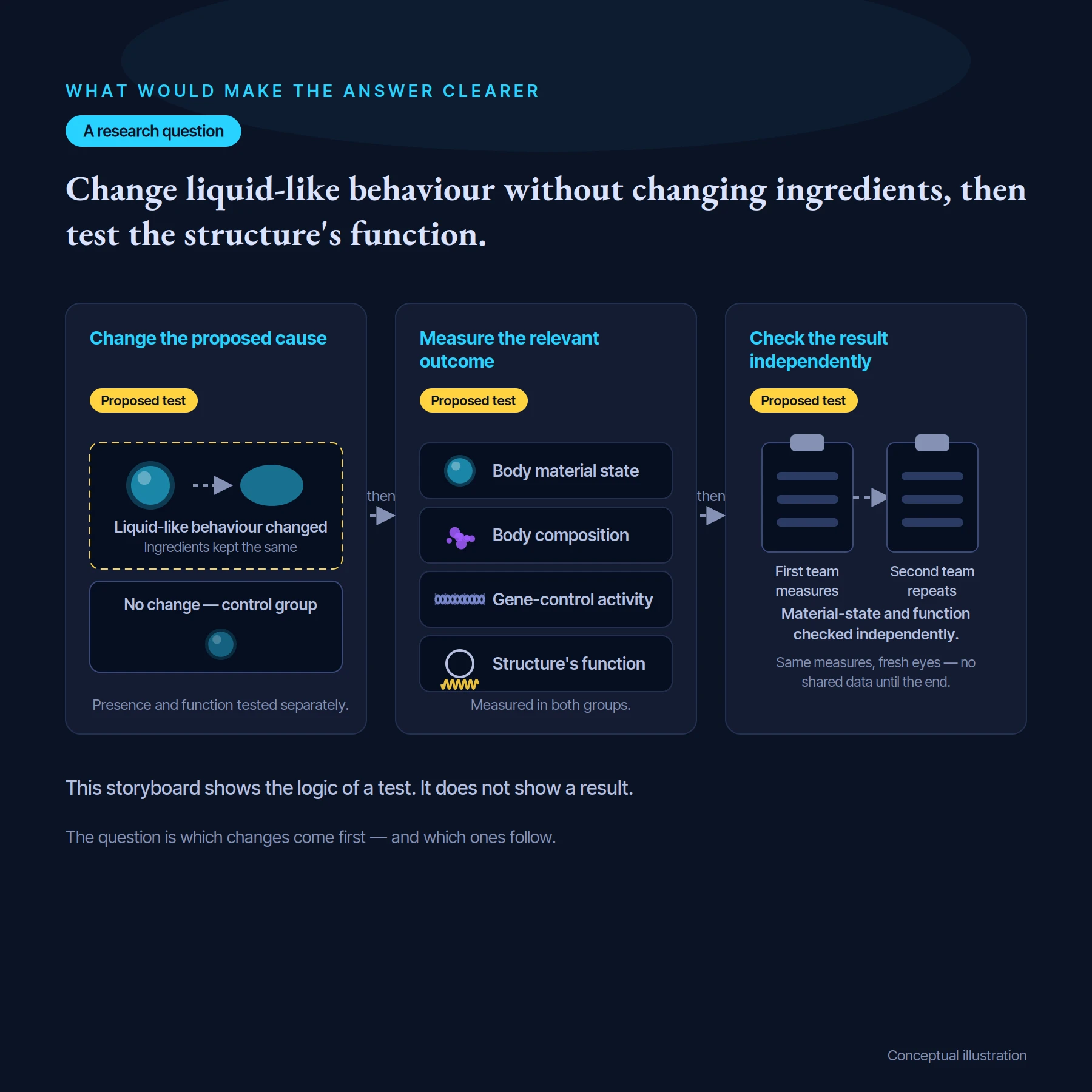
WHAT WOULD MAKE THE ANSWER CLEARER
A research question
Change liquid-like behaviour without changing ingredients, then test the structure's function.
then
then
Change the proposed cause
Proposed test
Liquid-like behaviour changed
Ingredients kept the same
No change — control group
Presence and function tested separately.
Measure the relevant outcome
Proposed test
Body material state
Body composition
Gene-control activity
Structure's function
Measured in both groups.
Check the result independently
Proposed test
First team measures
Second team repeats
Material-state and function checked independently.
Same measures, fresh eyes — no shared data until the end.
This storyboard shows the logic of a test. It does not show a result.
The question is which changes come first — and which ones follow.
Conceptual illustration
Change liquid-like behaviour without changing ingredients, then test the structure's function.
Check that the intended change really happened.
Allow for other factors and compare with suitable controls.
Look for independent confirmation and the limits of the effect.
These are questions for research, not a claim that the proposed studies have already succeeded.
Proposed tests: 1 test design(s) are registered in the scorecard.
In plain terms, researchers would change the proposed cause, check that it changed as intended, then measure a meaningful outcome while controlling plausible alternatives. The result should be able to support or count against the claim—not only show that a pathway exists.
Study design: In preregistered nucleolar, speckle and paraspeckle systems, use endogenous reversible sequence/charge edits that change relaxation or demixing while preserving abundance, RNA/client affinity and catalytic activity; rescue the material state with matched constructs and test physical and processing outputs separately.
What would be measured: Calibrated interfacial mixing/rheology, client composition, nascent-rRNA maturation or endogenous splicing and cell-state measures
Important controls: Expression/valency/client-affinity matched rescue, light/solvent controls, orthogonal probes of RNA/protein mobility, cell-cycle and global transcription stress
Result that would support the claim: Output changes track state across orthogonal edits and recover on state restoration with binding/function conserved
Result that would count against it: Output remains intact after verified state change, or only loss of binding/scaffold explains impairment
Follow the studies, detailed comparisons and evidence ratings behind this guide.
Open the scientific review →