The question
Does persistent infection with cancer-causing HPV lead to common cervical cancers?
This is the specific idea being tested.
Does persistent infection with cancer-causing HPV lead to common cervical cancers?
What you need to knowPersistent cancer-causing HPV is required for the common HPV-related cervical cancer pathway, but infection alone is not enough.Relative explanatory fit: Leading among models compared
Why the evidence supports this: A required infection is not a guaranteed cancer outcome. Uncommon different pathways fall outside this claim.
Claim assessed: Among primary invasive cervical squamous carcinomas and usual-type endocervical adenocarcinomas classified by anatomy and histomorphology before HPV-result review, development of the common HPV-associated pathway requires prior type-specific persistent infection with a carcinogenic HPV genotype; preventing that infection should markedly reduce the corresponding cancers.
Finding: Persistent carcinogenic HPV is the primary upstream cause of nearly all common squamous and usual-type cervical carcinomas, and preventing infection changes high-grade and invasive disease as predicted. The claim stops at Θ because 'HPV-associated' is circular unless independently operationalized, most infections are not sufficient, and rare HPV-independent squamous and glandular cervical carcinomas are real.
Evidence scope: Primary prospective, tumour-attribution, randomized prophylaxis, population-incidence, screening, pathology, genomics, and viral-oncogene perturbation evidence through 2026-09-29. Full text was read wherever accessible and abstract-only rows are labeled. The attached packet (SHA256 7E097D3D50D2068F68BDB1CD022DF4A045DAC46A9F25E51262EC7568E9DB11EB) was treated as methodology, not scientific evidence.
The grade applies to the stated claim. Model rankings and individual subclaim grades remain separate from the overall causal-evidence grade.
Full scientific assessment and references · Scorecard (JSON) · Review source (Markdown)
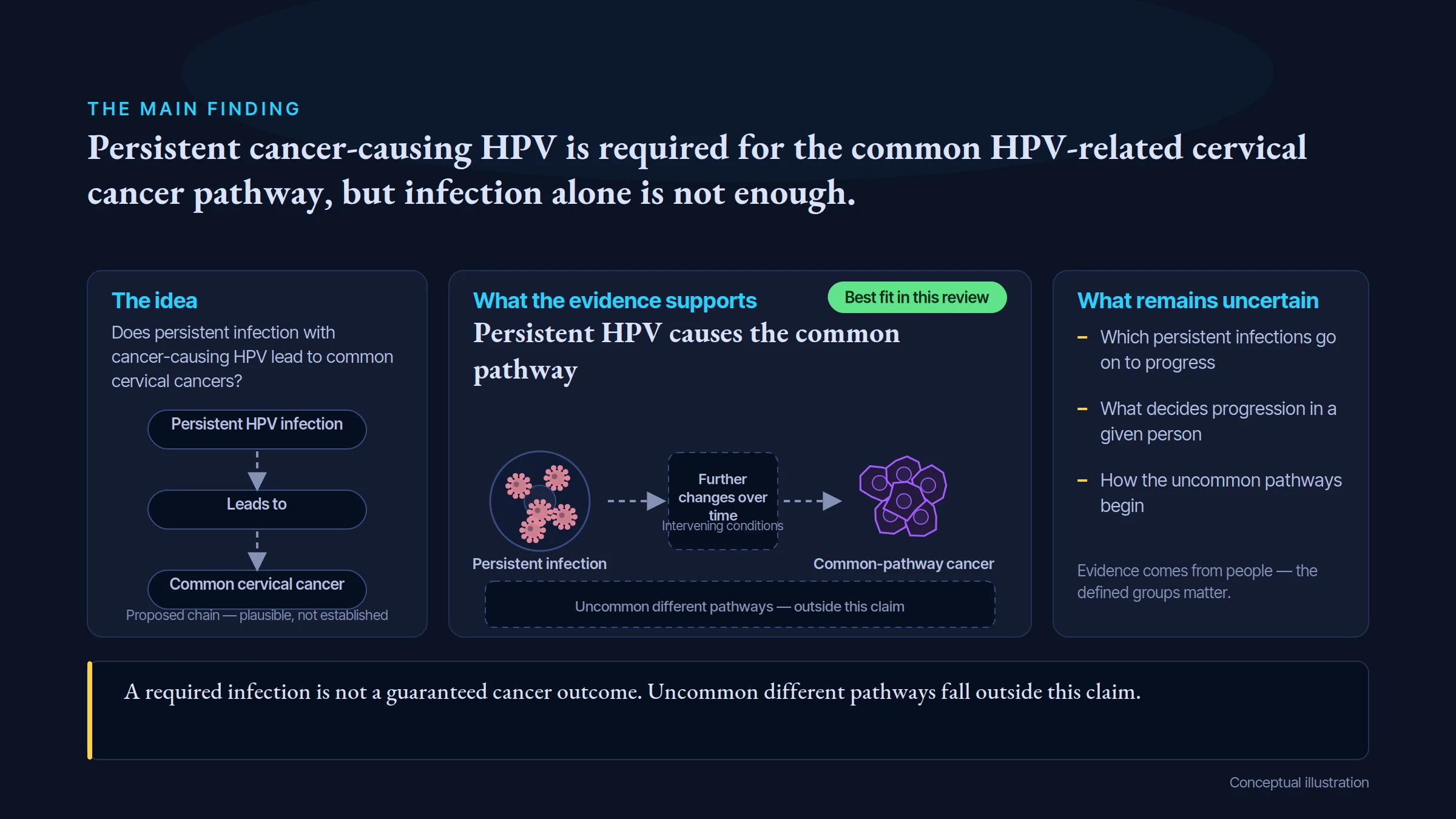
THE MAIN FINDING
Persistent cancer-causing HPV is required for the common HPV-related cervical cancer pathway, but infection alone is not enough.
The idea
What the evidence supports
What remains uncertain
Does persistent infection with cancer-causing HPV lead to common cervical cancers?
Persistent HPV infection
Leads to
Common cervical cancer
Proposed chain — plausible, not established
Persistent HPV causes the common pathway
Best fit in this review
Persistent infection
Further changes over time
Intervening conditions
Common-pathway cancer
Uncommon different pathways — outside this claim
Which persistent infections go on to progress
What decides progression in a given person
How the uncommon pathways begin
Evidence comes from people — the defined groups matter.
A required infection is not a guaranteed cancer outcome. Uncommon different pathways fall outside this claim.
Conceptual illustration
This is the specific idea being tested.
A required infection is not a guaranteed cancer outcome. Uncommon different pathways fall outside this claim.
This conclusion applies to the people, conditions and outcomes covered by the review.
The reviewed hypothesis ranks first among 5 models compared for this stated claim.
Claim under review: rank 1 among 5 compared models.
Leading explanation: Persistent carcinogenic-HPV necessary-cause model.
Position in this comparison: First rank.
The causal grade asks how well the stated causal claim is established. This comparison asks which of the assessed explanations fits the reviewed findings better. A leading explanation can remain unproven. Models can overlap or include the tested mechanism; an alternative ahead does not make that mechanism irrelevant. These ordinal ranks apply within this review; they do not measure the size of a difference or rank scientific strength across topics.
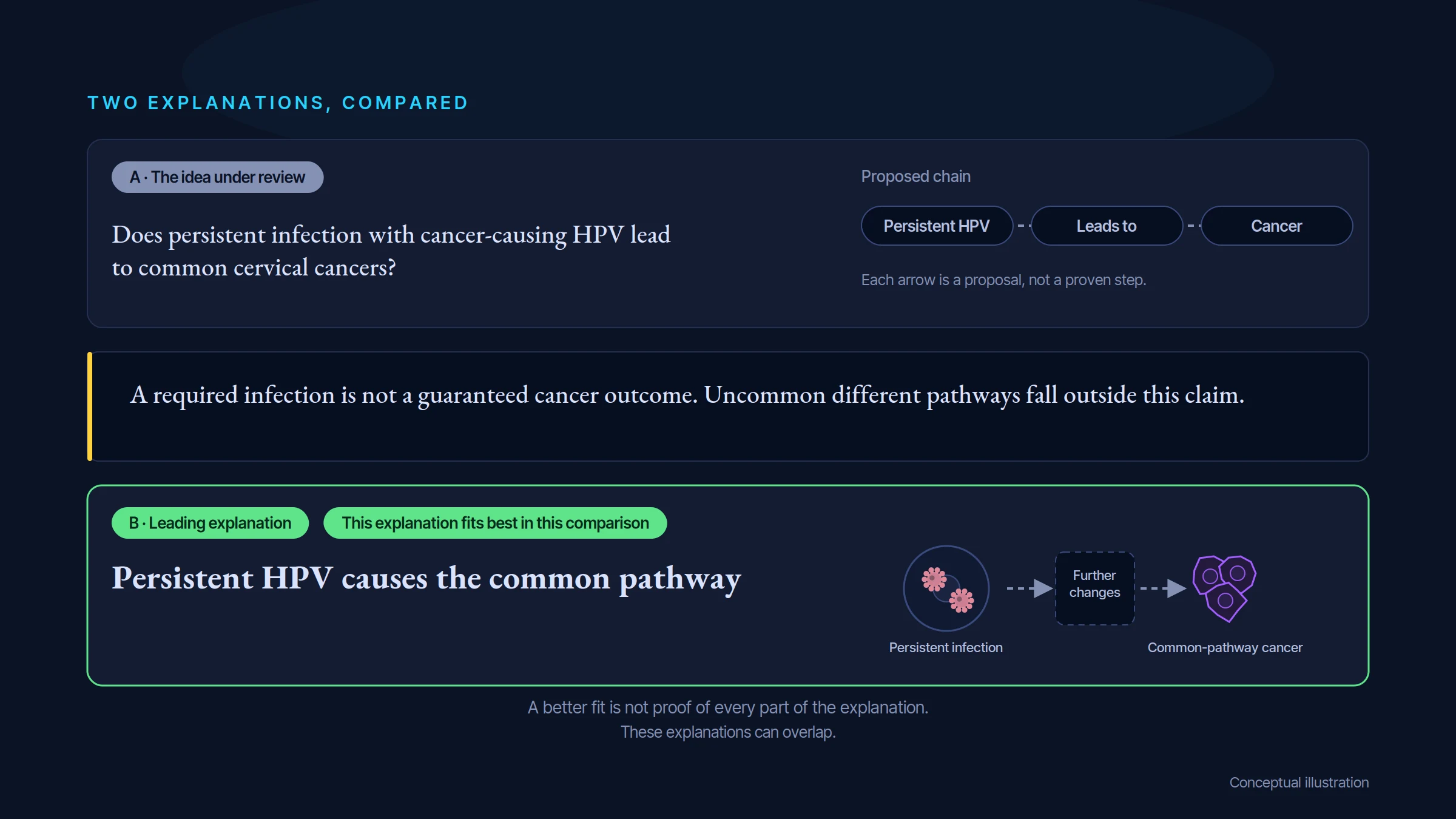
TWO EXPLANATIONS, COMPARED
A · The idea under review
Does persistent infection with cancer-causing HPV lead to common cervical cancers?
Proposed chain
Persistent HPV
Leads to
Cancer
Each arrow is a proposal, not a proven step.
A required infection is not a guaranteed cancer outcome. Uncommon different pathways fall outside this claim.
B · Leading explanation
Persistent HPV causes the common pathway
This explanation fits best in this comparison
Persistent infection
Further changes
Common-pathway cancer
A better fit is not proof of every part of the explanation.
These explanations can overlap.
Conceptual illustration
Very well established for the stated claim.
A required infection is not a guaranteed cancer outcome. Uncommon different pathways fall outside this claim.
These explanations can overlap. Ranking their fit to the evidence is separate from deciding how firmly a cause has been established.
Rank 1: Persistent carcinogenic-HPV necessary-cause model — Type-specific persistent carcinogenic HPV is the indispensable upstream exposure in the common HPV-associated cervical-cancer pathway, while host cofactors govern progression.
Rank 2: Histotype-mixture and technical-false-negative model — Most apparent HPV-negative exceptions are either genuine HPV-independent cervical tumour classes, noncervical mimics, poor specimens, or assay failures rather than failures of the common HPV-driven pathway.
Rank 3: Host-first permissive model — Host genomic instability, immune failure, smoking, hormonal exposure, or tissue state is primary, while HPV is a frequent passenger or accelerator.
Rank 4: Incomplete carcinogenic-genotype-set model — Persistent papillomavirus remains causal, but accepted high-risk panels omit rare causal genotypes or occasional nominally low-risk types.
Rank 5: Transient hit-and-run model — HPV initiates transformation but can later be lost, leaving a truly virus-negative descendant still caused by prior infection.
Evidence rating: Θ · High confidence. How the evidence was assessed.
A required infection is not a guaranteed cancer outcome. Uncommon different pathways fall outside this claim.
For human health, the finding supports vaccination, screening, follow-up of abnormal results, and timely treatment of high-grade precancer when indicated. HPV is common, can persist without symptoms, and is not a moral verdict or evidence about a person's worth or faithfulness. Effective prevention works best through regular, evidence-based care rather than through attempts to infer personal cancer risk from a single result or from symptoms alone.
Look for the proposed factor and the outcome, in the people or systems covered by the claim.
Persistent HPV causes the common pathway. A required infection is not a guaranteed cancer outcome. Uncommon different pathways fall outside this claim.
Measure prevention of persistent infection and the corresponding cancers in the defined groups.
These illustrations show the key questions tested in the review. They are conceptual drawings, not microscope images or experimental results.
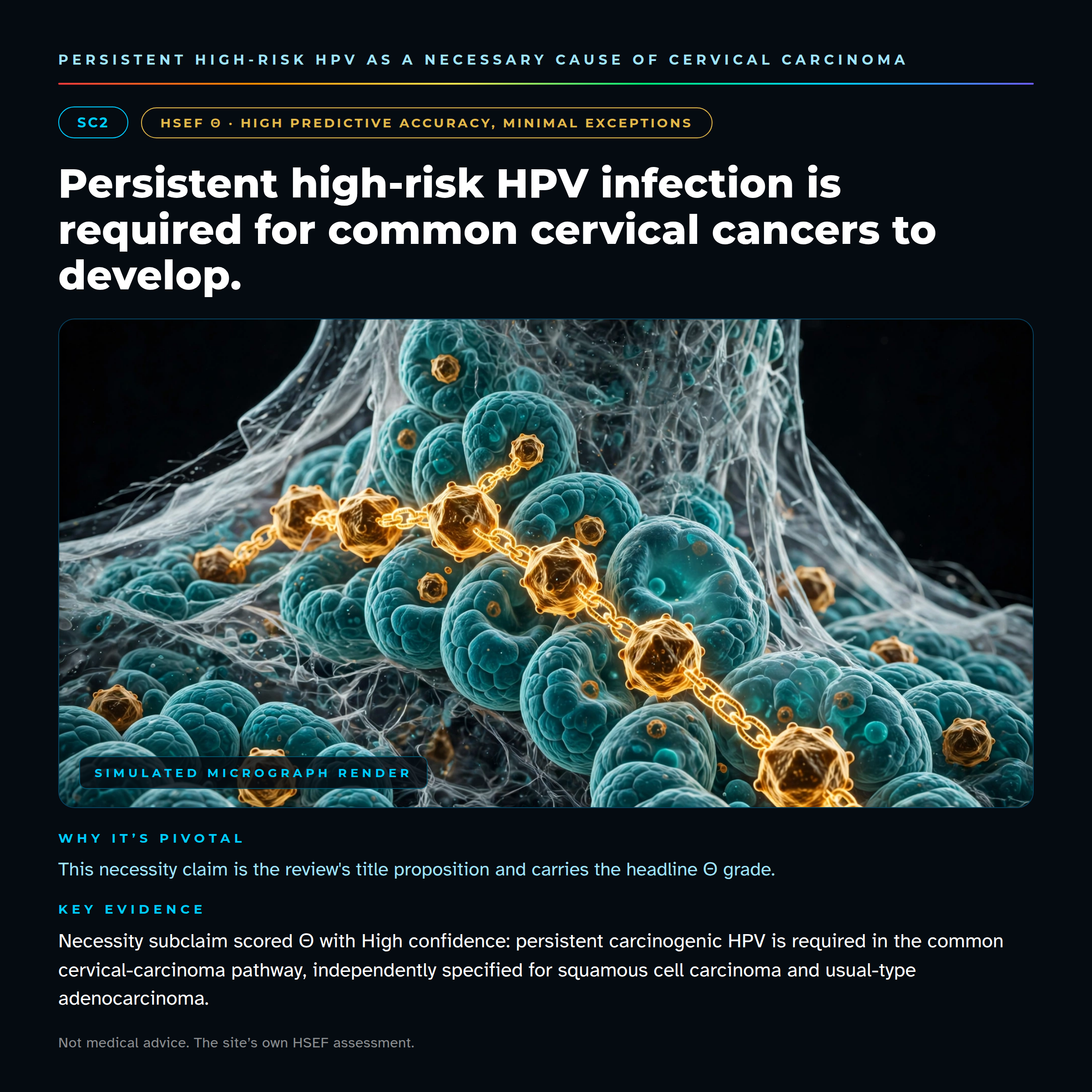
Prior persistent carcinogenic HPV is an etiologic requirement for the common squamous and usual-type endocervical carcinoma pathways when those histologies are specified before the viral assay.
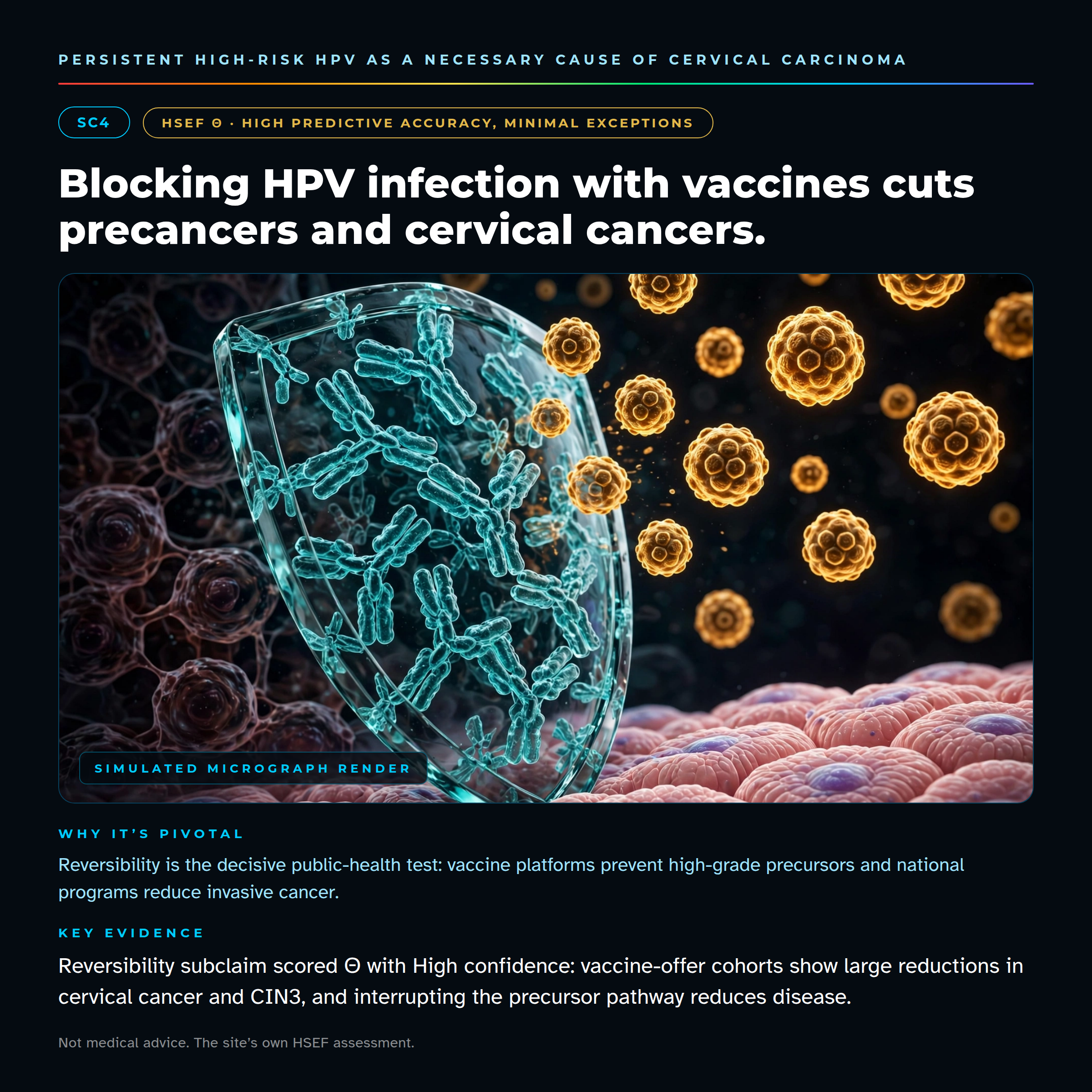
Preventing acquisition of carcinogenic HPV, or detecting and treating its precursor pathway, reduces high-grade cervical neoplasia and invasive cervical carcinoma.
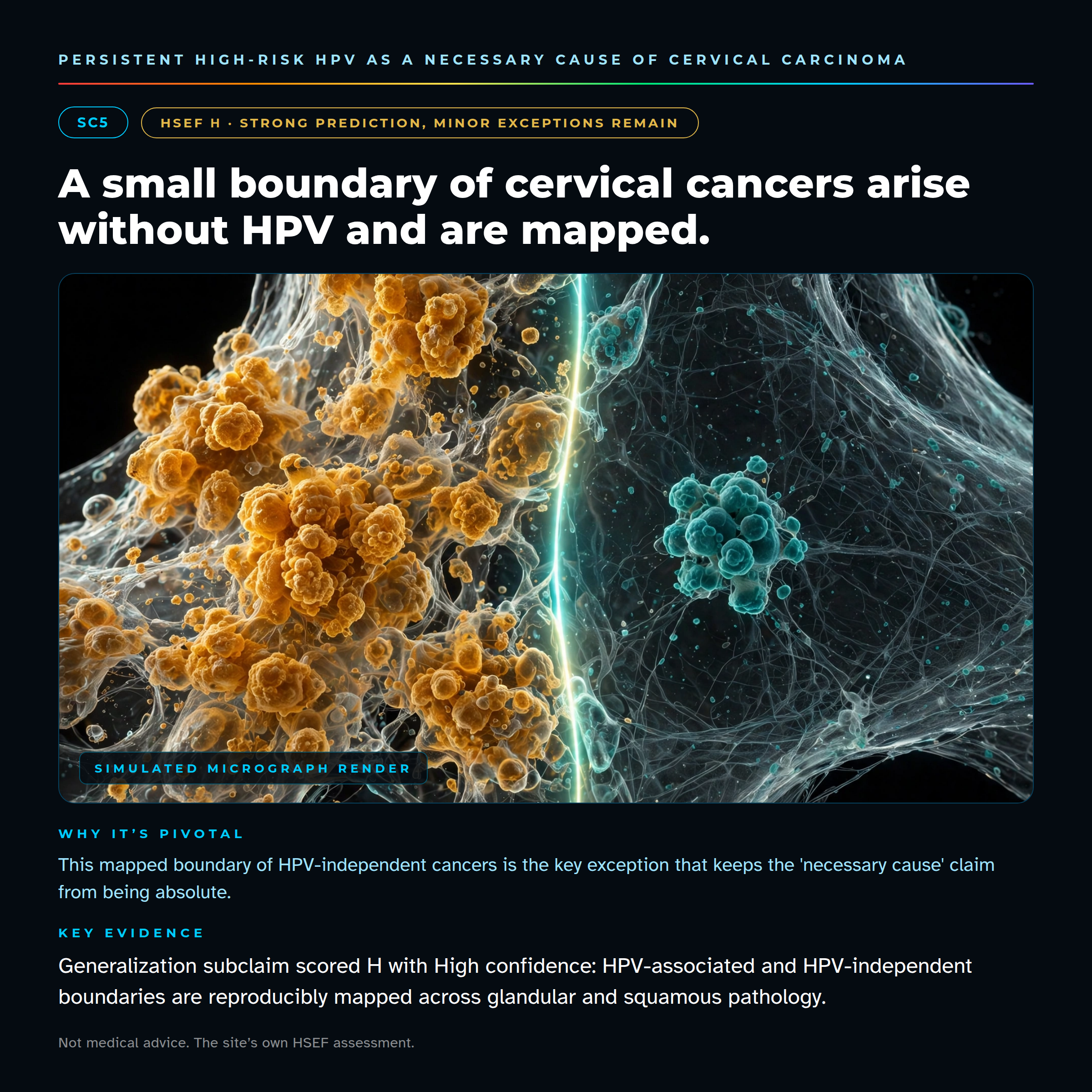
The HPV-associated causal pathway and its HPV-independent boundary can be mapped reproducibly without deleting discordant tumours after their viral result is known.
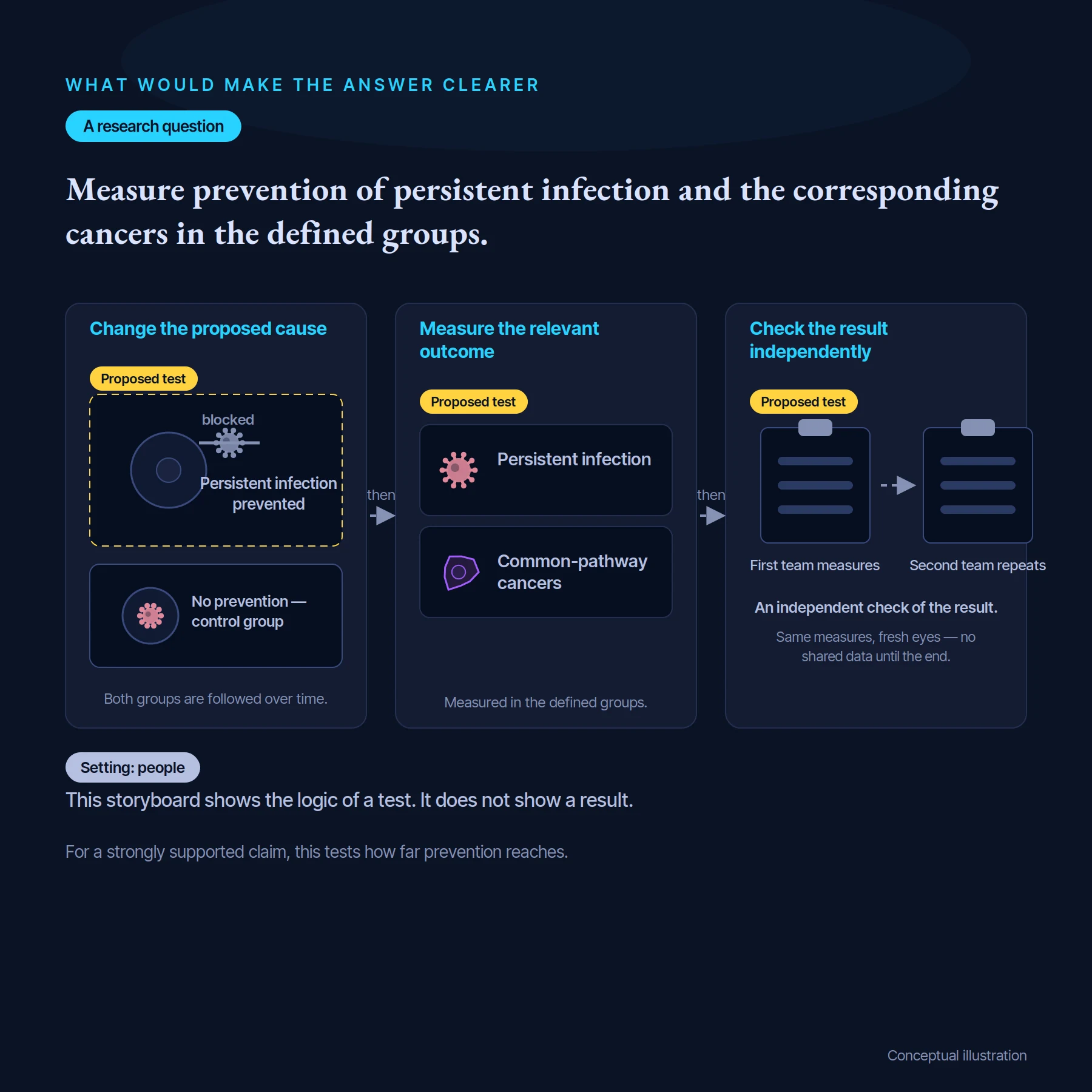
WHAT WOULD MAKE THE ANSWER CLEARER
A research question
Measure prevention of persistent infection and the corresponding cancers in the defined groups.
then
then
Change the proposed cause
Proposed test
Measure the relevant outcome
Proposed test
Check the result independently
Proposed test
blocked
Persistent infection prevented
No prevention — control group
Persistent infection
Common-pathway cancers
Measured in the defined groups.
First team measures
Second team repeats
An independent check of the result.
Same measures, fresh eyes — no shared data until the end.
Both groups are followed over time.
Setting: people
This storyboard shows the logic of a test. It does not show a result.
For a strongly supported claim, this tests how far prevention reaches.
Conceptual illustration
Measure prevention of persistent infection and the corresponding cancers in the defined groups.
Check that the intended change really happened.
Allow for other factors and compare with suitable controls.
Look for independent confirmation and the limits of the effect.
These are questions for research, not a claim that the proposed studies have already succeeded.
Proposed tests: 3 test design(s) are registered in the scorecard.
In plain terms, researchers would change the proposed cause, check that it changed as intended, then measure a meaningful outcome while controlling plausible alternatives. The result should be able to support or count against the claim—not only show that a pathway exists.
Study design: Enroll consecutive primary cervical carcinomas and freeze the anatomic and histomorphologic class before any HPV, p16, or genomic result; then apply orthogonal DNA, RNA, serologic, and integration assays with blinded central review.
What would be measured: Fraction of each predeclared histologic class with type-concordant causal HPV evidence, plus a molecularly coherent HPV-independent trajectory in discordant cases.
Important controls: Endometrial or metastatic mimics, degraded archival blocks, HPV-independent glandular types, and synthetic low-copy controls for each assay target.
Result that would support the claim: Nearly all common-pathway tumours retain type-concordant viral evidence, while negatives cluster prospectively in distinct HPV-independent classes.
Result that would count against it: A reproducible, nontrivial fraction of predeclared common-pathway tumours lacks all causal HPV evidence despite adequate tissue and instead shows an independent precursor and genomic route.
Study design: In a genotype- and HLA-defined trial such as NCT05639972, quantify E7 target engagement, tumour-cell killing, viral transcript change, resistant clones, and radiographic/pathologic response before standard therapy.
What would be measured: Within-patient tumour regression mediated by selective loss of E7-expressing clones, with disease-free follow-up.
Important controls: Pretreatment and on-treatment biopsies, HLA-loss and antigen-loss analysis, independent immune activation markers, and non-HPV tumour controls where ethically feasible.
Result that would support the claim: Replicated tumour regression tracks E7-specific engagement and resistance arises through antigen or presentation loss.
Result that would count against it: Adequate E7 target engagement repeatedly fails to alter tumour viability or selectively spares E7-expressing clones.
Study design: Use archived preinvasive lesions, primary tumours, and recurrences from the same patients with integration-site sequencing and viral-host junction lineage tracing.
What would be measured: Direct evidence of a shared clone that contained causal HPV early and later lost all viral sequence and oncogene expression.
Important controls: Independent tumour origin, contamination, assay sensitivity, and sampling of spatially heterogeneous viral copies.
Result that would support the claim: Multiple independent tumours show an unambiguous viral integration lineage followed by complete viral loss while retaining clonal ancestry.
Result that would count against it: All well-sampled HPV-undetected tumours lack an earlier type-concordant viral lineage or resolve into technical/histotype explanations.
Follow the studies, detailed comparisons and evidence ratings behind this guide.
Open the scientific review →