The question
Does every cancer depend on a rare, fixed group of cancer stem cells?
This is the specific idea being tested.
Does every cancer depend on a rare, fixed group of cancer stem cells?
What you need to knowSome cell states help tumours regrow, but the cells doing that job can change.Relative explanatory fit: Alternative ranked ahead
Why the alternative fits better: Cells can switch state, replace targeted cells and use different relapse routes. A fixed hierarchy does not explain all these findings.
Claim assessed: Across tumour types, a prospectively identifiable rare self-renewing cell subset occupies the apex of a functional hierarchy, is sufficient to serially reconstitute a heterogeneous tumour, and is necessary for tumour maintenance and post-treatment reinitiation because the remaining malignant cells cannot replace it.
Finding: The claim is a six-part conjunction stated across tumour types. The three clauses that carry that cross-tumour scope — rarity (SC2), broad sufficiency (SC3) and irreplaceability (SC6) — all sit at Γ under recorded ceilings: the strongest rarity and serial-reconstitution evidence is transplantation-based and falls under the rubric's xenograft hard rule, and the field-valid endogenous tests of irreplaceability are negative. The three clauses that reach Ε (SC1, SC4, SC5) do so by narrowing to defined tumour contexts, which is what Ε means, so under the prescribed scope-matched rule they are the narrower subclaims reported separately rather than the headline. Stem-like states do causally maintain or reinitiate tumours in defined cancers and stages; that bounded result is reported at Ε in the matrix and is not what the nominal sentence asserts.
Evidence scope: Primary literature through 2026-09-30; accessible full text read where available. The prior review was withheld until the independent score was locked. The red-team pass resolved every identifier, re-verified every numeric claim, and searched 2023-2026 for missed evidence, adding two randomized human trials and two dedifferentiation studies.
The grade applies to the stated claim. Model rankings and individual subclaim grades remain separate from the overall causal-evidence grade.
Full scientific assessment and references · Scorecard (JSON) · Review source (Markdown)
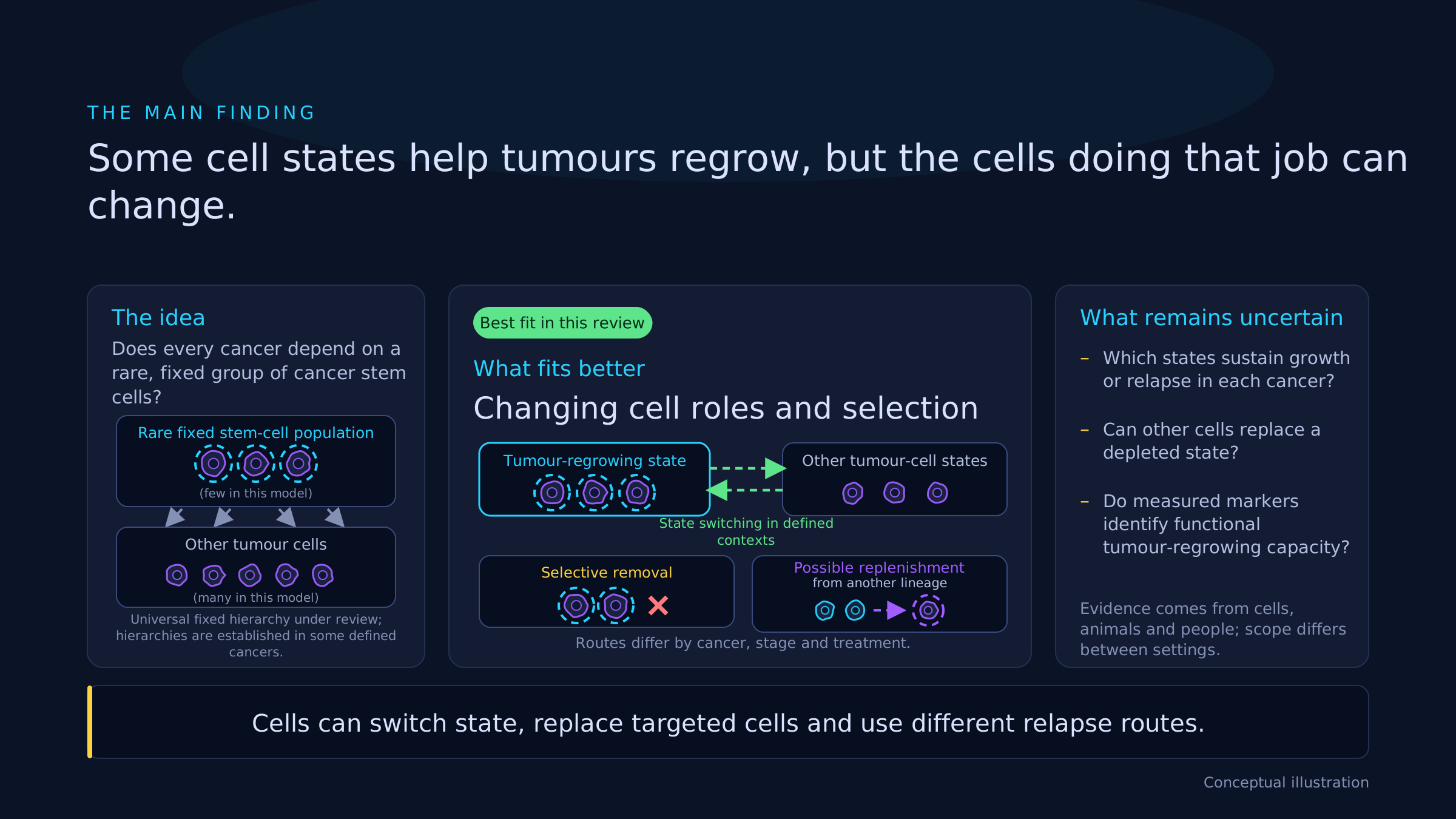
THE MAIN FINDING
Some cell states help tumours regrow, but the cells doing that job can change.
The idea
Does every cancer depend on a rare, fixed group of cancer stem cells?
Rare fixed stem-cell population
Other tumour cells
Universal fixed hierarchy under review; hierarchies are established in some defined cancers.
What fits better
Changing cell roles and selection
Best fit in this review
Tumour-regrowing state
Other tumour-cell states
State switching in defined contexts
Selective removal
Possible replenishment from another lineage
Routes differ by cancer, stage and treatment.
What remains uncertain
Which states sustain growth or relapse in each cancer?
Can other cells replace a depleted state?
Do measured markers identify functional tumour-regrowing capacity?
Evidence comes from cells, animals and people; scope differs between settings.
Cells can switch state, replace targeted cells and use different relapse routes.
Conceptual illustration
This is the specific idea being tested.
Cells can switch state, replace targeted cells and use different relapse routes. A fixed hierarchy does not explain all these findings.
A higher rank means a better fit to the evidence in this comparison. It does not prove every part of the leading explanation.
The reviewed hypothesis ranks 3 among 4 models compared; 1 alternative model(s) hold first rank for this stated claim.
Claim under review: rank 3 among 4 compared models.
Leading explanation: Context-dependent dynamic hierarchy with plasticity and clonal selection.
Position in this comparison: Between leading and last ranks.
The causal grade asks how well the stated causal claim is established. This comparison asks which of the assessed explanations fits the reviewed findings better. A leading explanation can remain unproven. Models can overlap or include the tested mechanism; an alternative ahead does not make that mechanism irrelevant. These ordinal ranks apply within this review; they do not measure the size of a difference or rank scientific strength across topics.
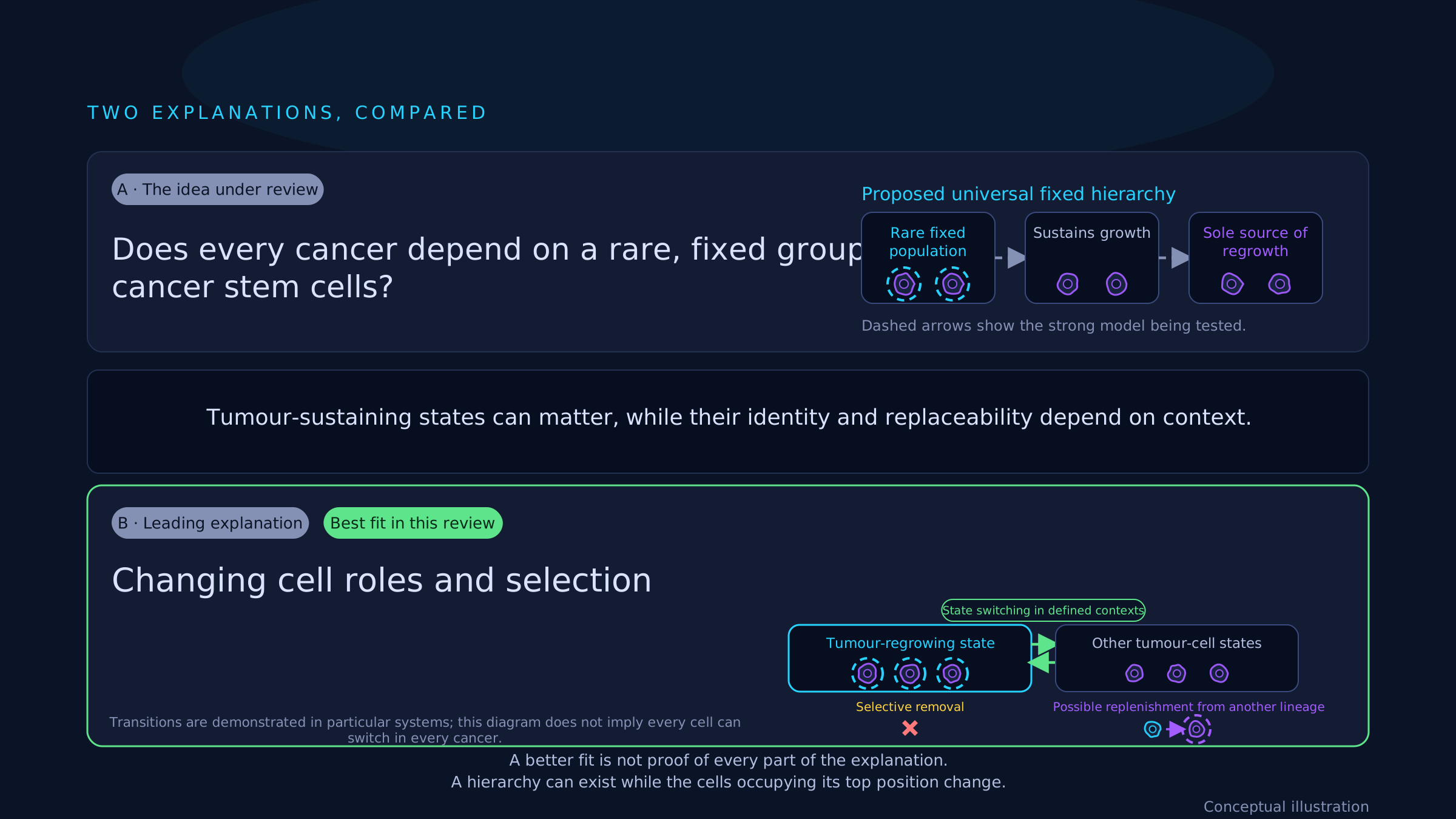
TWO EXPLANATIONS, COMPARED
A · The idea under review
Does every cancer depend on a rare, fixed group of cancer stem cells?
Proposed universal fixed hierarchy
Rare fixed population
Sustains growth
Sole source of regrowth
Dashed arrows show the strong model being tested.
Tumour-sustaining states can matter, while their identity and replaceability depend on context.
B · Leading explanation
Changing cell roles and selection
Best fit in this review
Tumour-regrowing state
Other tumour-cell states
State switching in defined contexts
Selective removal
Possible replenishment from another lineage
Transitions are demonstrated in particular systems; this diagram does not imply every cell can switch in every cancer.
A better fit is not proof of every part of the explanation.
A hierarchy can exist while the cells occupying its top position change.
Conceptual illustration
Plausible, not established for the stated claim.
Cells can switch state, replace targeted cells and use different relapse routes. A fixed hierarchy does not explain all these findings.
These explanations can overlap. Ranking their fit to the evidence is separate from deciding how firmly a cause has been established.
Rank 1: Context-dependent dynamic hierarchy with plasticity and clonal selection — Tumour-sustaining states are causal in defined cancers and stages, but their frequency, identity, and accessibility change with genotype, niche, therapy, and reversible state transitions.
Rank 2: Clonal evolution with selected stem-like phenotypes — Genetic and epigenetic clonal selection generates variable self-renewal capacity, and stem-like behavior reflects selected clones rather than a universal cellular hierarchy.
Rank 3: Rare fixed cancer stem cell hierarchy — A rare, discrete, self-renewing apex population is uniquely sufficient and necessary for tumour maintenance and relapse.
Rank 4: Stochastic equipotence — Most malignant cells have comparable long-term tumour-sustaining potential, with observed differences arising mainly from stochastic events and assay conditions.
Evidence rating: Γ · High confidence. How the evidence was assessed.
Cells can switch state, replace targeted cells and use different relapse routes. A fixed hierarchy does not explain all these findings.
This supports careful development of treatments that target tumour-maintaining states in the specific cancer, stage, and genetic setting where they matter. It does not establish that finding one so-called cancer-stem-cell marker will provide a durable cure, or that a treatment aimed at one cell population will work across cancers. The evidence also explains why combination strategies and studies of resistance, recurrence, and cell-state plasticity remain important.
Look for the proposed factor and the outcome, in the people or systems covered by the claim.
Changing cell roles and selection. Cells can switch state, replace targeted cells and use different relapse routes. A fixed hierarchy does not explain all these findings.
Track cell families and state changes before and after selectively removing tumour-regrowing cells.
These illustrations show the key questions tested in the review. They are conceptual drawings, not microscope images or experimental results.
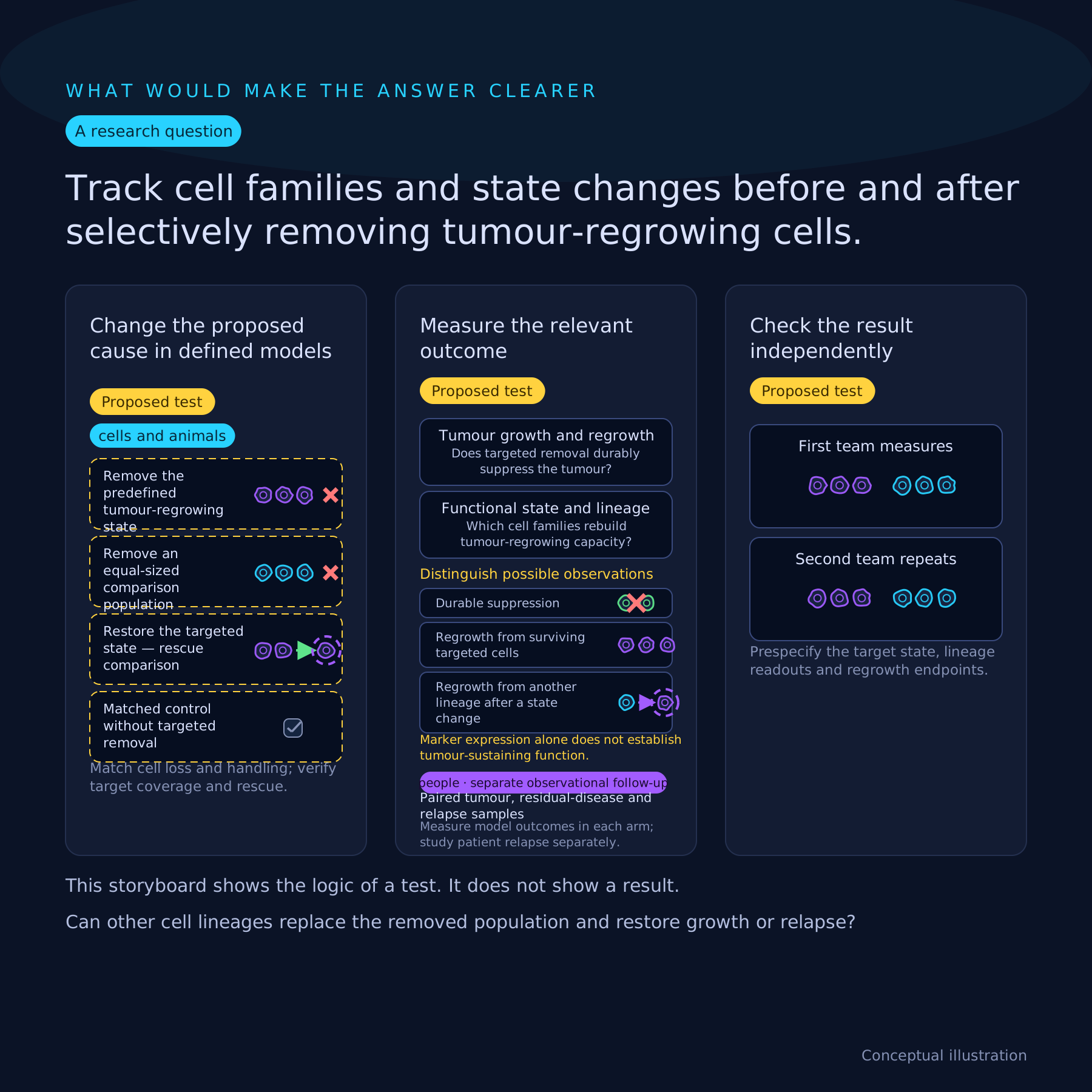
WHAT WOULD MAKE THE ANSWER CLEARER
A research question
Track cell families and state changes before and after selectively removing tumour-regrowing cells.
Change the proposed cause in defined models
Proposed test
cells and animals
Remove the predefined tumour-regrowing state
Remove an equal-sized comparison population
Restore the targeted state — rescue comparison
Matched control without targeted removal
Match cell loss and handling; verify target coverage and rescue.
Measure the relevant outcome
Proposed test
Tumour growth and regrowth
Does targeted removal durably suppress the tumour?
Functional state and lineage
Which cell families rebuild tumour-regrowing capacity?
Distinguish possible observations
Durable suppression
Regrowth from surviving targeted cells
Regrowth from another lineage after a state change
Marker expression alone does not establish tumour-sustaining function.
people · separate observational follow-up
Paired tumour, residual-disease and relapse samples
Measure model outcomes in each arm; study patient relapse separately.
Check the result independently
Proposed test
First team measures
Second team repeats
Prespecify the target state, lineage readouts and regrowth endpoints.
This storyboard shows the logic of a test. It does not show a result.
Can other cell lineages replace the removed population and restore growth or relapse?
Conceptual illustration
Track cell families and state changes before and after selectively removing tumour-regrowing cells.
Check that the intended change really happened.
Allow for other factors and compare with suitable controls.
Look for independent confirmation and the limits of the effect.
These are questions for research, not a claim that the proposed studies have already succeeded.
Proposed tests: 3 test design(s) are registered in the scorecard.
In plain terms, researchers would change the proposed cause, check that it changed as intended, then measure a meaningful outcome while controlling plausible alternatives. The result should be able to support or count against the claim—not only show that a pathway exists.
Study design: In predeclared autochthonous models spanning haematologic and solid tumours, prospectively label the proposed apex state, ablate it after tumour establishment, and follow all remaining clones with heritable lineage barcodes through growth and treatment.
What would be measured: Tumour maintenance, recurrence-free survival, state-transition trajectories, and restoration of tumour-propagating function.
Important controls: Matched ablation of an equally sized non-apex population, ablation-efficiency calibration, and rescue by restoring only the targeted state.
Result that would support the claim: Across predeclared tumour types, complete apex-state ablation causes durable collapse and no lineage outside the state restores function; matched rescue restores growth.
Result that would count against it: Tumours persist or recur because cells outside the state regenerate equivalent tumour-sustaining function.
Study design: Sample paired primary tumour, minimal residual disease, and relapse before and after therapy; combine phylogenetic lineage reconstruction, state-resolved profiling, and patient-derived selective depletion with matched rescue and in vivo confirmation.
What would be measured: Whether relapse founders originate exclusively from the prospectively defined state and remain dependent on it.
Important controls: Separate genetic clone identity from reversible transcriptional state and measure sampling sensitivity for rare alternatives.
Result that would support the claim: Independent patients show exclusive state-restricted relapse origins, durable dependence, and rescue-specific restoration.
Result that would count against it: Relapse founders arise from multiple baseline states or re-enter the proposed state after starting outside it.
Study design: Measure the same prospectively isolated tumour cells by native intravital lineage tracing, orthotopic transplantation, and graded recipient permissiveness without redefining the state after outcomes.
What would be measured: The fraction of cells with long-term self-renewal and tumour-reconstitution capacity in each assay.
Important controls: Equal viability, cell-cycle state, niche access, barcode recovery, and limiting-dilution uncertainty across fractions.
Result that would support the claim: A consistently rare, prospectively defined fraction carries durable function across native and permissive settings.
Result that would count against it: The estimated rare fraction expands substantially with recipient permissiveness or differs between native and transplantation assays.
Follow the studies, detailed comparisons and evidence ratings behind this guide.
Open the scientific review →