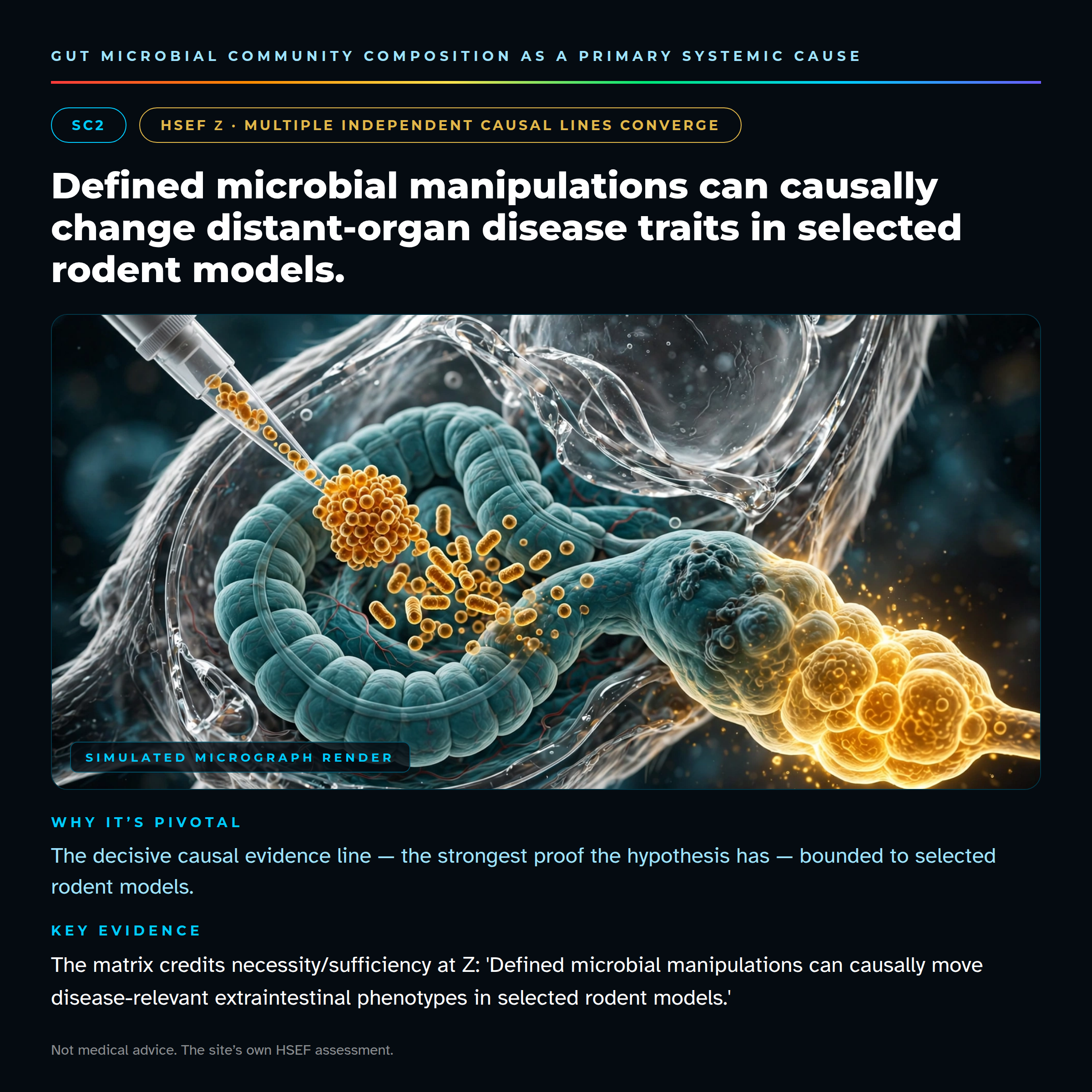
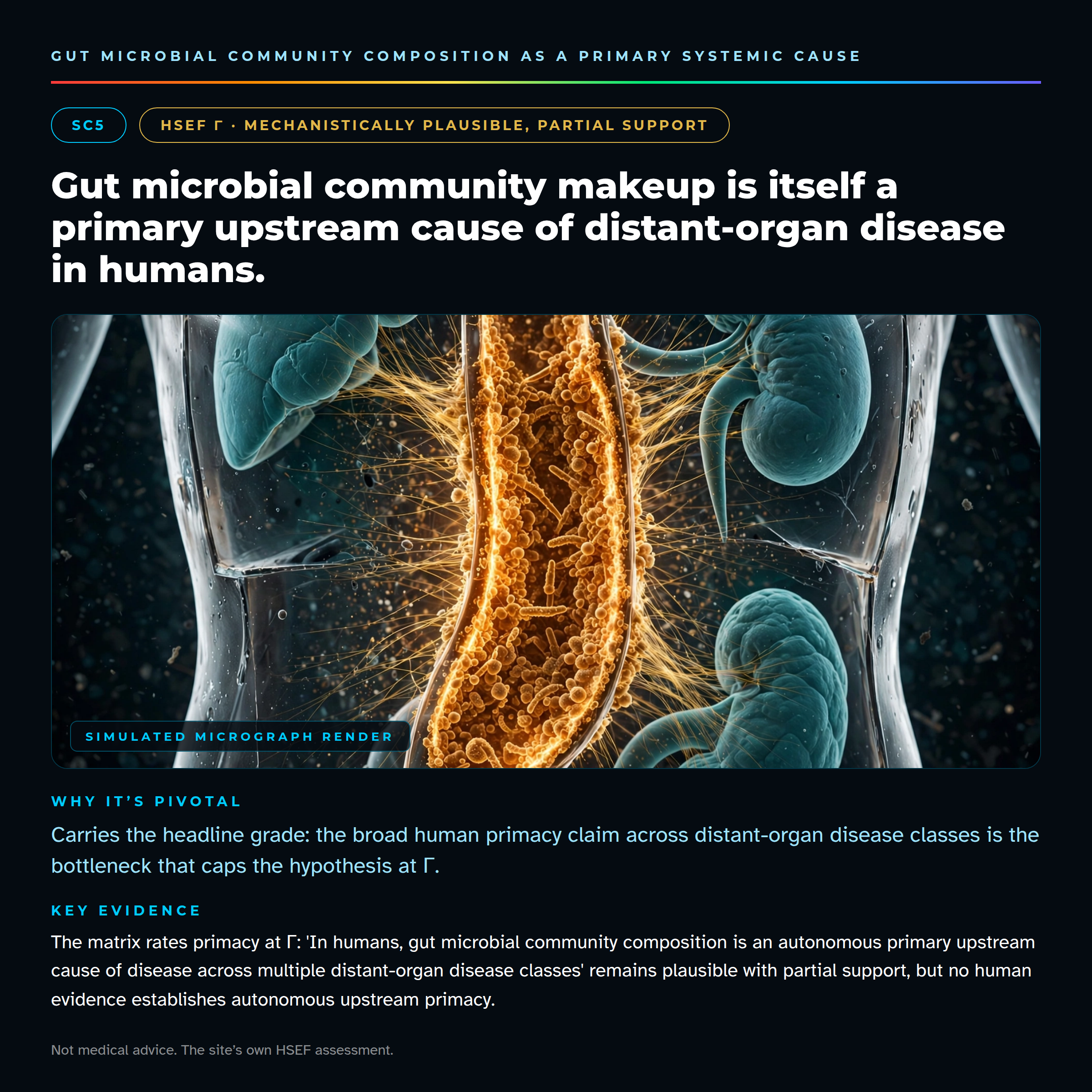
The question
Are gut microbial changes a primary cause of diseases in distant organs?
This is the specific idea being tested.
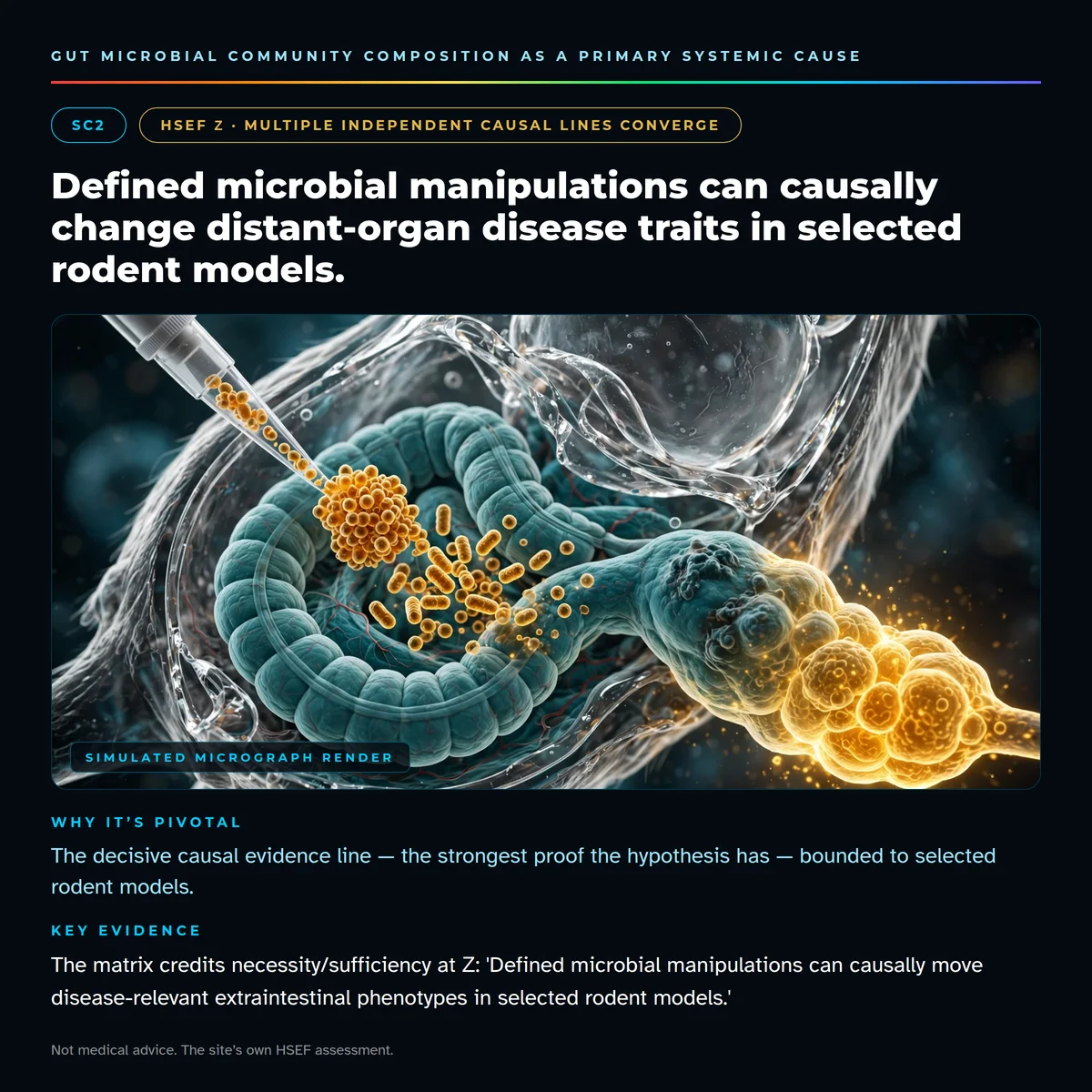
Are gut microbial changes a primary cause of diseases in distant organs?
What you need to knowMicrobes can contribute in particular settings, but a broad primary-cause claim is not established.Relative explanatory fit: Alternative ranked ahead
Why the alternative fits better: Disease and exposures change microbes, and microbes can affect disease. This helps explain variable treatment and transfer results.
Claim assessed: In humans, prespecified changes in gut microbial community composition are primary upstream causes of disease across distant-organ disease classes.
Finding: Gut communities can causally modify selected animal phenotypes and recurrent CDI, with mixed context-specific human metabolic, hepatic, and Parkinson signals. No evidence establishes community composition as a primary cause across human distant-organ disease classes.
Evidence scope: Primary peer-reviewed studies sampled through 2026-09-27; the union of both inputs' ledgers plus four omission-audit additions. Not a systematic review.
The grade applies to the stated claim. Model rankings and individual subclaim grades remain separate from the overall causal-evidence grade.
Full scientific assessment and references · Scorecard (JSON) · Review source (Markdown)
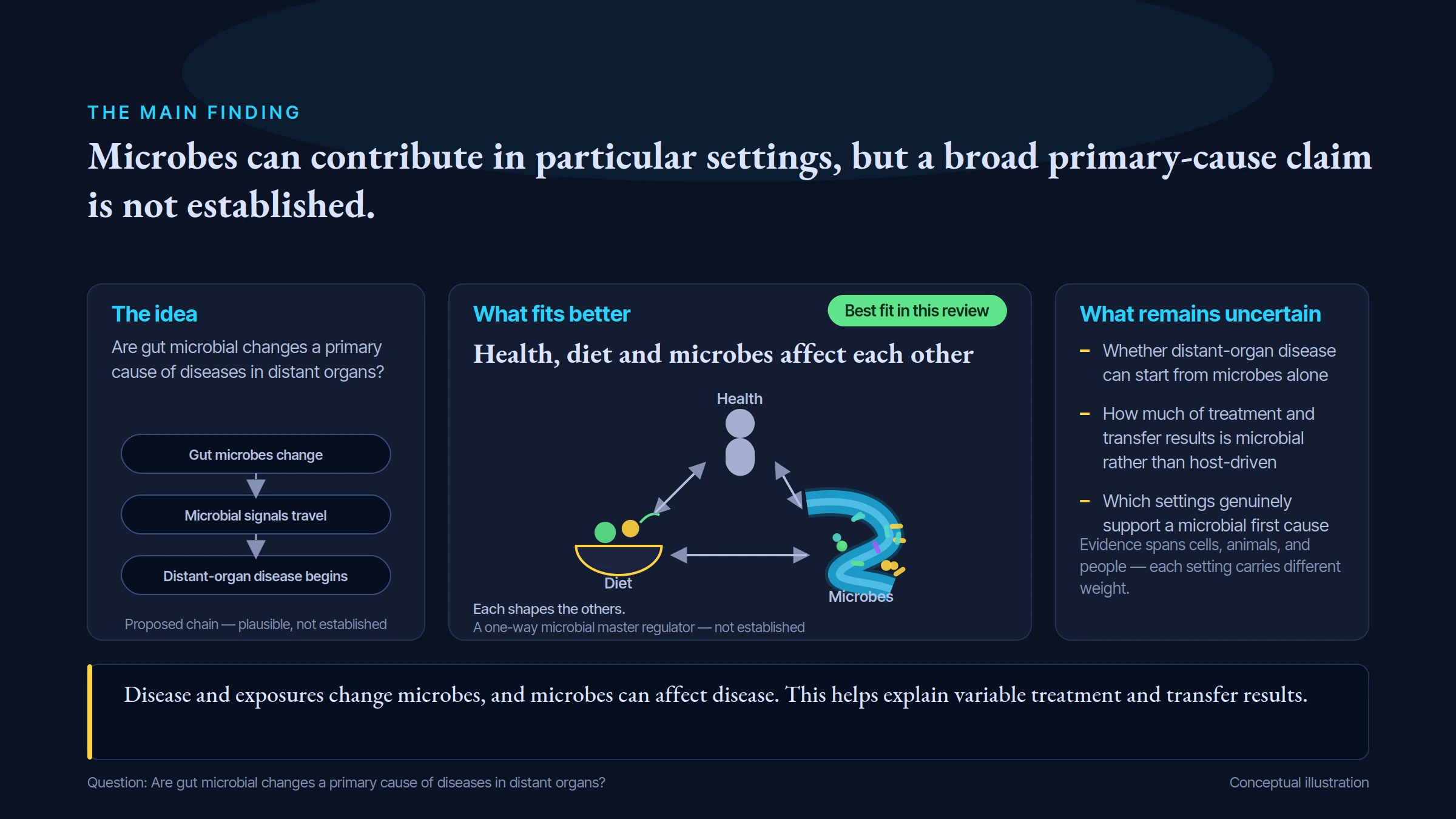
THE MAIN FINDING
Microbes can contribute in particular settings, but a broad primary-cause claim is not established.
The idea
Are gut microbial changes a primary cause of diseases in distant organs?
Gut microbes change
Microbial signals travel
Distant-organ disease begins
Proposed chain — plausible, not established
What fits better
Best fit in this review
Health, diet and microbes affect each other
Health
Diet
Microbes
Each shapes the others.
A one-way microbial master regulator — not established
What remains uncertain
Whether distant-organ disease can start from microbes alone
How much of treatment and transfer results is microbial rather than host-driven
Which settings genuinely support a microbial first cause
Evidence spans cells, animals, and people — each setting carries different weight.
Disease and exposures change microbes, and microbes can affect disease. This helps explain variable treatment and transfer results.
Conceptual illustration
Question: Are gut microbial changes a primary cause of diseases in distant organs?
This is the specific idea being tested.
Disease and exposures change microbes, and microbes can affect disease. This helps explain variable treatment and transfer results.
A higher rank means a better fit to the evidence in this comparison. It does not prove every part of the leading explanation.
The reviewed hypothesis ranks 3 among 5 models compared; 1 alternative model(s) hold first rank for this stated claim.
Claim under review: rank 3 among 5 compared models.
Leading explanation: Host-, disease-, and exposure-first reciprocal ecosystem.
Position in this comparison: Between leading and last ranks.
The causal grade asks how well the stated causal claim is established. This comparison asks which of the assessed explanations fits the reviewed findings better. A leading explanation can remain unproven. Models can overlap or include the tested mechanism; an alternative ahead does not make that mechanism irrelevant. These ordinal ranks apply within this review; they do not measure the size of a difference or rank scientific strength across topics.
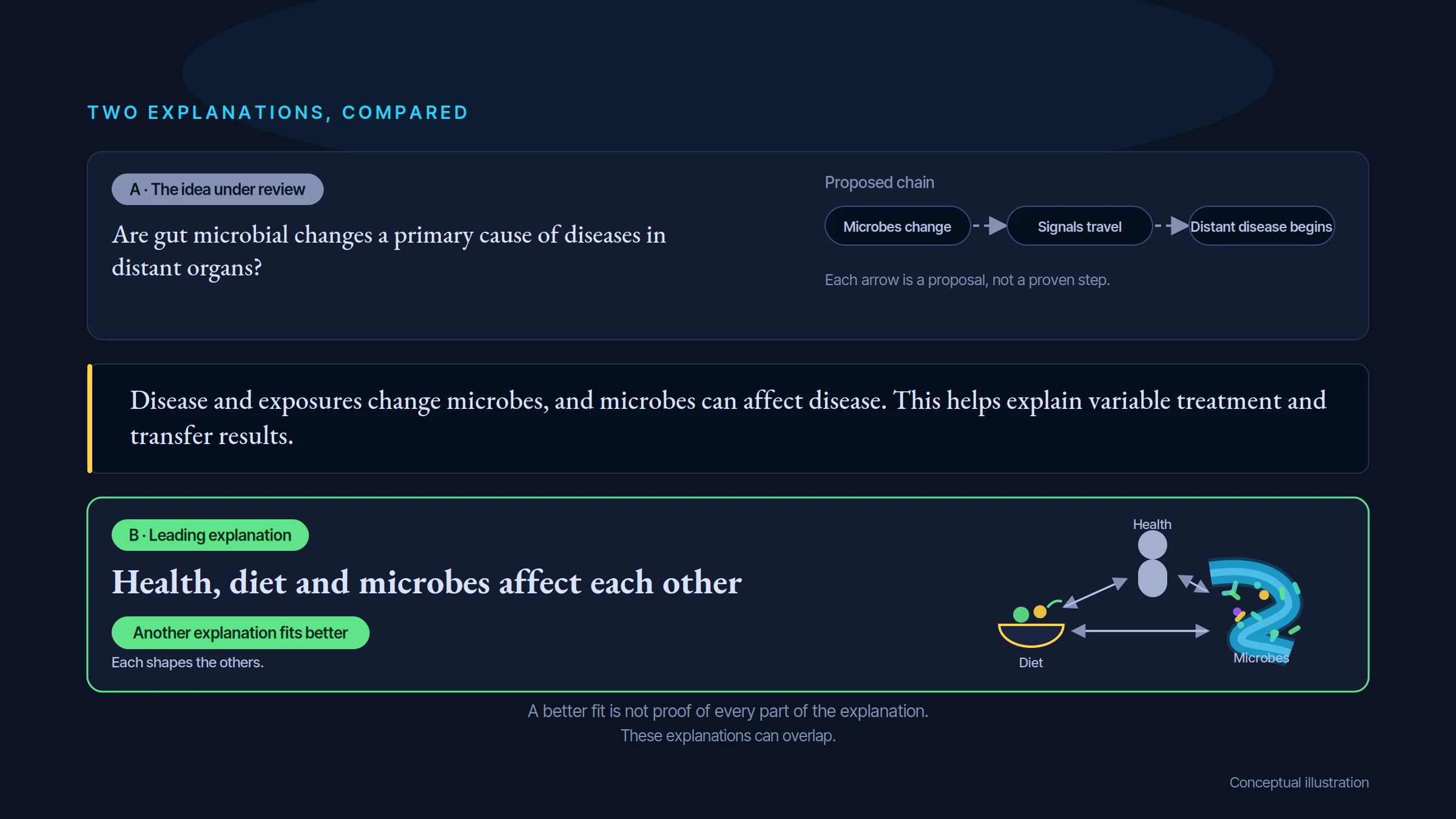
TWO EXPLANATIONS, COMPARED
A · The idea under review
Are gut microbial changes a primary cause of diseases in distant organs?
Proposed chain
Microbes change
Signals travel
Distant disease begins
Each arrow is a proposal, not a proven step.
Disease and exposures change microbes, and microbes can affect disease. This helps explain variable treatment and transfer results.
B · Leading explanation
Health, diet and microbes affect each other
Another explanation fits better
Health
Diet
Microbes
Each shapes the others.
A better fit is not proof of every part of the explanation.
These explanations can overlap.
Conceptual illustration
Plausible, not established for the stated claim.
Disease and exposures change microbes, and microbes can affect disease. This helps explain variable treatment and transfer results.
These explanations can overlap. Ranking their fit to the evidence is separate from deciding how firmly a cause has been established.
Rank 1: Host-, disease-, and exposure-first reciprocal ecosystem — Host physiology, diet, transit, medication, genotype, and established disease shape community composition, while microbes feed back on selected phenotypes.
Rank 2: Niche-specific microbial causality — Microbes become causal when host state or a depleted niche makes a microbial function rate-limiting.
Rank 3: Gut microbiome as autonomous multi-system master regulator — Community composition autonomously acts as a primary upstream determinant of human health across distant organs and disease classes.
Rank 4: Diet-substrate control — Diet is a dominant upstream determinant of microbial function and systemic outcomes.
Rank 5: Host-genotype and physiology gating — Host genotype, immunity, barrier state, and transit determine whether a community feature affects disease.
Evidence rating: Γ · Moderate confidence. How the evidence was assessed.
Disease and exposures change microbes, and microbes can affect disease. This helps explain variable treatment and transfer results.
The review supports a narrower, more useful view: microbiome-based treatment is clearly established for selected recurrent gut infections, while most claims about treating distant-organ disease, metabolic disease, cancer, or brain conditions remain experimental or mixed. A promising biological signal is a reason for well-controlled trials, not a reason to replace evidence-based prevention or treatment with supplements, consumer tests, or unsupervised microbial interventions.
Look for the proposed factor and the outcome, in the people or systems covered by the claim.
Health, diet and microbes affect each other. Disease and exposures change microbes, and microbes can affect disease. This helps explain variable treatment and transfer results.
Separate the microbial change from diet, illness and other exposures in controlled studies.
These illustrations show the key questions tested in the review. They are conceptual drawings, not microscope images or experimental results.
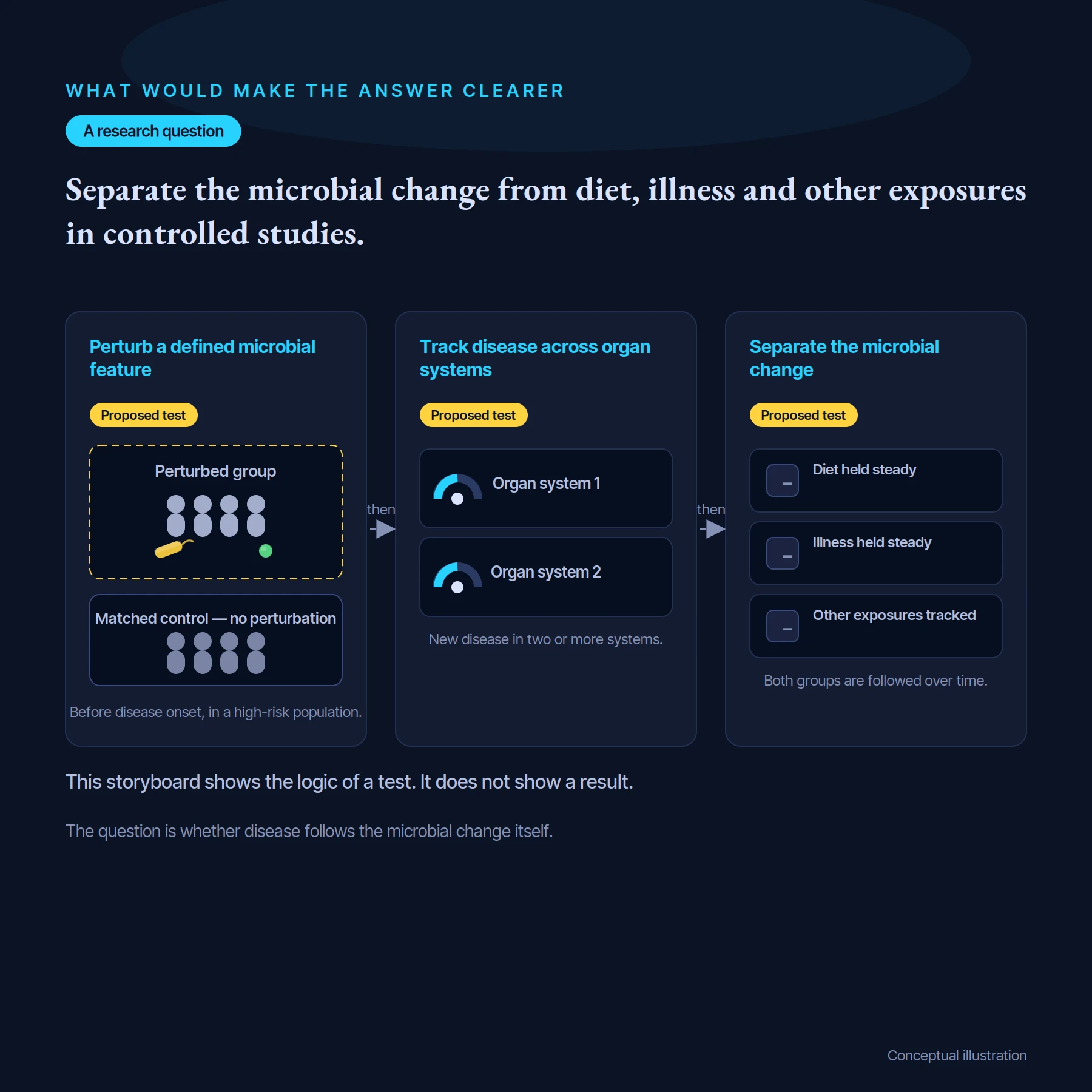
WHAT WOULD MAKE THE ANSWER CLEARER
A research question
Separate the microbial change from diet, illness and other exposures in controlled studies.
then
then
Perturb a defined microbial feature
Proposed test
Perturbed group
Matched control — no perturbation
Before disease onset, in a high-risk population.
Track disease across organ systems
Proposed test
Organ system 1
Organ system 2
New disease in two or more systems.
Separate the microbial change
Proposed test
Diet held steady
Illness held steady
Other exposures tracked
Both groups are followed over time.
This storyboard shows the logic of a test. It does not show a result.
The question is whether disease follows the microbial change itself.
Conceptual illustration
Separate the microbial change from diet, illness and other exposures in controlled studies.
Check that the intended change really happened.
Allow for other factors and compare with suitable controls.
Look for independent confirmation and the limits of the effect.
These are questions for research, not a claim that the proposed studies have already succeeded.
Proposed tests: 3 test design(s) are registered in the scorecard.
In plain terms, researchers would change the proposed cause, check that it changed as intended, then measure a meaningful outcome while controlling plausible alternatives. The result should be able to support or count against the claim—not only show that a pathway exists.
Study design: In a prespecified high-risk population, perturb a defined microbial feature - a strain-resolved consortium or a named microbial function - before disease onset, verify target engagement longitudinally, and follow incident distant-organ disease in at least two organ systems.
What would be measured: Incident distant-organ disease, with longitudinal measurement of the microbial target, host state, diet, medication and transit.
Important controls: Pre-outcome eligibility, blinded endpoint adjudication, negative controls, independent replication, and reversal or add-back evidence where feasible.
Result that would support the claim: A defined shift precedes and reproducibly changes incident disease across organ classes, with narrowed mediation and rescue.
Result that would count against it: Verified target engagement without change in incident outcomes, or host and disease changes preceding the microbial shift.
Study design: Replicate the strongest existing signal - the Parkinson motor result or the six-week metabolic result - multicentre and blinded, with a defined product rather than whole stool, prespecified durability endpoints beyond the point at which current effects fade, and a removal or add-back arm.
What would be measured: Target engagement plus the prespecified organ-specific clinical outcome, with host, diet, medication and transit measured.
Important controls: Co-transferred metabolites, bowel preparation, concomitant treatment and donor variability.
Result that would support the claim: Reproducible phenotype movement tied to the prespecified feature, with add-back or rescue evidence.
Result that would count against it: Target engagement without the predicted clinical effect across sites.
Study design: Instrument community-composition features directly, with sensitivity analyses against host pleiotropy at the known loci, across independent cohorts and against more than one distant-organ endpoint.
What would be measured: Causal estimates for composition features against incident distant-organ disease endpoints, replicated across cohorts.
Important controls: Weak-instrument diagnostics, pleiotropy-robust estimators, and explicit handling of the host loci that dominate microbiome GWAS.
Result that would support the claim: Replicated causal estimates for prespecified composition features against more than one distant-organ endpoint - the cheapest available route to Δ at the graded scope.
Result that would count against it: Null causal estimates for composition features where the equivalent function-level instruments are positive.
Follow the studies, detailed comparisons and evidence ratings behind this guide.
Open the scientific review →